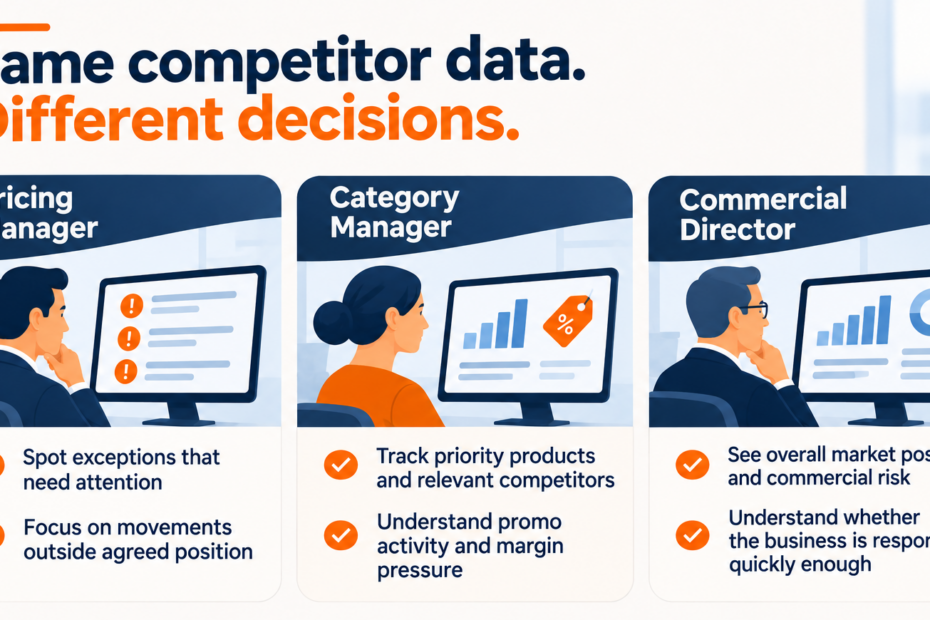
One thing I have seen repeatedly is that the same competitor data can mean something very different depending on who is looking at it.
A Pricing Manager may want to know which products have moved outside an agreed position or where something needs attention. A Category Manager is more likely to focus on priority products, competitor promotions and margin pressure within their area. A Commercial Director usually wants a much broader view of market position, risk and whether the business is responding quickly enough.
The market is the same and the underlying data is the same. What changes is the decision each person needs to make.
For me, that is where price intelligence becomes much more useful. The aim should not be to give everybody the same report. It should be to make sure each person sees the part of the market that helps them do their job.
The Pricing Manager Needs to Know What Needs Attention
A Pricing Manager may be dealing with hundreds or thousands of competitor movements. The challenge is not always seeing what changed. It is working out which changes actually deserve attention.
If every movement appears with the same level of importance, the report can quickly become another task to manage. The team still has to work through the noise before they get to the real decision.
A more useful view might focus on exceptions. Products that have moved outside an agreed position, important competitors changing price on a KVI, products that fall outside a rule, competitors coming back into stock, or movements that are large enough to justify a closer look.
For the Pricing Manager, the value is in reducing the amount of searching and checking that happens before the decision can be made.
The Category Manager Needs to Understand What It Means for Their Category
Move to the Category Manager and the same market activity takes on a different meaning.
They are looking at the commercial performance of a particular part of the range. That means they are likely to care more about which products have become less competitive, which promotions are changing the shape of the category and where margin could be coming under pressure.
Competitor relevance also becomes much more specific. A retailer that has a major influence on one category may have very little impact on another. Some products may be highly price sensitive, while others give the business more room to protect margin. A lower competitor price may be important on one line and almost irrelevant on another.
The Category Manager therefore needs context around the movement, not simply the movement itself.
The most useful view is the one that helps them understand where something has changed enough to deserve a decision.
The Commercial Director Needs to See the Commercial Consequence
The Commercial Director is looking at the same market from a much higher level.
They are unlikely to want to review individual product movements unless there is a specific reason to do so. Their questions are broader. Are we becoming materially less competitive in an important part of the business? Is margin exposure increasing? Are competitors becoming more promotional? Are we seeing unusual activity in a strategically important category? Are pricing decisions being made quickly and consistently enough?
The detailed product data still matters because it sits underneath those answers, but the senior view should not simply reproduce that detail.
It should help explain what is happening commercially.
That is a very different requirement from the one facing the Pricing Manager, even though both are working from the same underlying market information.
One Version of the Truth Does Not Mean One Version of the Report
Everyone should be working from the same trusted information. If three people are discussing the same product or competitor, they should not be working from three different versions of what happened.
That does not mean they need the same view.
The Pricing Manager may need exceptions. The Category Manager may need a focused view of priority products and relevant competitors. The Commercial Director may only need to know that one important area of the business has moved outside the intended market position and understand why.
That is still one version of the truth. It is simply being presented differently because the decision is different.
The Best Reporting Usually Starts With the User
When we talk to customers about reporting, one of the easiest traps is to start with the data.
What can we show? What can we add? What other chart could go on the page?
I prefer to start somewhere else.
What does this person actually need to decide?
That question usually simplifies things very quickly.
If the Pricing Manager needs to know which exceptions require intervention, the report should make those obvious. If the Category Manager needs to understand where the competitive position of a key group of products has changed, that should be easy to see. If the Commercial Director wants an overview of commercial risk, the detail should be condensed into something meaningful at that level.
A report should not be designed around how much information is available. It should be designed around the decision it is there to support.
This Becomes More Important as the Business Grows
This becomes even more important as retail businesses become more complex.
More categories, more channels and more competitors usually mean more data. They also mean more people need different parts of that data for different reasons.
Trying to make one report serve every role often makes it less useful for everyone. The operational team gets too much irrelevant information. The senior team gets too much detail. Category teams spend time filtering out products or competitors that do not matter to them.
A better approach is to accept that different users should have different priorities.
The intelligence underneath should stay consistent. The way it is presented should reflect the role.
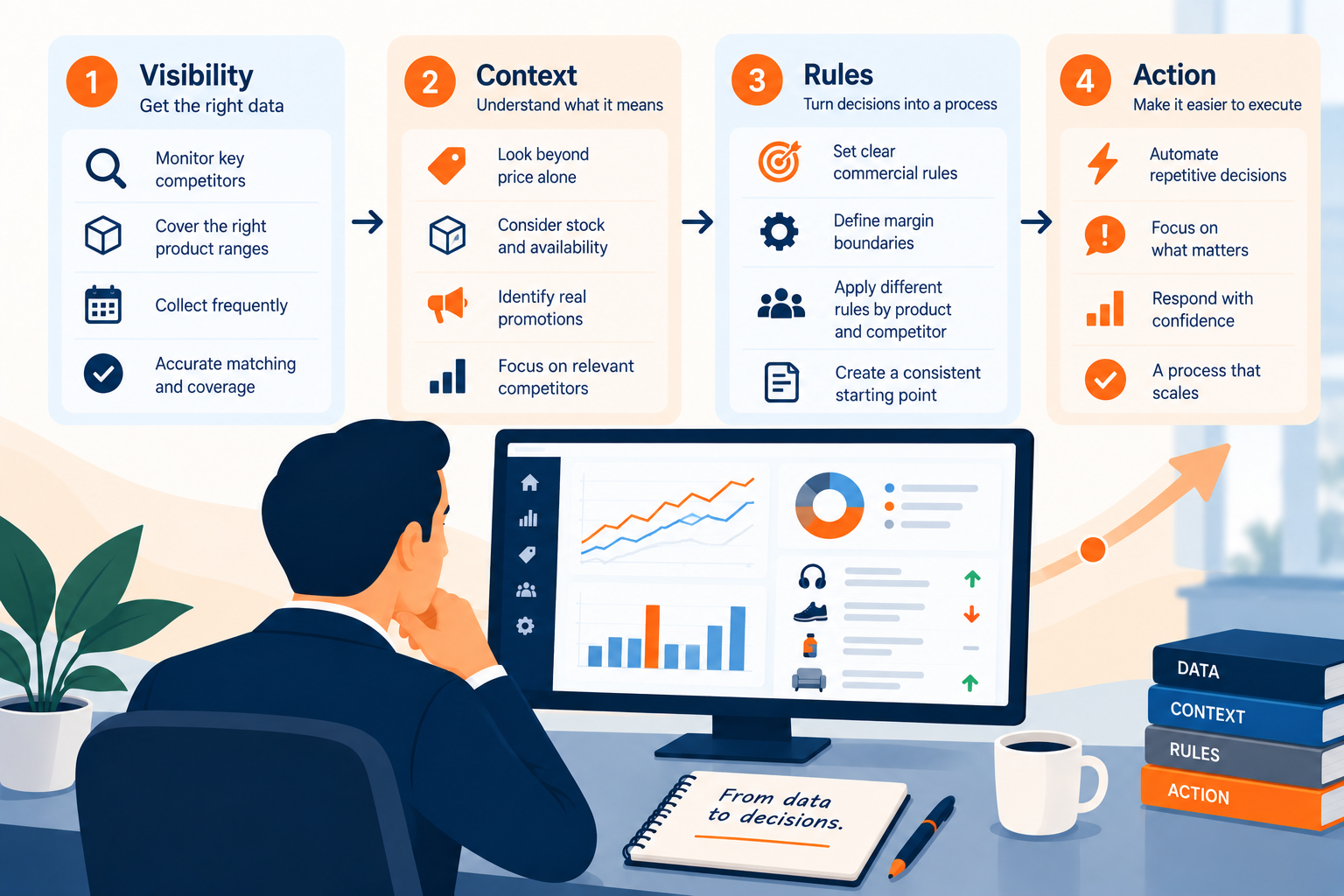
Good Price Intelligence Should Reduce the Distance Between Data and Decision
For me, this is the real point.
Price intelligence should not be judged purely by how much competitor information it can collect. The more useful question is how quickly the right person can get from that information to a confident decision.
For a Pricing Manager, that may mean seeing the exceptions first. For a Category Manager, it may mean understanding the few products or competitors that are changing the commercial picture. For a Commercial Director, it may mean having enough visibility to know where the business should look more closely without getting buried in product level detail.
The same market can support all three.
The difference is in how the information is organised around the person using it.
That is when reporting stops being just a way of displaying competitor data and starts becoming part of the pricing process itself.