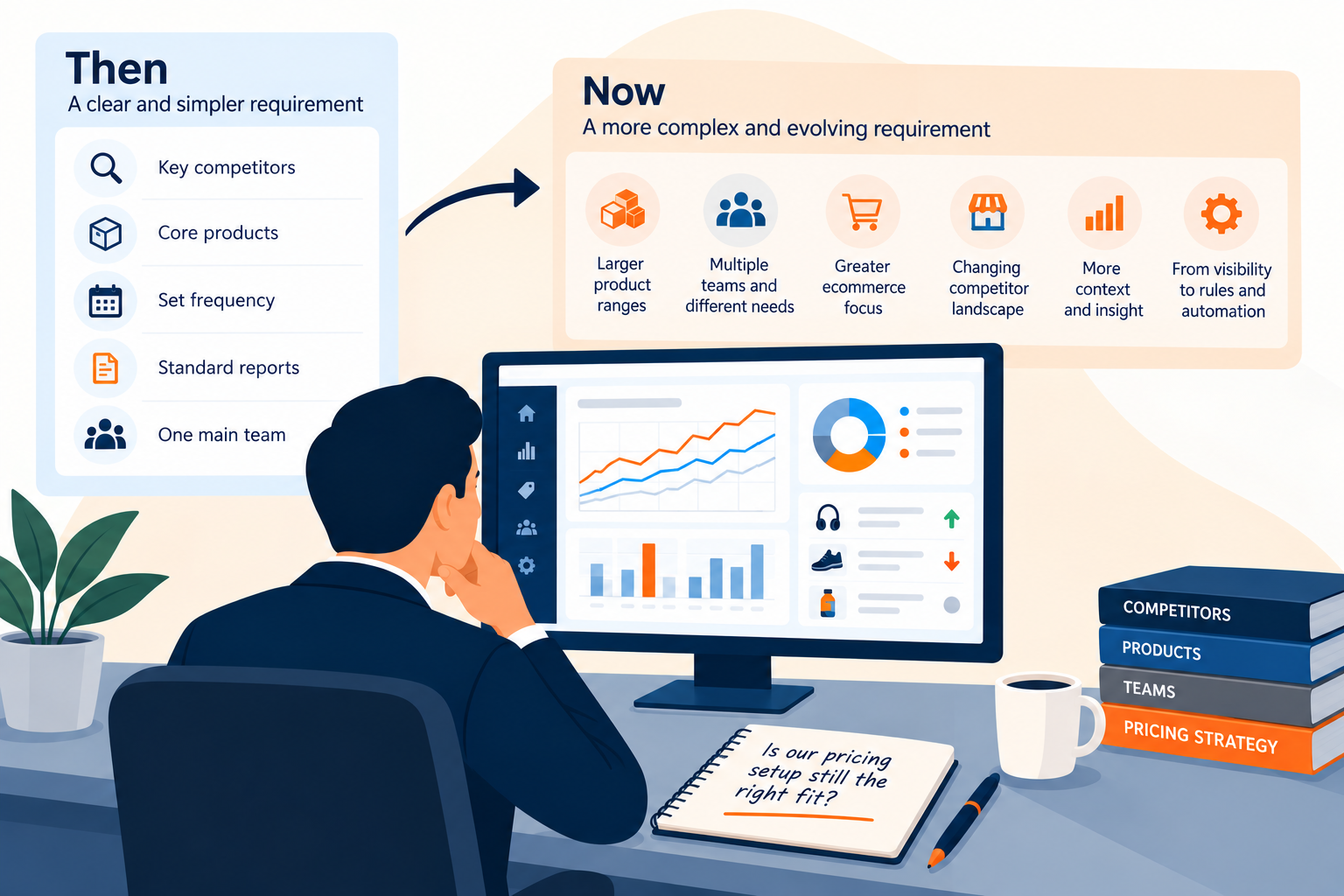
One thing I have noticed with long standing customers is that the questions they ask tend to change over time. At the beginning, the questions are usually about the data. Can we see this competitor? Can we monitor this range? How frequently can we collect prices? Can we improve coverage across a particular category?
Those are important questions because visibility and confidence have to come first. If the business cannot rely on the underlying data, it is difficult to build anything meaningful on top of it. Once that foundation is in place, however, the conversation usually moves on. The questions become less about what can be seen and more about what the information should help the business do.
The First Stage Is Visibility
For many retailers, the initial value of price intelligence is straightforward. They want to understand where they sit against the market and reduce the amount of manual checking required to get there. That often means improving competitor coverage, increasing collection frequency and making sure products are matched accurately enough to trust the comparison.
At this stage, the main question is whether the business can see what is happening outside its own four walls with enough confidence to use it. That visibility is a necessary first step, but it is not where the greatest commercial value sits. It creates the foundation for better decisions rather than being the finished outcome in itself.
The Questions Start to Change
As the data becomes more established, the questions tend to become more sophisticated. Instead of asking whether a competitor changed price, the team starts asking whether that movement actually matters. Instead of asking for more competitors, they begin asking which competitors should influence a particular category. Instead of simply reporting a promotion, they want to know whether it deserves a response.
That shift is important because it shows the business is moving from visibility towards decision support. The data has not become less important. It has simply become the starting point rather than the end result. The focus moves from collecting information to understanding which parts of that information deserve action.
Not Every Movement Deserves Attention
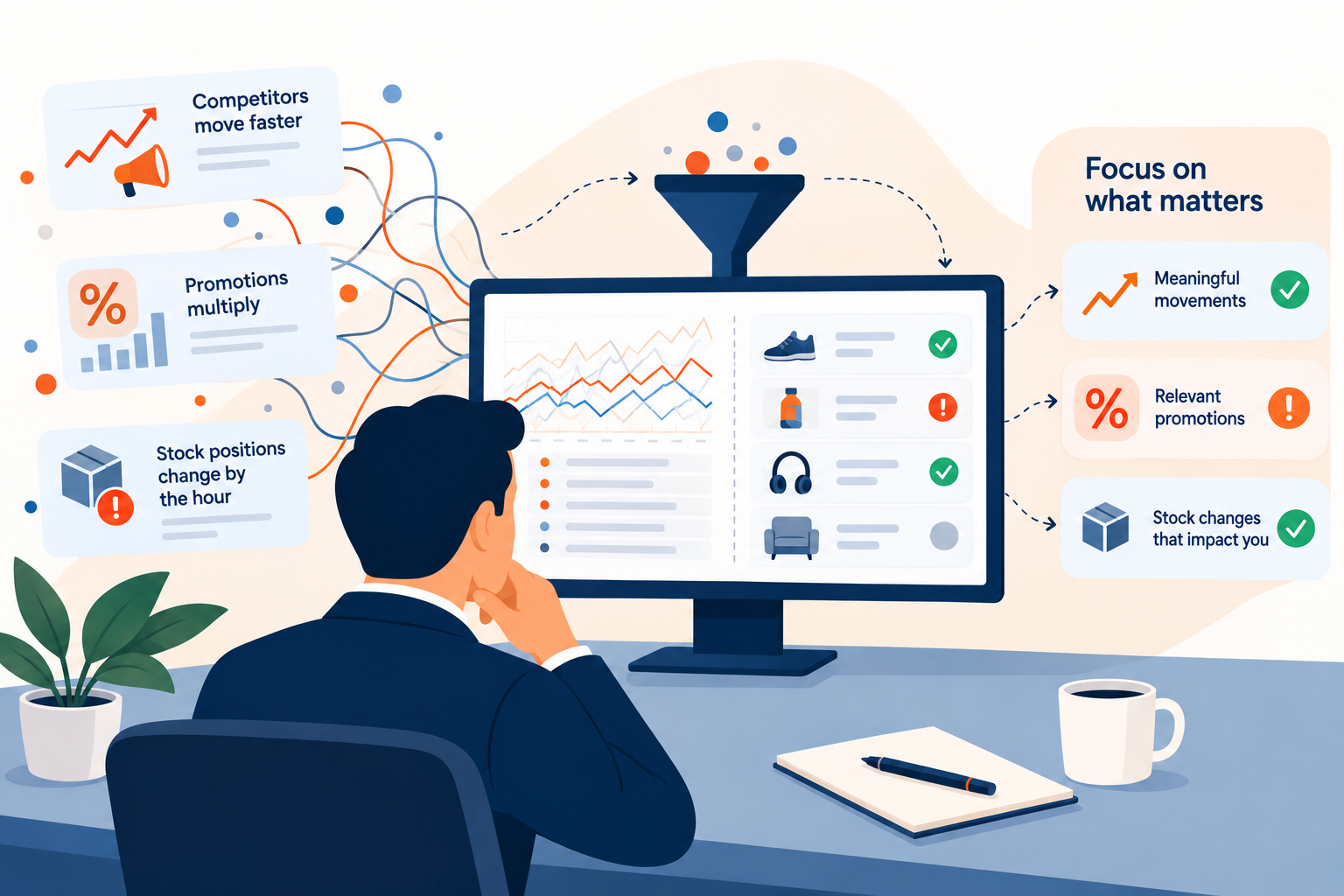
This is often one of the first major changes in how price intelligence is used. A retailer may be receiving accurate competitor data across thousands of products, but that does not mean every movement deserves the same level of attention. A price change from a marginal competitor on a low priority product should not carry the same weight as a move from a key competitor on a high visibility line.
We have seen customers reach a point where the volume of information is no longer the issue. The challenge becomes deciding what should be looked at first. That is where product importance, competitor relevance, stock position, promotions and commercial thresholds start to matter much more. The objective becomes reducing a large amount of market activity into a smaller number of commercially important decisions.
Competitor Relevance Becomes More Specific
Another common progression is that the original competitor set becomes more nuanced. At the beginning, a business may simply want to monitor the major players in the market. Over time, it becomes clear that those competitors do not matter equally across every category, product or channel.
One competitor may be highly relevant for entry level products but much less important at the premium end. Another may influence ecommerce strongly while having little impact elsewhere. A marketplace seller may appear aggressive on price but matter only when they are actually in stock. Once that becomes visible, the question changes from “What are competitors doing?” to “Which competitors should influence this decision?”
That is a much more useful question because it introduces commercial relevance into the process. It also prevents teams from giving the same level of attention to every movement simply because it appears in the data.
Context Starts to Matter as Much as Price
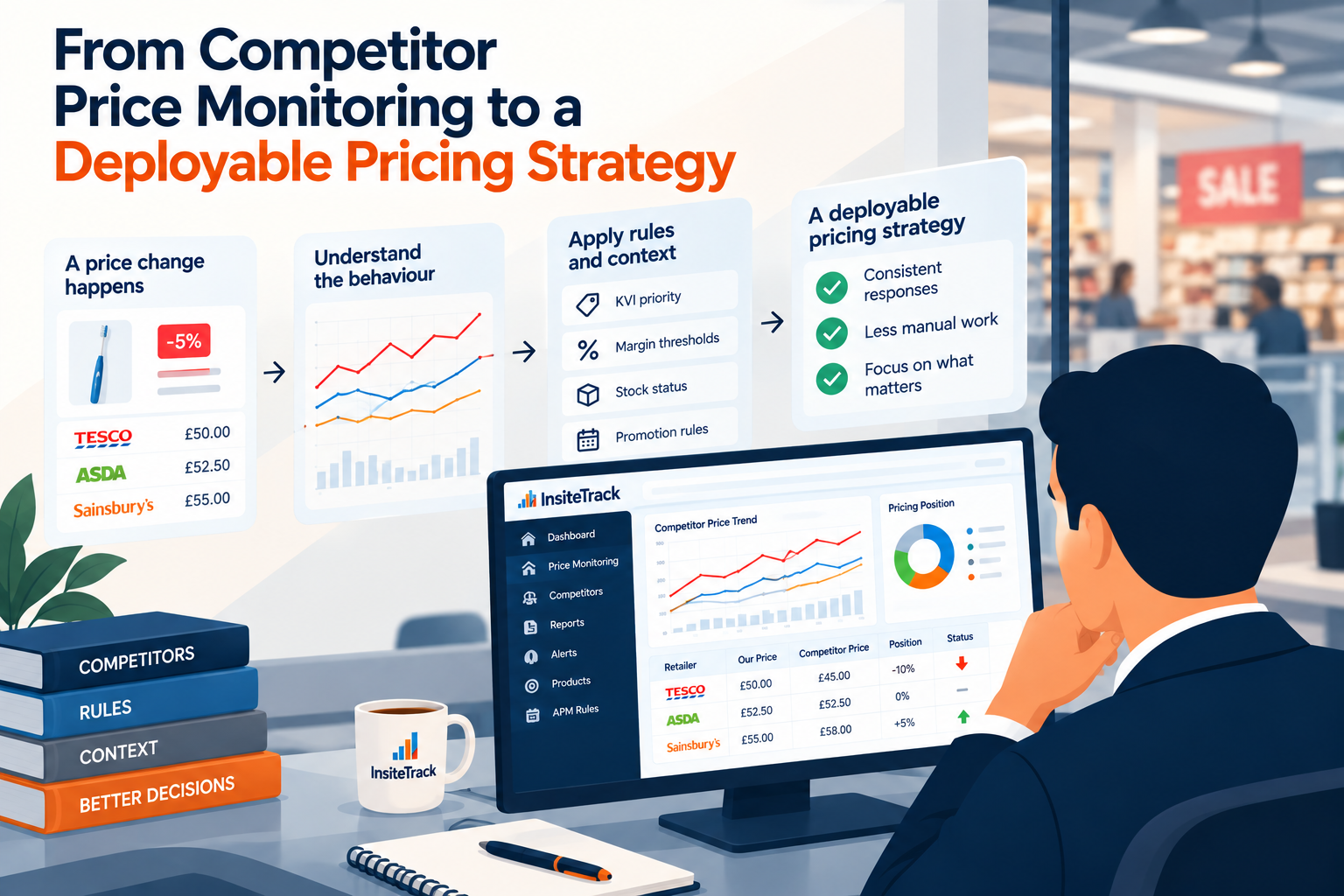
The same thing happens with the price itself. A lower competitor price may look significant until the team sees that the product is out of stock. A large movement may appear worrying until it becomes clear that it is part of a short term promotion. A competitor may look cheaper on headline price but less competitive once delivery or availability is considered.
This is where price intelligence becomes more valuable when it is connected to the wider market context. The decision is no longer based on one number. It is based on what that number means commercially. Price, stock, promotion and competitor relevance together create a much clearer picture than price alone.
Repeated Decisions Start to Become Rules
Once the same types of decisions are being made repeatedly, another question usually appears. Can this decision become a rule? If the team consistently responds in the same way when a particular competitor moves on a particular group of products, it may no longer make sense to rebuild that logic every time.
The same principle applies to out of stock competitors, temporary promotions or agreed price gaps. This does not mean removing commercial judgement. It means separating the predictable decisions from the situations that genuinely require thought. The more clearly those patterns are understood, the easier it becomes to create a more consistent pricing process.
Rules Make the Process Easier to Scale
Rules give teams a clearer starting point for repeated pricing situations. They help make sure the same type of market movement is not interpreted differently simply because a different person happens to be looking at it. This becomes increasingly important as ranges grow, more people become involved and the number of daily signals increases.
The business is no longer relying purely on individual judgement to recreate the same decision again and again. Instead, the strategy starts becoming part of the process itself. That makes pricing decisions easier to apply consistently across products, categories and teams.
Automation Comes Later
Automation can be valuable, but it works best once the logic behind the decision is already clear. It should not decide what the business wants to do. It should help execute the decisions the business has already made and understood.
If the rule is clear, the margin boundaries are defined and the relevant competitors and products are known, some predictable actions can potentially be handled automatically. That frees people to focus on exceptions and situations where the answer is less obvious. The more mature the process becomes, the less time the team should spend repeating decisions it has effectively already made.
This Progression Is a Positive Sign
This shift in customer questions should not be seen as a sign that the original setup was wrong. In many cases, it means the opposite. It shows that the retailer has become more sophisticated in how it uses competitor information and is asking the data to support a broader part of the pricing process.
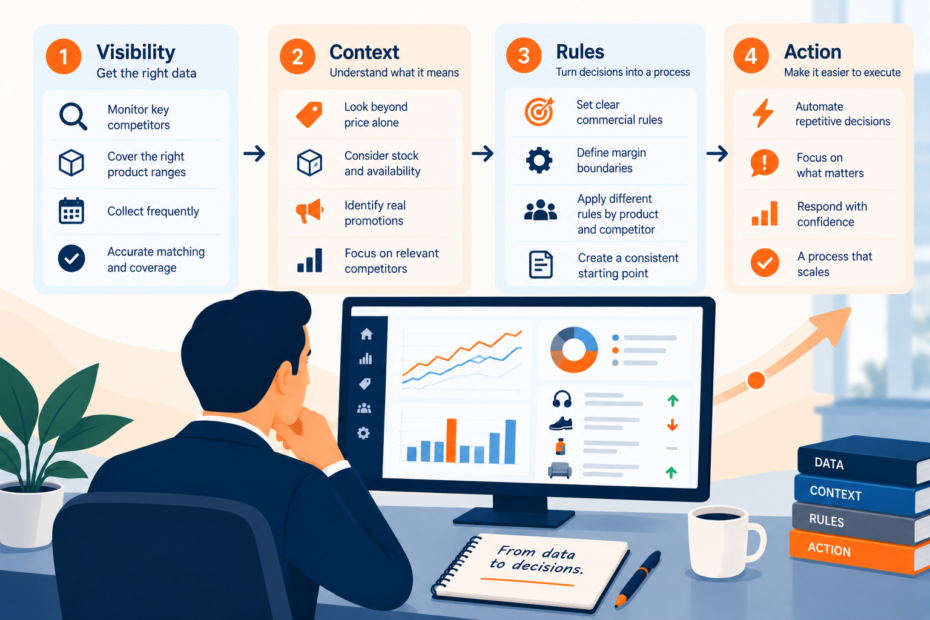
The journey often starts with visibility, then moves towards context, prioritisation, rules and eventually action. Each stage builds on the one before it. The role of price intelligence becomes broader as the business becomes more confident in how it uses the information.
The Value Is in What the Data Helps You Do
Accurate competitor data will always matter. The greater commercial value appears when that information helps the business decide where to focus, when to respond, when to hold position and which decisions can be made more consistently. That is why the most interesting customer conversations tend to change over time.
They stop being about how much data the business can see. They start being about what that data helps the business do. That is the point where price intelligence begins to support the wider pricing process rather than simply monitor the market.