Most retailers do not struggle to define their value proposition. At a central level, it is usually very clear. Pricing is positioned carefully, promotions are planned, and the overall offer is designed to be competitive within the market. On paper, the strategy makes sense.
The problem is that retail is not experienced on paper.
It is experienced in-store, in real time, against whatever else the customer can see around them. That is where even strong strategies can begin to drift from how customers actually perceive them.
Strategy Is Designed Centrally. Value Is Judged Locally
Retail strategies are typically built using aggregated views of performance, pricing, and competition. Leadership teams look at broad market positioning, category-level performance, and overall competitiveness across regions and channels.
Customers do not experience retail in aggregated views. They experience specific moments.
A customer standing in-store compares what they see against nearby competitors, visible promotions, product availability, and their own expectations of value. They react to what feels relevant in that moment, not to the broader strategic intent behind the pricing model.
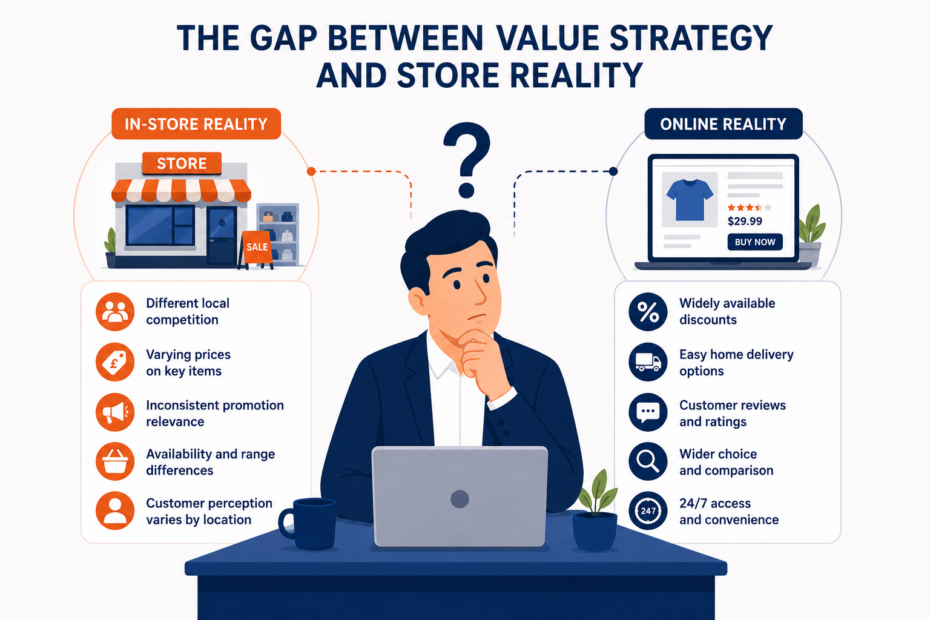
This creates one of the biggest challenges in modern retail: the same pricing and promotional strategy can feel very different depending on where it is experienced.
A product that feels competitively priced in one location may feel expensive in another. A promotion that performs strongly in one region may go largely unnoticed elsewhere. A category that appears commercially stable in central reporting may actually be under significant local pressure.
These differences are not always immediately visible internally, but they are highly visible to customers.
Where Execution Starts to Drift
The gap between strategy and reality rarely appears because of a major pricing mistake. More often, it develops gradually through small differences in execution that accumulate over time.
Store environments vary, local competitors behave differently, operational pressures influence decision-making, and pricing or promotional updates are not always implemented consistently across locations. Individually, these issues may seem relatively minor, but together they create variation in how the brand is experienced.
That variation matters because customers interpret it as inconsistency.
This is where retailers often become exposed. The strategy itself may still be commercially sound, but the customer experience begins to feel fragmented from one location to another. A centrally aligned value proposition can quickly lose strength if it is not reinforced consistently at store level.
Local Competition Is the Real Benchmark
One of the reasons this challenge persists is that central pricing strategies are often built using broad market views, while stores compete in much narrower and more localised environments.
Customers do not benchmark retailers against national averages. They compare against what is visible nearby, what they can easily access, and whichever competitor is shaping price expectations in that specific location.
This means a pricing strategy that appears “correct” overall can still feel uncompetitive in practice because the local reference point is different.
In many cases, retailers believe they are competitively positioned because central reporting suggests they are broadly aligned with the market. Meanwhile, individual stores may be facing much more aggressive local competition that is not fully reflected in national reporting structures.
That is one of the hidden limitations of aggregated visibility. It can conceal local pressure until it eventually appears in performance metrics.
Why This Is Usually an Execution Problem, Not a Strategy Problem
In most cases, the value proposition itself is not fundamentally flawed. The challenge lies in how consistently it is delivered across stores, regions, and customer touchpoints.
Store teams are often expected to execute against a central pricing strategy without full visibility into how their local market is behaving. They may not clearly understand where they are competitively exposed, how nearby competitors are positioning key products, whether promotions are genuinely relevant in their area, or how their real-time pricing compares locally.
Without that visibility, decision-making naturally becomes more cautious and reactive. Teams rely more heavily on instinct and local judgement because the wider context is unclear. Over time, this creates operational inconsistency, even when the central strategy itself remains unchanged.
The Hidden Cost of Partial Visibility
When local context is incomplete, execution quality inevitably becomes uneven.
Some stores appear highly competitive while others feel noticeably out of line with customer expectations. Some locations react quickly to changes in the market while others lag behind. Internally, the strategy may still appear aligned and coherent, but externally the customer experience feels inconsistent.
That inconsistency has a direct impact on how customers interpret value.
The risk is rarely immediate or dramatic. Instead, it builds gradually through repeated experiences where the pricing, promotions, or overall value proposition feel disconnected from what customers expect to see.
Customers may not consciously analyse every pricing decision, but they quickly recognise when value feels inconsistent.
What Better Execution Looks Like
Retailers that manage this challenge effectively do not attempt to control every detail centrally. Instead, they focus on making the strategy translatable at a local level while maintaining overall commercial alignment.
That means giving teams better visibility into local competitor behaviour, understanding how value is perceived in different markets, identifying which products genuinely shape customer perception, and allowing central decisions to adapt intelligently to local realities where necessary.
The objective is not perfect consistency across every location.
It is relevant consistency.
Customers do not expect every store to operate identically, but they do expect the value proposition to feel coherent wherever they encounter it. The retailers that achieve this best tend to create stronger alignment between central strategy and local execution, allowing store teams to make more confident decisions while still supporting the broader commercial goals of the business.
From Strategy to Reality
The real challenge for retailers is not defining the strategy. It is ensuring that the strategy translates effectively into the customer experience.
When local teams have the visibility and context they need, decisions become more confident, execution becomes more aligned, and the value proposition begins to feel consistent across locations — not because every store behaves identically, but because the customer experience makes sense wherever it occurs.
A useful way to pressure test this internally is to ask a few simple questions. Does your pricing feel competitive in every location, not just overall? Can store teams clearly see how they compare to local competitors? Are promotions equally relevant across different regions? Would a customer experience the same sense of value in different stores?
If the answers vary significantly, the gap is probably not in strategy.
It is in execution.