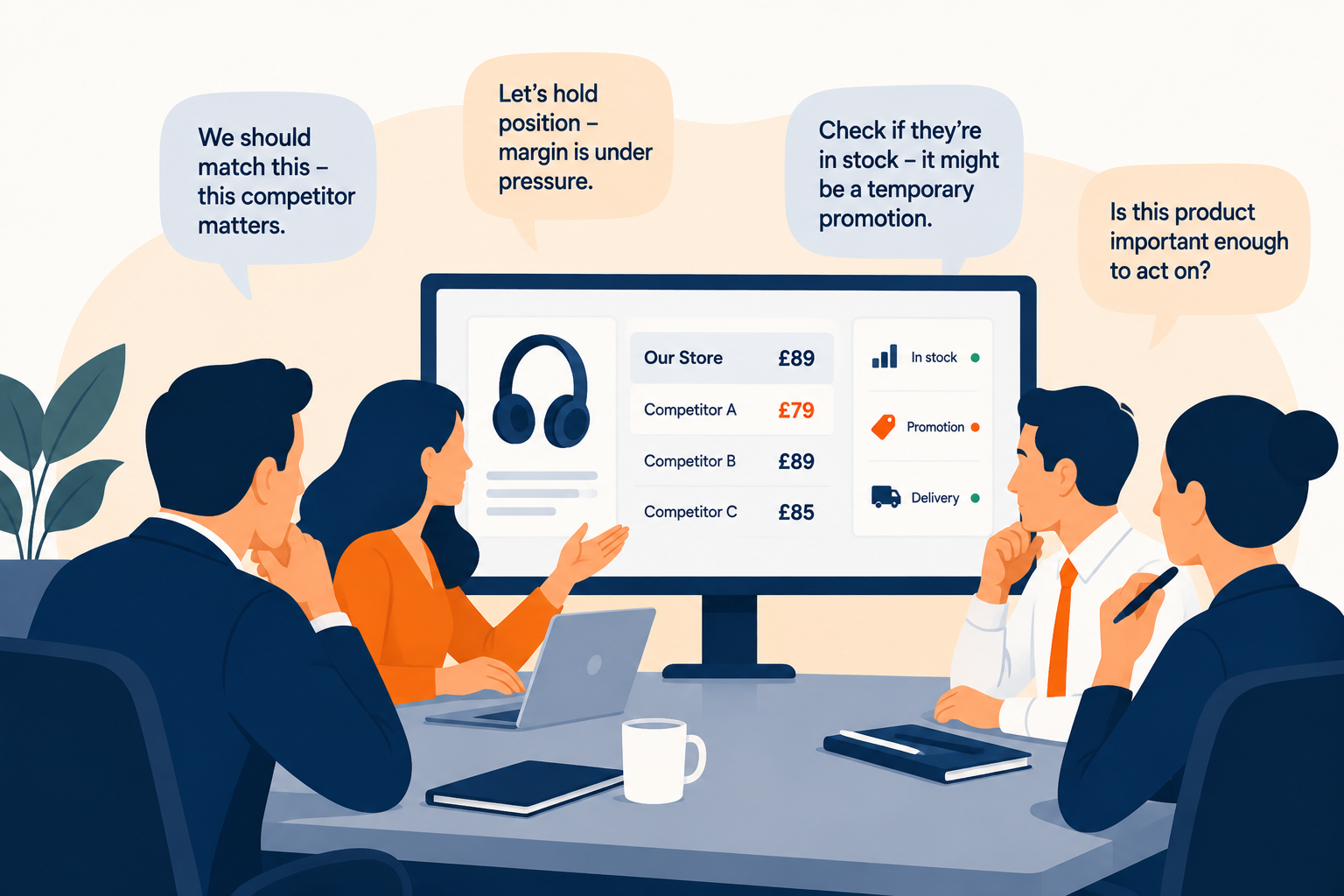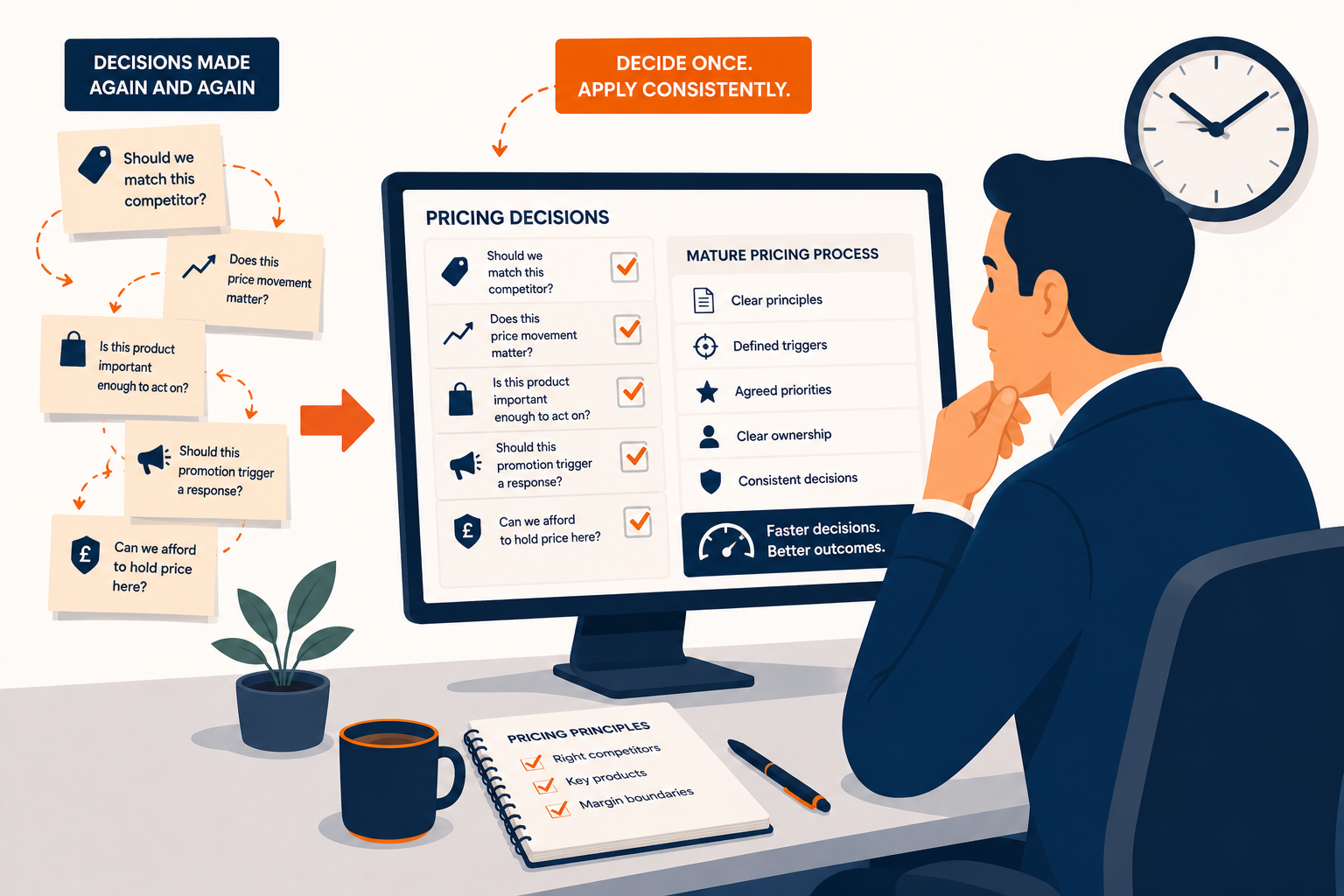
Commercial managers are expected to improve performance. They are responsible for identifying growth opportunities, challenging underperformance, protecting margin, and making commercially sound recommendations. In many organisations, they sit at the centre of decision-making, connecting category performance, supplier relationships, trading activity, and financial results.
The challenge is that most of the information they rely on comes from inside the business.
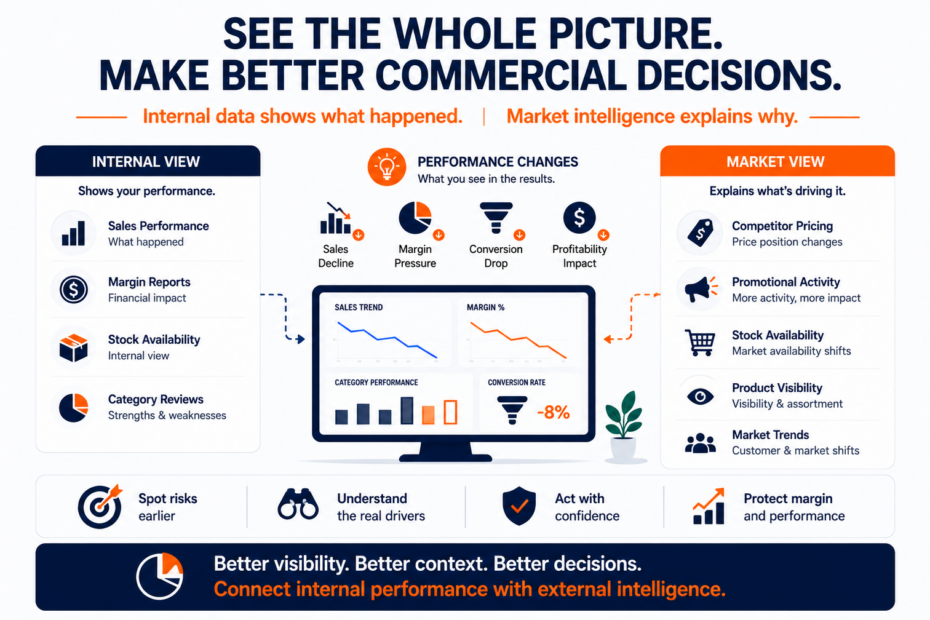
Sales reports show what happened. Margin reports highlight financial performance. Stock reports identify availability issues, while category reviews reveal areas of strength and weakness. All of this information is valuable, but it only tells part of the story.
Performance does not happen in isolation. Customers are influenced by competitor pricing, promotional activity, product availability, supplier investment, and wider market conditions every day. When commercial teams only have visibility of internal performance, they are often left trying to explain results without understanding the market forces that shaped them.
That creates a significant commercial challenge.
The Problem With Looking Inward
Most commercial reporting is designed to answer a straightforward question: How are we performing?
What it often struggles to answer is an equally important one: Why are we performing that way?
A decline in sales might initially appear to be a pricing issue. Margin pressure may seem like a product mix problem, while weaker category performance could easily be attributed to changes in customer demand. However, these conclusions can be misleading when viewed through an internal lens alone.
Internal performance data records the outcome, but it rarely explains the market conditions that created it. Without external context, commercial teams are often left making assumptions about what is driving performance rather than understanding it with confidence.
Sales Data Explains Results, Not Market Behaviour
Sales reporting plays an essential role in commercial decision-making, but it has limitations.
It can tell you which products are growing, which categories are slowing, and where revenue is being won or lost. What it cannot tell you is what customers were comparing your offer against when they made their purchasing decision.
A sales decline could be driven by a competitor launching a major promotion. It could be caused by aggressive pricing on a handful of high-visibility products, or it may simply reflect a competitor returning to full stock after a prolonged shortage. In other cases, a rival may have improved product visibility, expanded its assortment, or secured additional supplier support that has shifted customer demand.
The internal data records the result.
The market explains the reason.
Understanding the difference is critical if commercial teams are expected to make confident recommendations rather than educated guesses.
The Missing Context Behind Margin Pressure
Margin is another area where incomplete visibility can lead to incomplete decisions.
When margins begin to soften, the natural response is to examine internal pricing decisions, promotional activity, supplier costs, and trading performance. While these factors are undoubtedly important, they rarely tell the whole story.
A competitor becoming more aggressive on key value items can create pricing pressure long before it becomes visible in financial reporting. Increased promotional activity across the market can gradually change customer expectations and make full-price selling increasingly difficult. Changes in competitor stock availability can alter price sensitivity and purchasing behaviour without any obvious warning inside internal reports.
By the time margin deterioration becomes visible, the market conditions driving it may have been developing for weeks.
This is one reason many commercial teams feel reactive. They are responding to outcomes rather than recognising the conditions that created them.
Competitor Activity Is About More Than Price
When businesses think about external market intelligence, pricing is often the first thing that comes to mind.
Price is important, but it is only one part of the competitive picture.
Competitors influence performance through promotional activity, stock availability, product visibility, assortment changes, supplier investment, and marketplace presence. In many situations, these factors have just as much influence on customer behaviour as price itself.
A retailer does not always become more competitive by reducing prices. A stronger promotion, better availability, improved product content, or broader assortment can create significant competitive pressure without a single price change taking place.
Commercial teams that focus exclusively on competitor pricing risk missing the wider market dynamics that are shaping customer decisions every day.
Why Commercial Decisions Need Market Context
Commercial managers are regularly asked difficult questions.
Why has this category slowed?
Why are margins under pressure?
Why has conversion changed?
Why are customers behaving differently?
Internal performance data can help identify where these issues are occurring, but it rarely explains why.
When competitor pricing, promotional activity, stock availability, product-level price position, and wider market movement are viewed alongside internal performance, commercial decisions become significantly stronger. Opportunities become easier to identify, risks become visible earlier, and recommendations are supported by a much richer understanding of the market.
Instead of reacting to performance, commercial teams gain the ability to anticipate it.
The Difference Between Reporting and Insight
Many organisations have no shortage of reports.
The challenge is that reports often stop at describing performance.
Insight goes further by connecting commercial results to the external conditions influencing them.
A report might tell you that sales declined by eight percent.
Insight explains that a key competitor launched a category-wide promotion, increased stock availability, and widened its price advantage across several high-profile products at exactly the same time.
One describes the outcome.
The other supports a decision.
That distinction is becoming increasingly important as markets become more competitive and customer behaviour becomes more dynamic.
What Better Commercial Visibility Looks Like
The strongest commercial teams combine internal and external visibility to create a complete picture of performance.
Rather than relying solely on sales reports or margin analysis, they connect internal performance with competitor pricing, promotional activity, stock availability, supplier investment, and broader market movement. This allows them to understand not only what is happening inside the business, but also what is changing around it.
With this wider perspective, commercial conversations become more proactive. Teams spend less time debating possible explanations and more time identifying opportunities, managing risk, and making informed commercial decisions.
The focus shifts from explaining yesterday’s results to influencing tomorrow’s performance.
The Shift Commercial Teams Need to Make
Most organisations have invested heavily in understanding internal performance.
The next opportunity is understanding that performance in context.
Sales data, margin reports, and category reviews remain essential, but they only reveal one side of the commercial picture. The other half exists outside the business, in competitor activity, promotional pressure, stock availability, supplier behaviour, product-level competitiveness, and wider market movements.
Commercial managers are increasingly expected to improve performance, identify growth opportunities, and make stronger strategic recommendations. To do that effectively, they need more than internal visibility.
They need market visibility.
Because the quality of a commercial decision is rarely determined by how much data is available.
It is determined by whether you can see the whole picture.