
There is usually an obvious point at which a business starts questioning a technology provider. The data becomes unreliable, service levels deteriorate, important requirements cannot be met or something simply stops working. Those are easy problems to recognise because there is a clear reason to consider change.
Price intelligence does not always become outdated that way. In many cases, the system continues doing exactly what it was originally introduced to do. Prices are collected, reports arrive and the technology appears to be functioning perfectly well. What changes is the business around it.
After more than 15 years working with retailers, one pattern we have seen repeatedly is that pricing requirements rarely stay still. Ranges expand, competitors change, ecommerce becomes more important, teams restructure and commercial priorities move. A solution that was a strong fit when it was introduced can gradually become less suited to how the organisation works today.
The warning sign is often not failure. It is the friction that slowly builds around the original setup.
Working and Working Well Are Different Measures
Imagine a retailer introduced competitor price monitoring several years ago. It improved market visibility, reduced manual collection and gave the business a more structured view of competitor activity.
Several years later, the system is still doing those things. On paper, there may be little reason to question it. However, the retailer itself may now be very different. The ecommerce operation may have grown significantly, the range may have expanded into new categories and additional competitors may have become commercially relevant. Pricing responsibilities may now sit across category, ecommerce and commercial teams rather than with the people who originally implemented the solution.
The original system has not necessarily become worse. The requirement has simply moved.
This is where reviewing a pricing solution based solely on whether it still functions can be misleading. A better question is whether it continues to support the decisions the organisation now needs to make, in the way those decisions are actually made.
Pricing Friction Usually Accumulates Gradually
Operational friction rarely appears as one major problem. It tends to develop through a series of sensible workarounds.
One team needs additional context, so a report is exported into Excel and adjusted before it is used. A particular competitor sits outside the normal coverage, so someone checks it manually. Another category needs information presented differently, so a separate reporting process develops. Alerts become broader than the team’s priorities, so people learn which ones require attention and which can usually be ignored.
None of these examples necessarily means the underlying solution is poor. In isolation, each workaround may seem perfectly reasonable. The issue is what happens when they accumulate.
Over time, the retailer can end up with a pricing process made up of the original technology plus spreadsheets, manual validation, separate reports, individual knowledge and additional internal processes. The system still works, but the business increasingly has to work around it.
That difference matters.
Look at the Whole Pricing Workflow
Technology is often evaluated by looking at what happens inside the platform. With price intelligence, it is equally important to look at everything that happens after the information arrives.
If a report needs substantial manipulation before a Category Manager can use it, that additional work is part of the pricing process. If competitor prices are still checked manually before the team feels comfortable acting, that validation effort also belongs in the process.
The same applies when pricing rules are maintained in separate spreadsheets, when commercial teams rebuild reports in Power BI or when individual people hold knowledge about which competitors and market movements genuinely matter.
Those activities may sit outside the price intelligence system, but they still affect the speed, consistency and confidence of pricing decisions.
This is why operational fit can be more revealing than a feature list. A platform may have sophisticated capabilities while the retailer still needs significant effort around it to turn the output into something useful.
Businesses Often Outgrow the Original Requirement
Retailers naturally change over time, and pricing complexity tends to increase with them.
A solution originally configured around 5,000 products may eventually support a much larger range. The technology may be technically capable of processing that additional volume, but that does not automatically mean the pricing process has scaled with it.
More products create more movements to review. New categories may require different competitor sets. Some products may carry greater pricing importance than others, while different areas of the range may need different levels of monitoring.
Organisational complexity can increase too. A pricing report originally built for one central team may later need to support ecommerce, category, trading and senior commercial users, all of whom view the market through a different commercial lens.
This is where the distinction between data scale and operational scale becomes important. Collecting more information is only one part of the challenge. The pricing process also needs to remain usable as the number of decisions, users and commercial priorities grows.
Price Intelligence Should Not Be a One Time Implementation
Price intelligence can sometimes be treated as a project with a clear finish line. Competitors are selected, products are matched, reports are created and the system goes live. Once that is complete, the emphasis shifts towards maintaining the setup.
The problem is that the market does not remain fixed after implementation.
Competitors that mattered three years ago may be less important today. New marketplaces or digital players may have emerged. Some categories may have become more price sensitive, while others now allow greater margin flexibility. Reporting requirements may also have changed as the organisation adopted new systems or new people took responsibility for pricing decisions.
The way the business uses price intelligence should therefore continue to develop.
At one stage, the priority may simply be gaining reliable competitor visibility. Once that is established, the focus may move towards prioritising important changes, reducing unnecessary alerts, creating clearer pricing rules or integrating information more closely into existing commercial workflows.
A mature pricing setup should be able to follow that progression rather than holding the retailer to the way the requirement was defined at the start.
Customisable Is Not Always the Same as Adaptable
Most modern pricing platforms offer some form of customisation, and that is useful. Reports can be adjusted, dashboards configured and filters changed.
However, there is a broader question around adaptability.
Can the pricing setup change easily when the commercial problem changes? Can different categories operate with different priorities? Can the competitor set evolve as the market changes? Can information be delivered into the systems where teams already make decisions rather than forcing them to create new processes around the platform?
Adaptability also includes the relationship with the provider. A retailer’s requirement today may be different from the one originally specified, and the provider should be able to respond to that change rather than simply continue delivering the original setup.
This becomes particularly important as pricing capability matures. The questions retailers need answering become more sophisticated over time, so the solution supporting those decisions needs to develop with them.
A Good Provider Should Challenge the Existing Setup
There is another side to this that is easy to overlook.
If a retailer has worked with a price intelligence provider for several years, the conversation should not simply be about continuing to supply the same data. The provider should periodically challenge whether the setup itself is still right.
Are these still the competitors that matter most? Are teams using all of the reports being produced? Have alerts become too broad? Are some products receiving more attention than their commercial importance justifies? Has the business changed in a way that should affect how price intelligence is collected or delivered?
Sometimes the right answer may even be to monitor less rather than more.
That may feel counterintuitive for a data provider, but useful price intelligence should ultimately improve decision making rather than simply increase the amount of information available.
A provider can therefore be delivering everything that was originally agreed while the retailer is still missing opportunities to improve the wider pricing process.
Pricing Maturity Changes What Good Looks Like
This is where pricing maturity becomes especially relevant.
For a retailer at an earlier stage, better competitor visibility may create a significant improvement. The immediate challenge is understanding what is happening in the market with enough confidence to make better decisions.
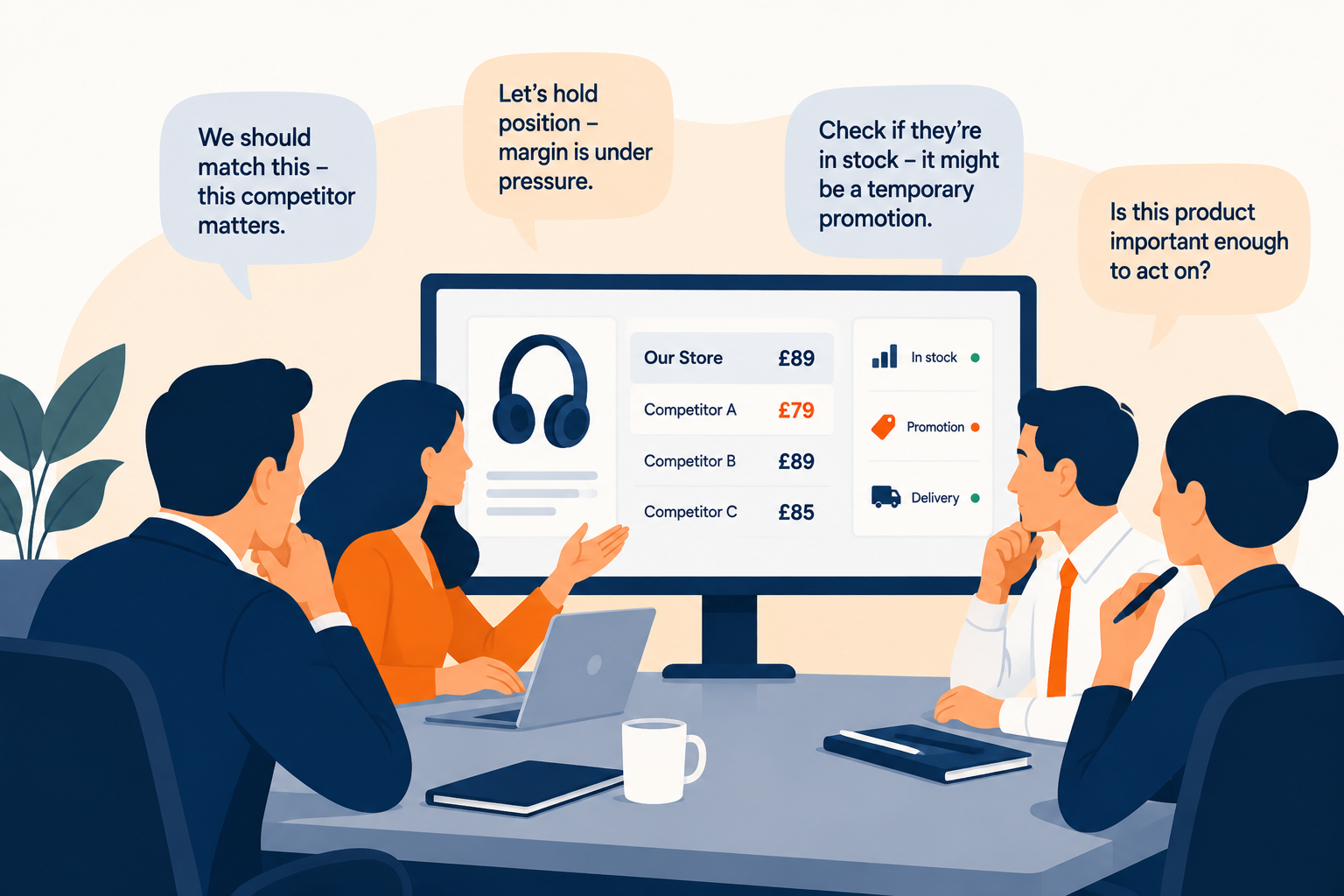
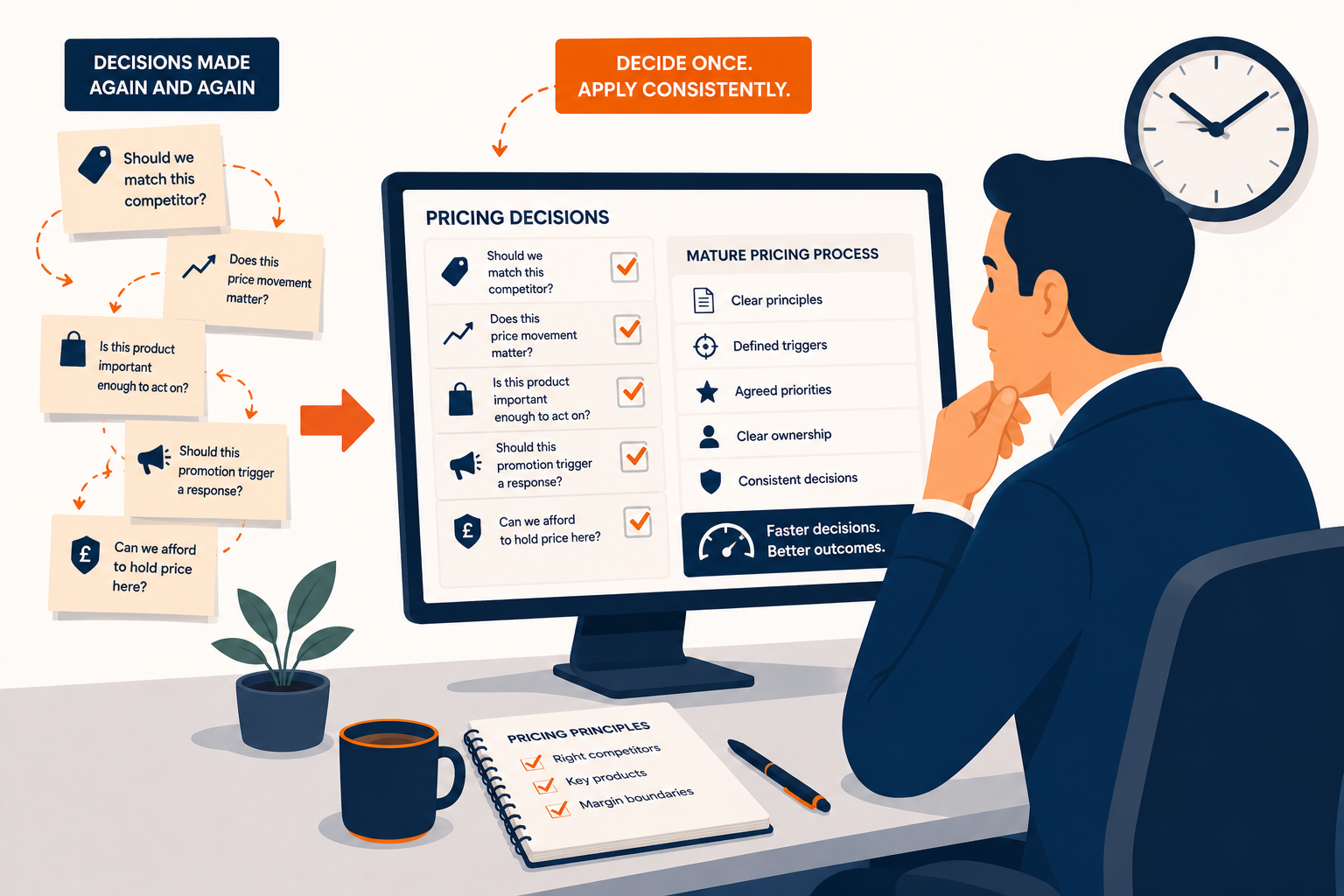
Once that capability is established, the bottleneck can move elsewhere. The team may now need clearer priorities, more consistent decision rules, better ownership or a stronger understanding of which market movements genuinely deserve action.
At this point, adding more competitor data may produce diminishing returns. The bigger opportunity lies in improving how information moves through the organisation and how consistently it becomes commercial action.
A retailer can therefore have sophisticated price intelligence and still have significant room to improve its pricing maturity. The technology has not necessarily failed. The organisation has simply reached a point where the original requirement is no longer the whole requirement.
Look for Friction Before You Look for Failure
If I were reviewing an established price intelligence setup, I would not begin by asking whether the system still works. I would look at where friction has accumulated around it.
How much information is still manually checked? Which reports need adjusting before teams use them? Where are spreadsheets essential to the process? How quickly can a new competitor, category or reporting requirement be accommodated? Which pricing decisions still rely heavily on individual knowledge?
I would also look at where the business has excellent market visibility but continues to spend significant time deciding what to do with it.
Those questions tell you far more about whether the pricing capability is still a good fit than simply asking whether the existing provider is delivering the agreed data.
The Right Solution Can Still Become the Wrong Fit
Choosing to review an existing pricing solution does not mean the original decision was wrong.
A platform may have been exactly what the retailer needed when it was introduced and still become less appropriate as the business develops. Mature organisations should expect their requirements to change.
That is why a price intelligence solution does not need to fail before it deserves another look. Sometimes the clearest indication is simply that more effort is being added around the edges to make the existing setup fit the way the organisation now operates.
There is a meaningful difference between a solution that still works and a pricing capability that is still working well.
If your price intelligence has been in place for several years, it may be worth looking beyond the technology itself and reviewing how effectively the wider pricing process is operating around it.
The Retail Pricing Intelligence Maturity Assessment provides a practical way to do that. It looks at how trusted, understood and embedded pricing intelligence is across the organisation, helping identify where the current process is working well and where the next opportunity for improvement may sit.

How Mature Is Your Pricing Intelligence?
Take our 5-minute assessment to see how trusted, usable and embedded your pricing intelligence is today. You’ll receive a personalised summary with your maturity stage, key focus areas and practical next steps.