Most retailers have a pricing strategy. The harder question is whether that strategy is applied consistently when hundreds of day-to-day decisions need to be made.
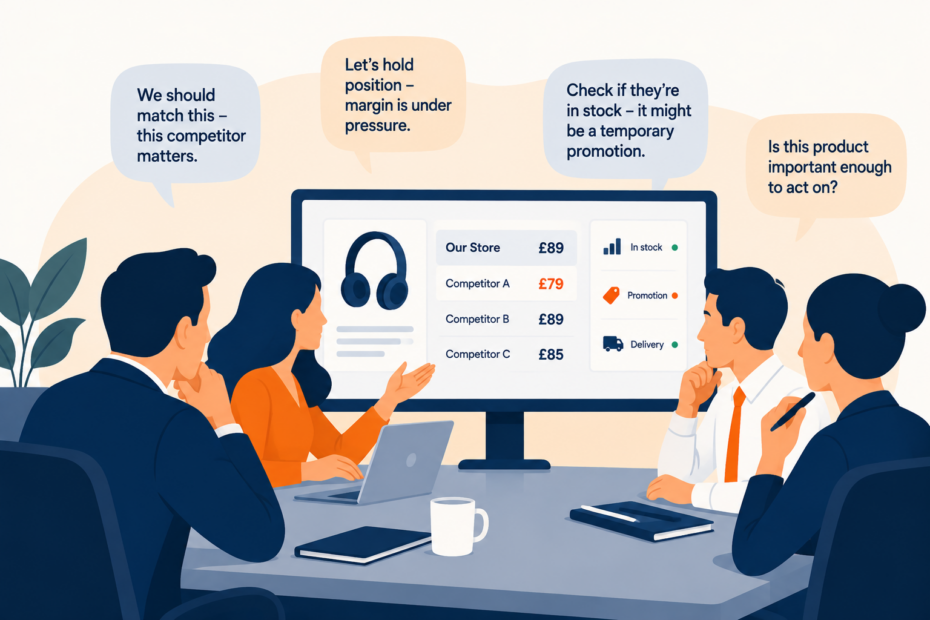
A competitor changes price. One Category Manager matches because they know that competitor matters. Another holds position because margin is under pressure. Someone else checks whether the competitor is in stock, whether the movement is promotional and whether the product is important enough to justify a response.
None of those decisions is necessarily wrong. The problem appears when the answer depends too heavily on who happens to be looking at the data.
That is where pricing strategy can begin to break down in execution.
Pricing Strategy Is Often Clearer at the Top Than in the Workflow
At leadership level, pricing strategy can sound straightforward. Protect margin where possible, stay competitive on important products, respond selectively to the market and avoid unnecessary price matching.
The difficulty comes when those principles need to be translated into individual decisions across thousands of products, multiple categories and different competitors.
Which competitors should influence the response? How much of a price gap is acceptable? Should a temporary promotion be treated differently from a permanent move? Should an out-of-stock competitor still influence price? At what point should margin protection take priority?
Experienced teams often know how they would answer these questions, but that logic may not always be visible or consistently applied across the wider business.
Pricing strategy can therefore exist without being fully embedded in the process.
When Knowledge Lives in People, Decisions Become Harder to Scale
A large amount of pricing capability naturally sits in experience. An experienced Category Manager knows which competitors customers genuinely compare. A Pricing Manager knows which movements deserve attention. A Commercial Director understands where the business is prepared to accept margin pressure.
That expertise is valuable, but it becomes a risk when the process depends on those individuals always being present.
As teams grow and ranges become more complex, two people can look at the same movement and reach different conclusions because one focuses on competitive position, another on margin and another on stock availability.
The issue is not that judgement exists. Commercial judgement should remain an important part of pricing. The issue is whether the principles guiding that judgement are clear enough for the wider team to apply consistently.
A more mature pricing process captures enough of that experience to make routine decisions more repeatable without removing the expertise needed for unusual situations.
Price Intelligence Should Support Decision Logic, Not Just Data
Price intelligence is often judged by the quality of the information it provides. Accurate competitor prices, reliable matching, sufficient update frequency and visibility of promotions and stock are all essential.
But as pricing capability develops, another question becomes increasingly important: what happens after the data arrives?
If a system identifies a competitor movement but the team still has to reconstruct the same commercial logic manually every time, the technology is only supporting part of the pricing process.
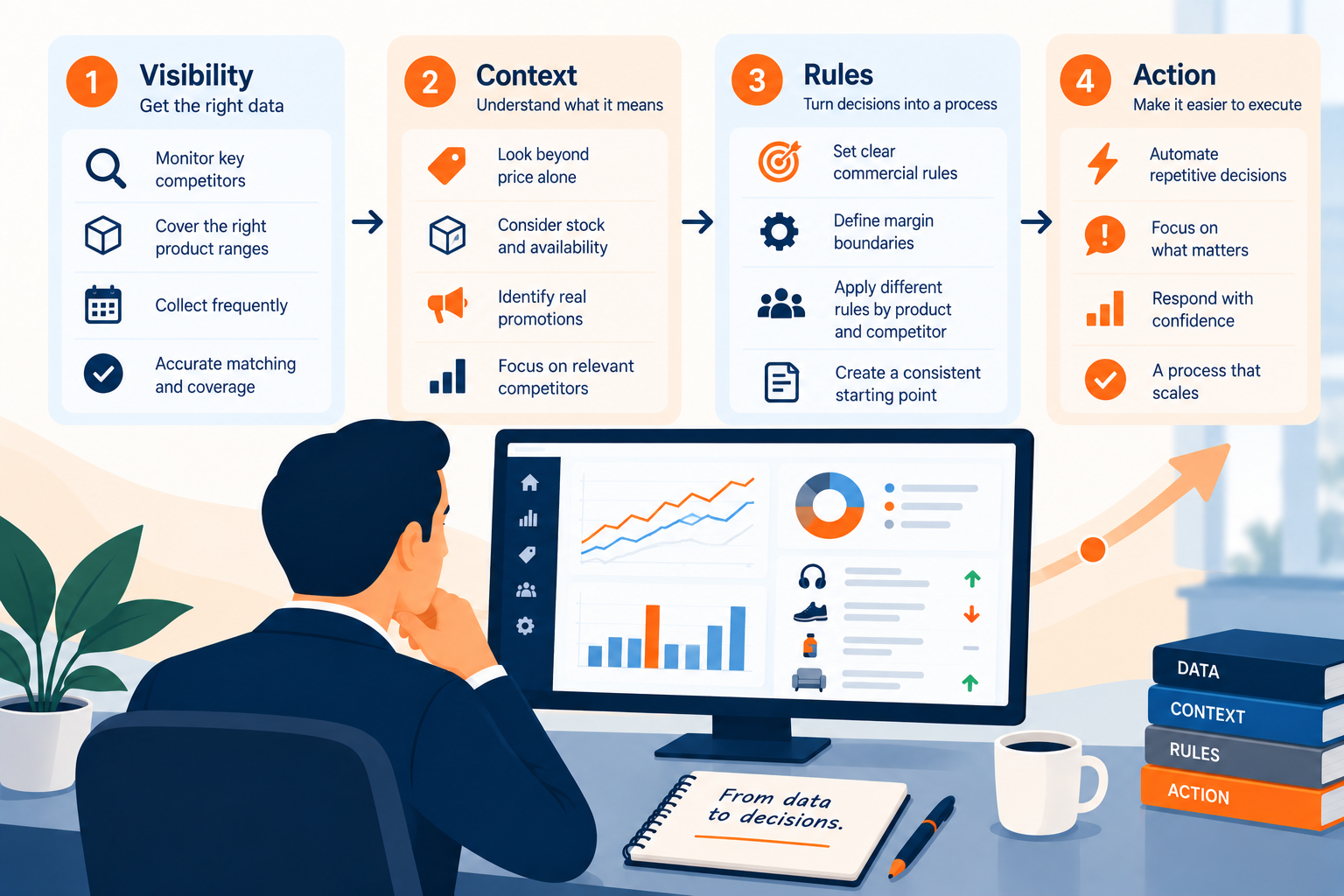
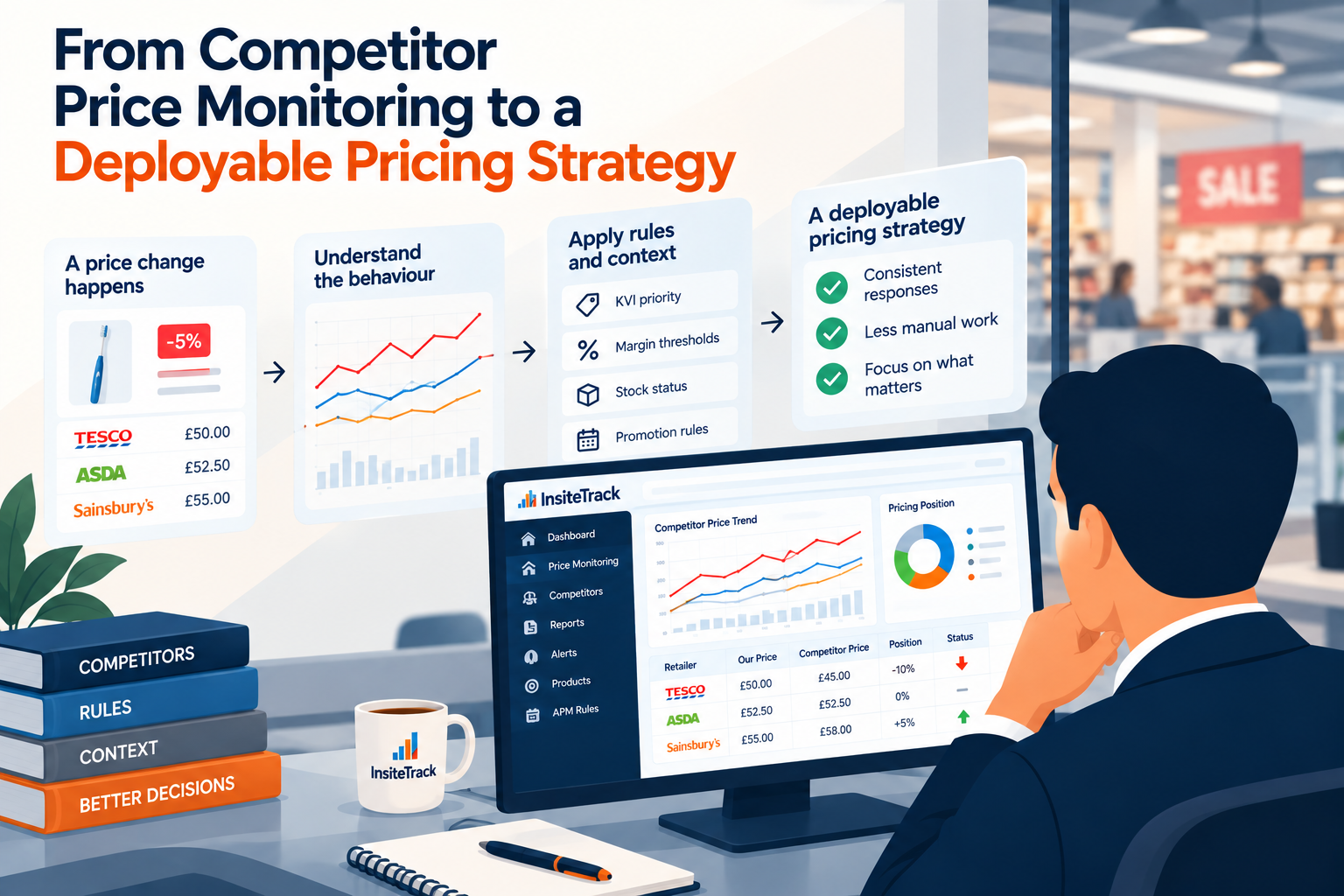
The next stage is to make more of that logic visible. This can include agreed competitor priorities, Key Value Item flags, margin thresholds, stock conditions, promotional rules, target price positions and clear escalation criteria.
The purpose is not to remove flexibility. It is to give teams a stronger and more consistent starting point.
Rules Turn Repeated Decisions Into Shared Decisions
Much of pricing activity is repetitive. The specific product may change, but the underlying question often does not.
If an important competitor moves below us on a Key Value Item, what should normally happen? If a temporary promotion creates a price gap, should we respond or monitor? If matching would take us below an agreed margin level, what is the next acceptable action?
When these questions are repeatedly debated, the business is effectively making the same decision again and again.
Pricing rules can turn those discussions into shared principles. The normal response becomes clearer before the situation appears, while teams still retain the ability to review an exception when the commercial context justifies it.
This improves consistency, reduces unnecessary debate and makes pricing decisions easier to explain.
Automation Should Execute Strategy, Not Invent It
This is also where automation becomes more useful.
Automated repricing should not decide what the pricing strategy is. It should execute the parts of the strategy the business has already decided.
If certain competitors should be matched within defined margin boundaries, that logic can potentially be automated. If some products should remain within a specific competitive position, the process can reflect that. If a competitor is out of stock, its price may not need to trigger a response. Temporary promotions can also be treated differently if agreed rules say they should be monitored rather than matched.
The value comes from managing predictable situations according to principles the business already understands.
That reduces the amount of time teams spend executing routine decisions and gives them more capacity for situations where genuine commercial judgement is needed.
Good Rules Should Create Freedom, Not Restriction
Pricing teams can sometimes associate rules with inflexibility, but good rules should have the opposite effect. They remove unnecessary uncertainty from routine situations and give experienced people more time to focus on exceptions.
A margin floor defines a boundary without dictating every decision. An agreed competitor hierarchy clarifies which movements deserve attention without requiring the business to respond to all of them. Promotional rules can help teams distinguish between temporary noise and meaningful market change.
The objective is structure rather than rigidity.
The normal approach should be understood, but the team should still be able to depart from it when there is a clear commercial reason.
What Happens When the Usual Person Is Not There?
One of the simplest tests of whether pricing strategy is genuinely embedded is to ask what happens when the most experienced person is unavailable.
Would the wider team know which competitor movements matter? Would they understand which products deserve priority? Would they know where margin can be protected, when competitive pressure requires action and when a decision should be escalated?
If the quality of the response changes significantly depending on who is present, then part of the strategy still lives in individual knowledge rather than in the pricing process.
That may be manageable in a small team, but it becomes increasingly difficult as the organisation grows.
Pricing maturity is therefore not only about having better data. It is also about making the logic behind pricing decisions more visible, consistent and repeatable.
Your Price Intelligence Setup Should Evolve With the Strategy
There is a wider implication for retailers that already have price intelligence in place.
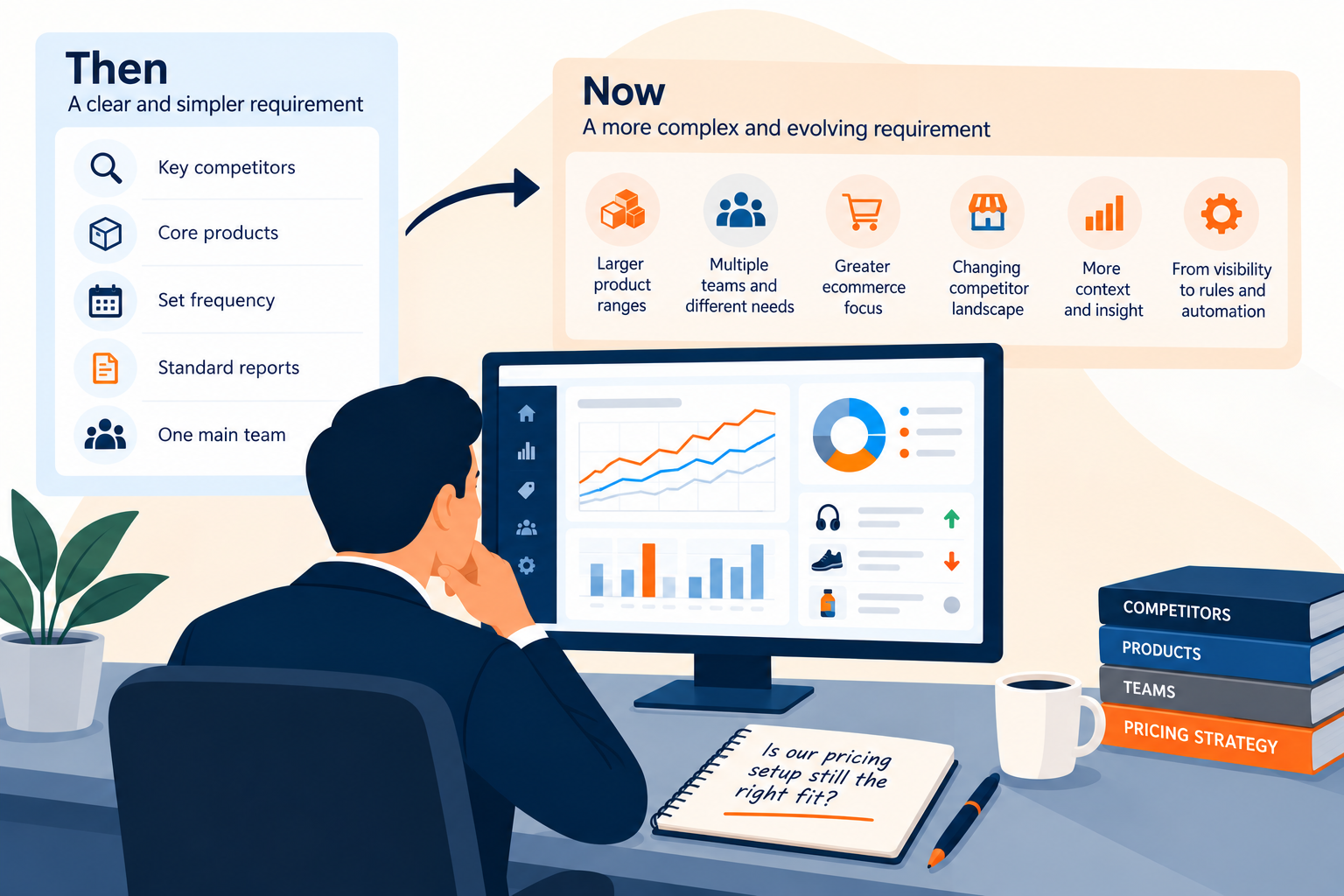
At an earlier stage, better visibility may have been the main requirement. The business needed reliable competitor pricing, good matching and a clearer understanding of the market.
Once that is established, the requirement should evolve. The focus moves towards prioritisation, clearer decision rules, ownership, workflow integration and, where appropriate, automation.
The price intelligence setup should evolve with that maturity.
If a retailer still relies heavily on spreadsheets, individual interpretation and repeated manual decisions despite having an established solution, it may be worth asking whether the current setup has developed far enough.
The question is no longer simply whether the system provides the data. It is whether it helps the organisation apply its pricing strategy consistently.
Pricing Strategy Should Not Depend on Who Is in the Room
Experienced people will always play an important role in pricing, especially when market conditions are unusual or a decision involves competing commercial priorities.
But routine pricing decisions should not need to be rediscovered every time they appear.
The clearer a business becomes about which competitors matter, which products deserve attention, where margin boundaries sit and when action is appropriate, the easier it becomes to build those principles into its price intelligence.
That can support more consistent decisions, clearer recommendations and, in the right areas, automated repricing within agreed boundaries.
The goal is not to automate judgement. It is to stop using human judgement on decisions the business has already made.
That is one of the clearest signs that pricing strategy has moved beyond the people in the room and into the way the business actually operates.