Category managers are not short of information. Competitor prices, promotional activity, sales performance, margin pressure, stock availability and wider category performance are already part of the day to day picture.
The challenge is what happens when that information needs to become a decision.
A competitor may reduce a price at the same time that sales soften on an important product. A promotion may appear elsewhere in the market while margin is already under pressure. A report might identify a new movement, but provide little indication of whether it deserves immediate attention.
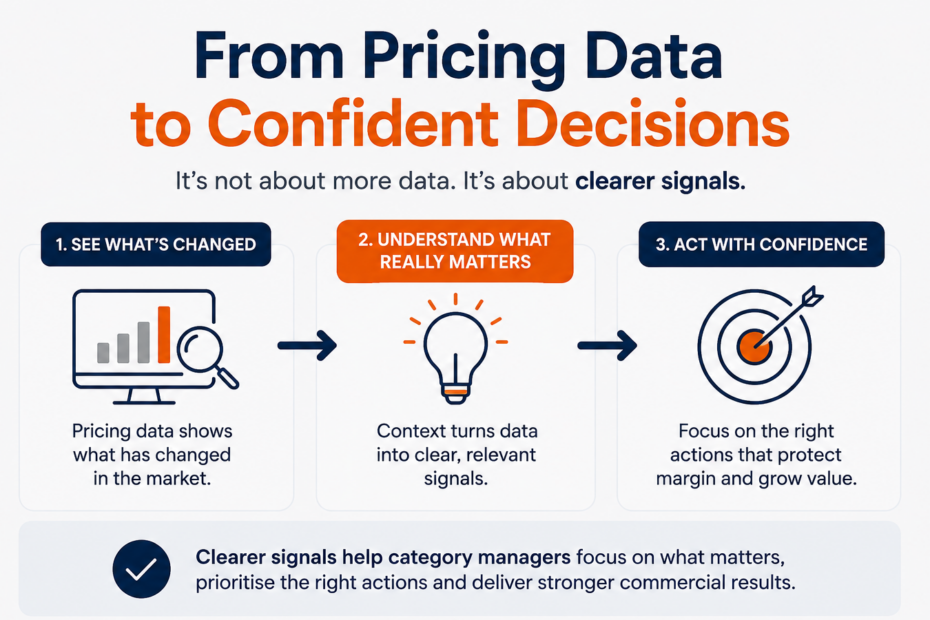
Seeing what has changed is only the beginning. Category managers still need to understand why it matters, how significant it is and what action, if any, should follow.
This is why more pricing data does not necessarily make category decisions easier. What category managers increasingly need are clearer signals that turn market information into something they can use with confidence.
Category Managers Are Balancing Competing Commercial Pressures
Category management has always required a careful balance between competing objectives. Sales need to grow, margin needs to be protected, stock needs to move and promotions need to perform. At the same time, competitors need to be monitored, customer value perception needs to remain strong and internal targets still need to be achieved.
Those priorities rarely move neatly in the same direction. A lower price may support conversion but reduce margin. Holding price may protect profitability while creating concern about competitiveness. A promotion may increase volume but simply bring future demand forward rather than generating genuinely incremental sales.
Competitor movements add another layer of complexity. A price reduction may initially look significant but have very little influence on customer behaviour. Equally, a relatively small movement on the right product could have much wider implications for how customers perceive value across the category.
This is why category decisions are rarely as simple as identifying the lowest price. The information may show what is happening, but it does not always make the appropriate response obvious.
Why More Pricing Information Can Create More Questions
There is a reasonable assumption that greater visibility should make pricing decisions faster. In practice, more information can sometimes create the opposite effect when teams still need to investigate the meaning behind each signal.
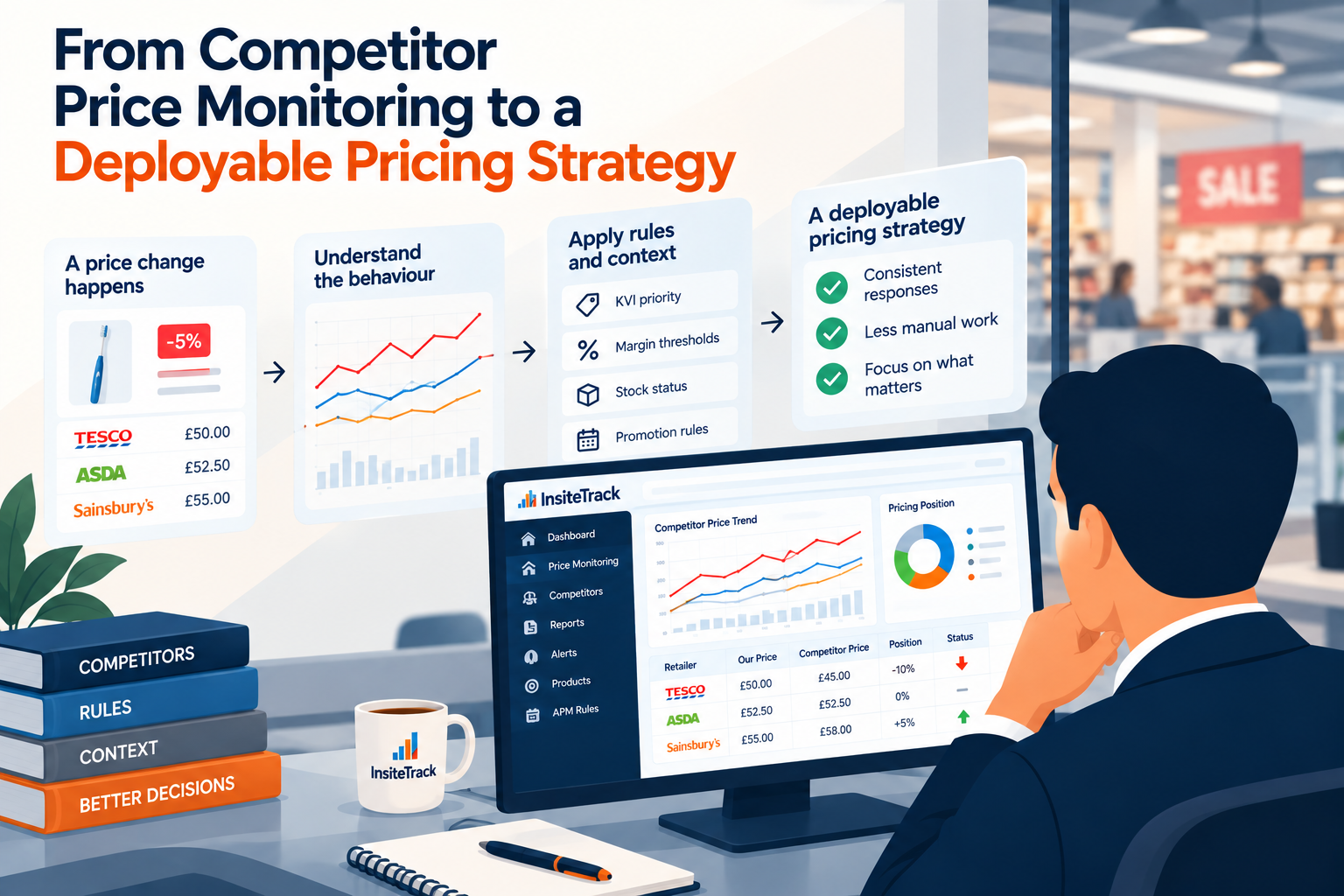
A competitor price change is a good example. The category team may see the movement immediately, but that visibility can create a new set of questions before a decision can be made.
Is the competitor actually in stock? Is the product directly comparable? Is the lower price part of a short term promotion? Does the offer apply across every channel? Is the product important enough to influence customer perception? Would responding protect demand, or would it simply reduce margin?
The price movement itself is easy to see. Understanding its commercial significance takes more work.
This is where pricing activity often becomes diagnostic before it becomes actionable. Category teams spend time validating information, adding context and deciding whether a movement is relevant before they can turn their attention to the decision itself.
The business has greater visibility, but it has not necessarily gained greater clarity.
A Competitor Price Is Only One Part of the Decision
Competitor pricing data is valuable, but price alone rarely provides enough context to make a strong category decision.
A retailer may appear significantly cheaper but have limited stock availability. A lower price may be the result of a temporary promotion or an attempt to clear a product from the range. Delivery costs may reduce the real difference between two offers, while marketplace sellers can make a retailer appear more competitive than its direct proposition actually is.
Competitor relevance also matters. A price movement from a retailer that customers regularly compare may deserve much greater attention than the same movement from a less relevant competitor.
Product importance adds another dimension. Certain products have a disproportionate influence on customer value perception, while others can carry a larger price difference with very little impact on demand.
Without this wider context, category teams can easily overestimate the importance of a movement. They may spend time investigating changes that have little commercial effect, react to promotions that disappear shortly afterwards or sacrifice margin to match competitors that are not genuinely influencing customer behaviour.
A pricing signal becomes useful when the team can understand the commercial meaning behind it.
When Every Pricing Signal Starts to Look Urgent
The problem becomes more difficult when several movements happen at the same time.
A competitor may adjust prices across multiple products while a promotion begins elsewhere in the market. Sales may soften on an important line at the same time that stock becomes tight in another part of the category. A margin report may highlight an additional area requiring attention.
Individually, each movement may deserve consideration. Together, they can create a long list of possible actions.
Without a clear way of prioritising those signals, everything begins to look urgent. A small movement on a low visibility product can receive the same attention as a significant change on a Key Value Item. A temporary competitor promotion can trigger the same internal response as a more meaningful repositioning across an entire category.
The result is fragmented attention. Teams remain busy reviewing information and discussing possible responses, but the most commercially important issue may not receive the attention it deserves.
This is not caused by a lack of effort. It happens because the information does not clearly distinguish what matters from what can safely be monitored.
The Difference Between Price Monitoring and Pricing Intelligence
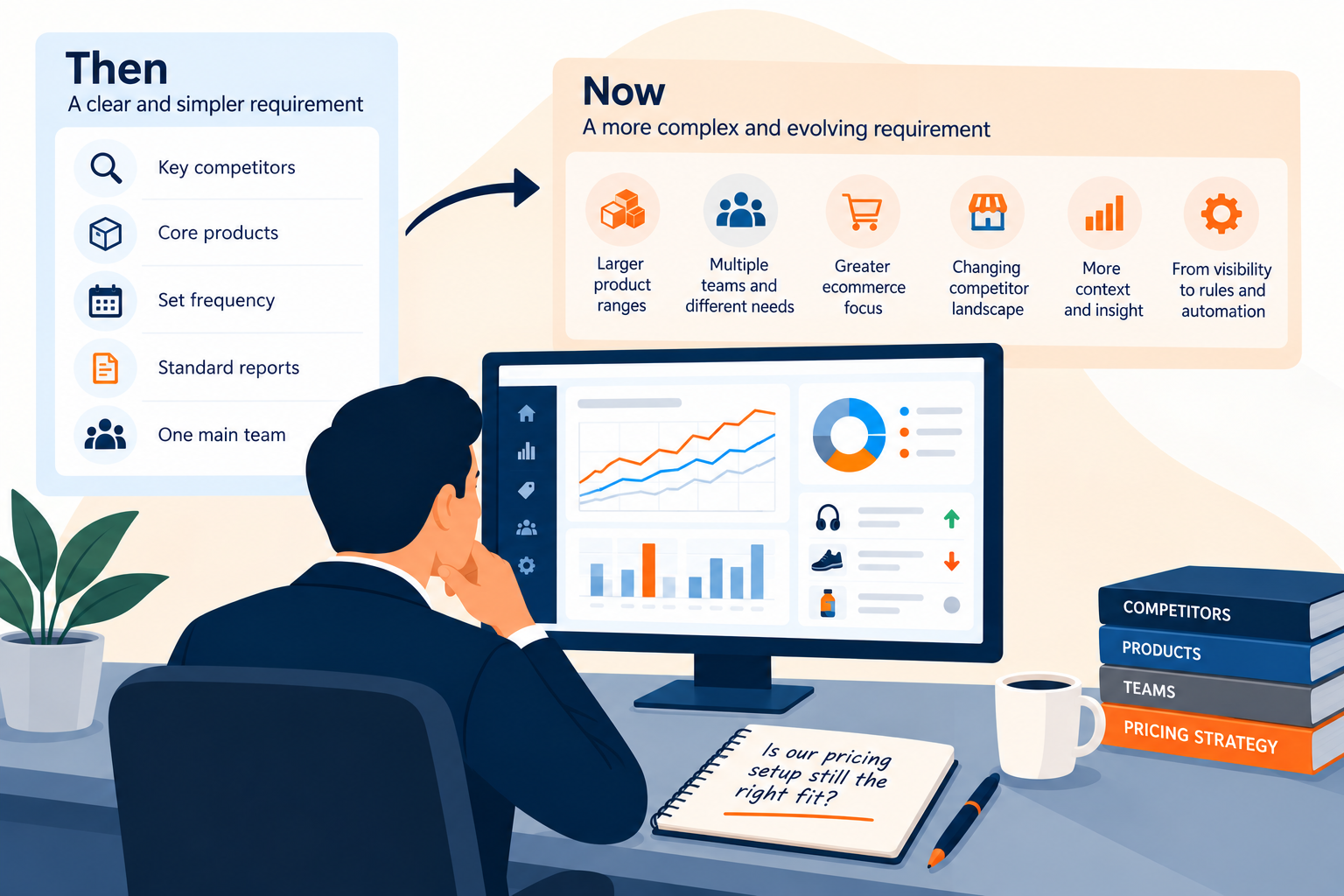
Price monitoring tells a category manager that something has changed. Pricing intelligence should help them understand why that change matters.
That is an important distinction.
Monitoring can tell a team what a competitor is charging, when its price changed, how large the difference is and which products are affected. Those are valuable pieces of information, but they still leave the category manager responsible for interpreting their significance.
Pricing intelligence should provide more context around the movement. It should help teams understand whether a competitor is relevant, whether the offer is genuinely comparable, whether the product is commercially important and whether the movement creates a meaningful risk or opportunity.
This means considering competitor prices alongside stock availability, promotions, margin exposure, product importance and customer behaviour.
The strongest category decisions are made when these factors can be understood together rather than being reviewed as disconnected pieces of information.
Clearer Pricing Signals Support Faster Decisions
Fast category decisions do not come from rushing. They come from reducing the uncertainty that exists before a decision is made.
When information is trusted and commercial priorities are clear, category managers can spend less time investigating every movement from the beginning.
If the team already understands which competitors genuinely matter, it does not need to give every competitor change equal attention. If products are prioritised according to their commercial importance, the team can focus its effort where there is the greatest potential impact.
Bringing stock, promotional context and margin information into the same decision also reduces the number of questions that need to be answered before action can be taken.
Clearer signals therefore reduce the distance between seeing that something has changed and understanding what response may be appropriate.
The objective is not to remove judgement from category management. Commercial judgement remains essential. The aim is to give category managers better information on which to apply that judgement.
Better Pricing Intelligence Also Helps Teams Know When to Hold
Pricing intelligence is often discussed in terms of finding opportunities to act, but knowing when not to act can be equally important.
A competitor reducing its price may initially create pressure to respond. Once the wider context is considered, the situation may look very different.
If that competitor has limited stock, the product has relatively low customer visibility and matching the price would create significant margin erosion, holding position may be the stronger commercial decision.
Without that context, doing nothing can feel risky because the visible signal is simply that a competitor has become cheaper. With clearer information, holding price becomes a deliberate decision rather than an absence of action.
This is one of the clearest differences between reactive and confident pricing. Reactive teams feel pressure to respond to every movement they can see. More confident teams understand which movements require action, which should be monitored and which are unlikely to affect the commercial outcome.
Category Knowledge Should Become Part of the Process
Experienced category managers naturally build valuable knowledge over time. They learn which competitors genuinely influence customers, which products have the greatest impact on value perception and which promotional patterns are likely to be temporary.
That experience is an important part of commercial decision making, but businesses become vulnerable when critical category knowledge exists only in individual people.
Decisions may vary significantly between team members. New employees can take longer to develop confidence, while similar situations may be interpreted differently across different categories.
Pricing intelligence becomes more powerful when it helps turn individual expertise into a shared decision process. Teams can establish a consistent understanding of competitor relevance, product priorities and the situations that warrant action.
This does not replace commercial judgement. It provides a stronger and more consistent foundation for it.
Clearer Signals Create Better Commercial Conversations
Category decisions rarely happen in isolation. Pricing, ecommerce, trading, commercial and finance teams may all contribute to the final decision.
When the underlying information is unclear or not fully trusted, a large part of those conversations can become focused on validating the data rather than discussing the commercial response.
Teams spend time checking whether a competitor price is correct, whether a product is genuinely comparable, whether a promotion is still active or whether the offer applies nationally.
These questions are necessary when the information is uncertain, but they reduce the time available to discuss what actually matters.
Trusted pricing intelligence changes the nature of the conversation. Instead of debating whether the signal is accurate, teams can focus on its commercial significance.
Should the price change? Should the product simply be monitored? Is the underlying issue price, promotion or availability? Does the movement affect the wider category strategy?
Clearer signals therefore do more than support individual decisions. They improve the quality of the conversations surrounding those decisions.
What Decision Ready Pricing Intelligence Should Provide
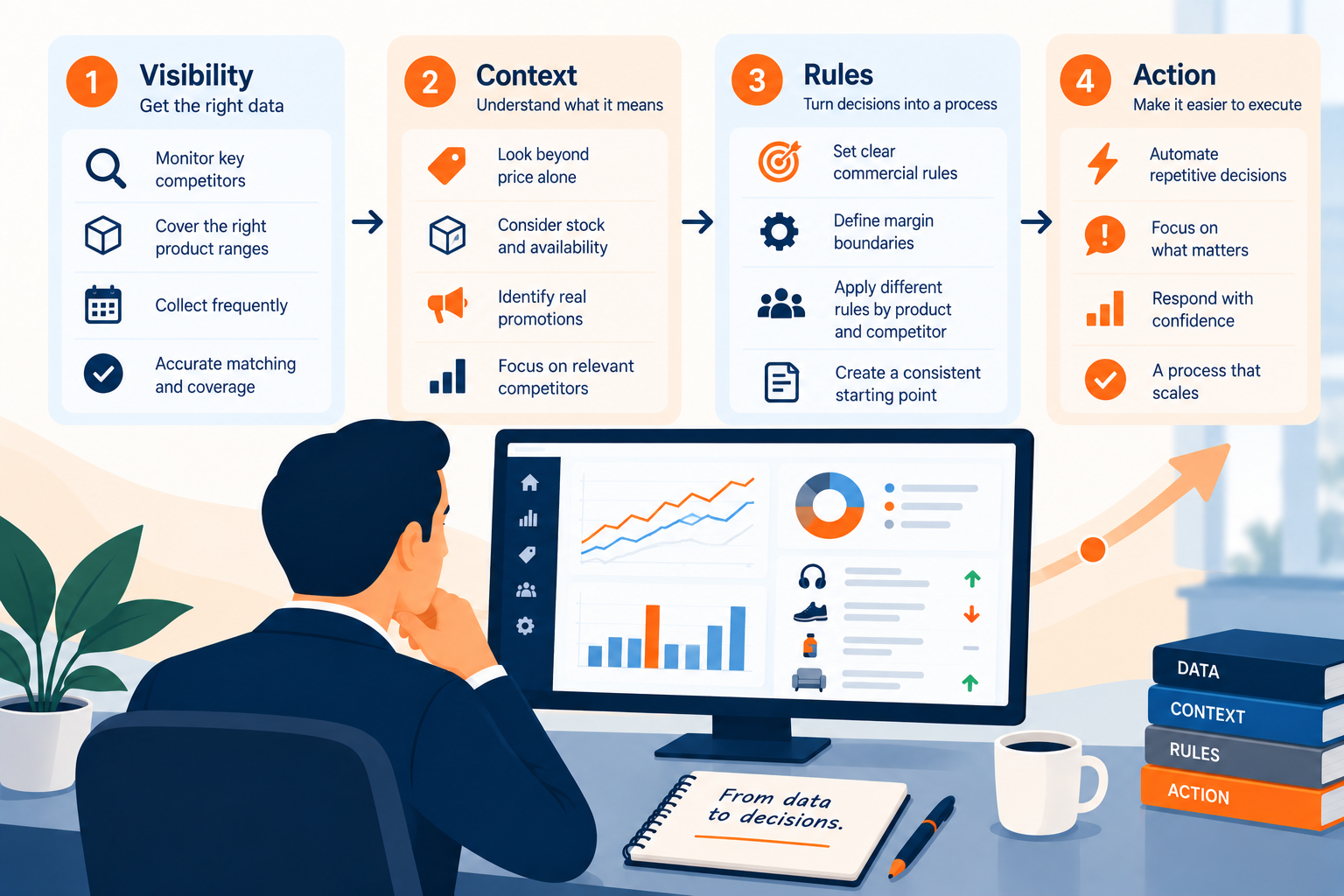
Decision ready pricing intelligence should help category teams understand four things: what has changed, why it matters, where the commercial risk or opportunity sits and what action may be required.
This does not mean that every pricing decision should be automated or that a system should prescribe every response.
Category management still requires experience, judgement and an understanding of the wider commercial picture. What should change is the amount of unnecessary interpretation required before that judgement can be applied.
A category manager should be able to move more quickly from checking whether the information is correct to understanding the commercial issue it represents.
That is the point at which pricing information begins to support decisions rather than simply describing the market.
Pricing Intelligence Needs to Fit the Way Decisions Are Made
Even accurate pricing information has limited value when it sits outside the commercial decision process.
A detailed report may provide excellent insight, but if it arrives after the trading meeting, reaches the wrong people or is disconnected from category priorities, its impact can be limited.
Pricing intelligence therefore needs to fit the existing commercial workflow. It should be available at the moments when category managers decide where to act, where margin needs protecting and where the business can confidently hold its position.
It also needs to be understood by the other teams involved in those decisions.
The more embedded pricing intelligence becomes within everyday commercial processes, the less likely it is to be treated as another report that needs reviewing.
Instead, it becomes part of how the category is managed.
Decision Confidence Is a Better Measure of Value
The value of pricing intelligence should not be measured solely by the volume of information a retailer collects.
A better measure is the confidence it creates around commercial decisions.
Can a category manager explain why a competitor movement matters? Can they identify which products deserve attention first? Can they distinguish a temporary promotion from a meaningful change in market position?
Can they decide whether action is required without spending hours validating the information? Can they confidently explain why holding price is the stronger commercial choice?
These questions provide a much clearer indication of whether pricing intelligence is supporting the category team effectively.
The goal is not simply to make more information available. It is to give teams greater clarity about what needs to happen next.
Final Thought
Category managers already have a huge amount of information available to them. The challenge is turning that information into clear commercial priorities.
Competitor prices, promotions, stock availability, margin and sales performance all matter, but they become much more valuable when they are trusted, understood and connected to the decision being made.
The strongest category teams are not necessarily those reviewing the largest amount of data. They are the teams that can quickly understand what has changed, why it matters and where action is required.
That is the shift from price monitoring to decision ready pricing intelligence.
For retailers looking to understand how well their current pricing intelligence supports that process, the Retail Pricing Intelligence Maturity Assessment provides a useful starting point. It takes around five minutes and provides a personalised view of the current maturity stage, what that means in practice and the areas that may deserve greater focus.
Before improving the amount of pricing information available, it is worth asking a more important question: does the information you already have make the next decision clearer?

How Mature Is Your Pricing Intelligence?
Take our 5-minute assessment to see how trusted, usable and embedded your pricing intelligence is today. You’ll receive a personalised summary with your maturity stage, key focus areas and practical next steps.