Retail pricing teams have never had more information to respond to.
Competitor prices change throughout the day. Promotions begin and end. Stock positions move. Reports highlight new risks, while trading meetings create a constant demand for answers.
As a result, pricing teams are almost always doing something.
Prices are reviewed. Promotions are discussed. Competitor changes are circulated. Another meeting is arranged to decide what should happen next.
The business appears responsive.
But responsiveness and progress are not always the same thing.
A pricing team can make dozens of decisions in a week without becoming more competitive, protecting more margin or gaining greater confidence in its strategy.
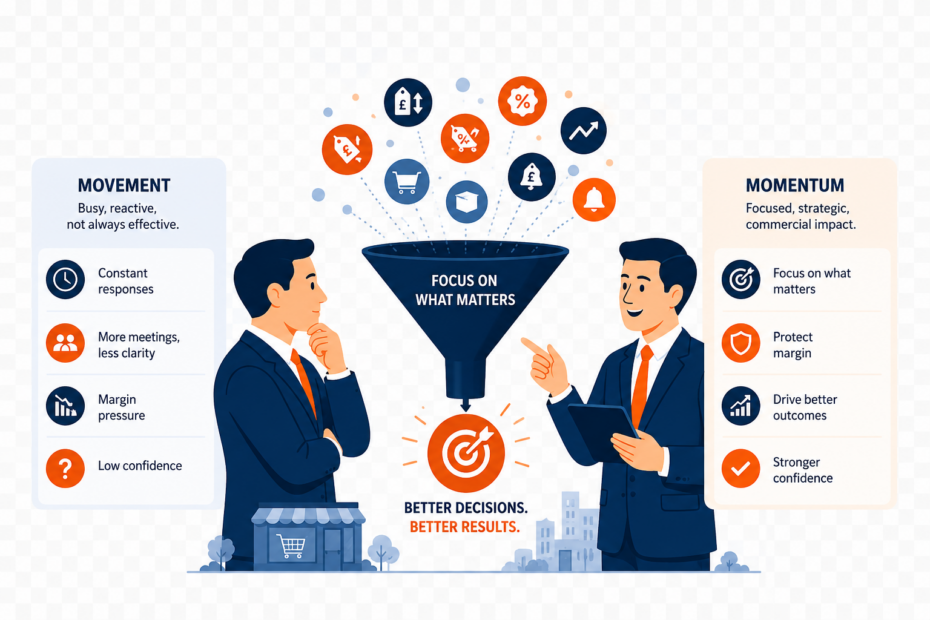
This is the difference between movement and momentum.
Movement describes activity.
Momentum describes purposeful action that improves the commercial outcome.
Why Pricing Activity Feels Productive
Most unnecessary pricing activity begins for understandable reasons.
Retail teams operate under constant pressure. Sales targets need to be achieved. Competitor movements attract attention. Leadership teams want quick explanations when performance changes.
Doing something creates a sense of control.
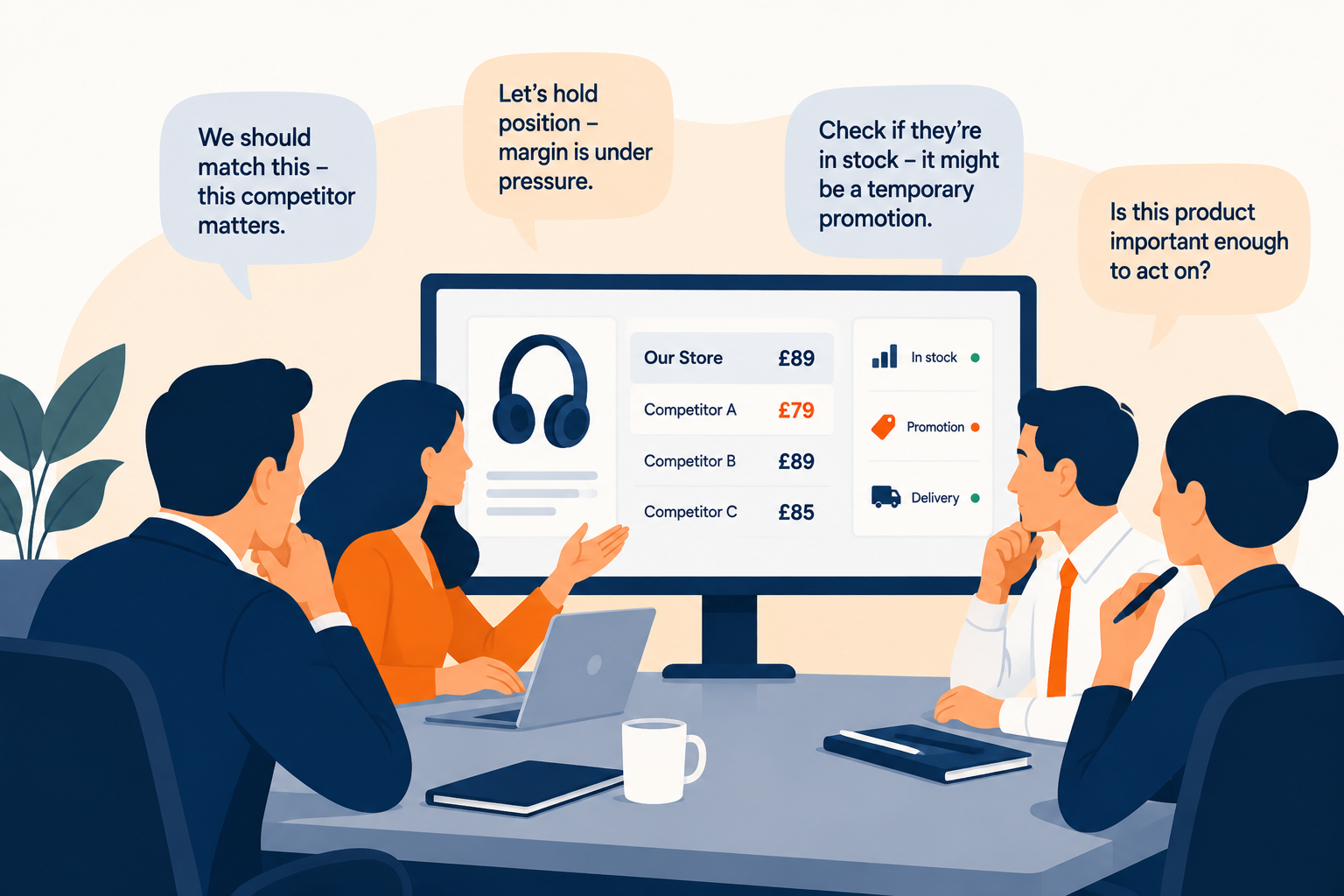
A competitor lowers its price, so the team reviews its own position. Conversion falls, so another promotional option is discussed. A report highlights a potential issue, so a new action is added to the trading agenda.
Each response may appear sensible when viewed in isolation.
The problem begins when those actions are not connected to clear commercial priorities.
The team becomes highly effective at responding to events, but less effective at deciding which events genuinely matter.
More Information Can Create More Movement
Pricing teams now have access to an enormous volume of market information.
Competitor prices can be monitored more frequently. Promotions are easier to track. Stock availability is more visible. Performance reports can highlight new opportunities and risks within hours.
That visibility can create significant value, but only when teams can interpret it confidently.
Without clear processes, more information simply creates more reasons to act.
Every competitor movement can become a potential risk. Every price difference can require an explanation. Every alert can appear urgent.
The result is a pricing function that spends much of its time investigating changes without being certain which ones could materially affect performance.
The challenge is not simply gaining access to data.
It is having a consistent method for deciding what deserves attention.
When Every Signal Appears Important
One of the clearest signs of movement without momentum is the inability to prioritise market signals.
A temporary competitor promotion may receive the same attention as a permanent price reduction.
A marketplace seller with limited stock may trigger the same internal response as a major competitor changing position across an entire category.
A price movement on a low visibility product can create as much discussion as a change on an important Key Value Item.
When every signal appears important, teams lose the ability to focus.
Decision volume increases while decision quality often declines.
The team remains active, but its attention becomes fragmented across issues with very different levels of commercial importance.
The Commercial Cost of Unnecessary Activity
Unnecessary pricing activity carries a commercial cost.
Every price review consumes time.
Every additional meeting delays another decision.
Every unnecessary price reduction creates potential margin loss.
Every reactive promotion can influence customer expectations and future demand.
There is also a less visible cost.
When teams repeatedly respond to movements that have little commercial impact, confidence begins to fall. People become less certain about which reports matter, which alerts deserve attention and whether the pricing strategy is guiding decisions at all.
Over time, activity becomes the process.
The business continues moving because stopping long enough to question that process feels risky.
Momentum Starts With Better Questions
Strong pricing teams do not ignore market activity.
They interpret it.
Before acting, they consider whether a movement is commercially significant.
They assess whether customers are likely to notice it, whether the competitor is relevant, whether the product influences value perception and whether responding would improve the outcome.
They also consider the wider context.
A lower competitor price means something very different when the product is out of stock, part of a short term promotion or being cleared from the range.
The same is true when the movement comes from a marketplace seller with limited availability or from a competitor that customers rarely compare.
This context helps teams distinguish genuine market signals from background noise.
The objective is not to delay decisions.
It is to ensure that speed is applied to the right decisions.
Strong Pricing Processes Create Focus
Pricing momentum depends on more than individual judgement.
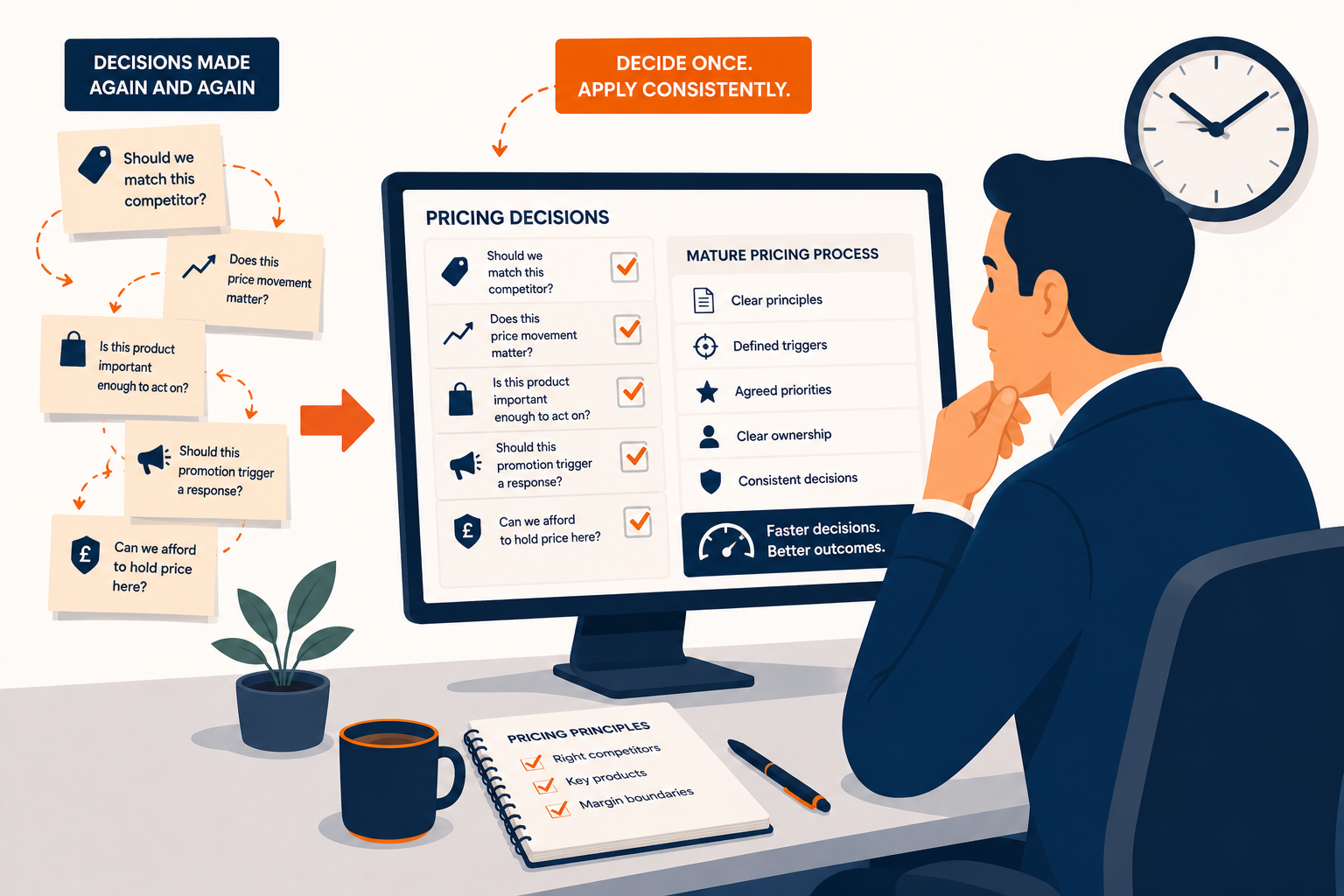
It requires a process that helps teams make consistent decisions.
That includes trusted information, clearly defined product priorities, relevant competitor coverage and agreed rules around when action is required.
Ownership also needs to be clear.
Teams should understand who reviews a movement, who decides the response and which situations require escalation.
Without that structure, the same issue can move between pricing, ecommerce, category and commercial teams without anyone being certain who should act.
Activity increases because the process lacks clarity.
A mature pricing process reduces that friction.
It gives teams a shared understanding of what matters, who is responsible and what should happen next.
The Strongest Pricing Teams Know What to Ignore
There is often a belief that successful pricing teams respond faster than everyone else.
In reality, the strongest teams are selective.
They respond quickly when a movement presents a genuine risk or opportunity.
They monitor situations where the commercial impact remains uncertain.
They ignore changes that are unlikely to affect customer behaviour or business performance.
This ability to ignore noise is not complacency.
It is a sign of confidence.
It allows the team to protect its time, maintain focus and avoid pricing decisions that create activity without creating value.
From Reactive Movement to Commercial Momentum
Momentum begins when pricing actions are connected to clear objectives.
A price is changed because the movement affects customer perception or competitive position.
A promotion is launched because it supports a defined trading goal.
A competitor signal is escalated because it represents a genuine commercial risk.
A price is held because the available context shows that reacting would damage margin without improving demand.
These decisions may not always create more visible activity.
They create something more valuable.
They create consistency, confidence and progress.
Why This Matters for Pricing Maturity
Pricing maturity is often associated with technology, automation or the amount of data available.
Those capabilities can support maturity, but they do not create it on their own.
Maturity becomes visible in how a business uses information.
Can teams agree which movements matter?
Can they make decisions without repeated internal debate?
Do they know which products deserve the greatest attention?
Can they explain why a price has changed or why it has been held?
Are pricing actions aligned with wider commercial objectives?
These questions reveal far more about pricing maturity than the number of reports being produced or the volume of competitor data being collected.
A mature pricing process does not simply make more information available.
It helps the business decide what that information means and what action should follow.
Better Pricing Is Not About Responding to Everything
Retail pricing will continue to become faster and more visible.
Teams will receive more competitor information, more alerts and more pressure to respond.
The answer cannot simply be to increase the amount of activity.
Retailers need the confidence to distinguish meaningful changes from temporary noise.
They need clear processes that help teams understand what matters, why it matters and who should act.
They also need the discipline to hold position when the evidence does not support a change.
That is the point at which pricing activity begins to create genuine commercial momentum.
Final Thought
A busy pricing team can appear productive.
But the number of reports reviewed, meetings held or prices changed tells you very little about whether the business is making better decisions.
Movement is easy to create.
Momentum requires clarity, context and purpose.
The strongest retailers are not those that respond to every market movement.
They are the ones that know which movements deserve attention, which require action and which can safely be ignored.
Because pricing performance is not improved by doing more.
It is improved by making the actions that matter count.