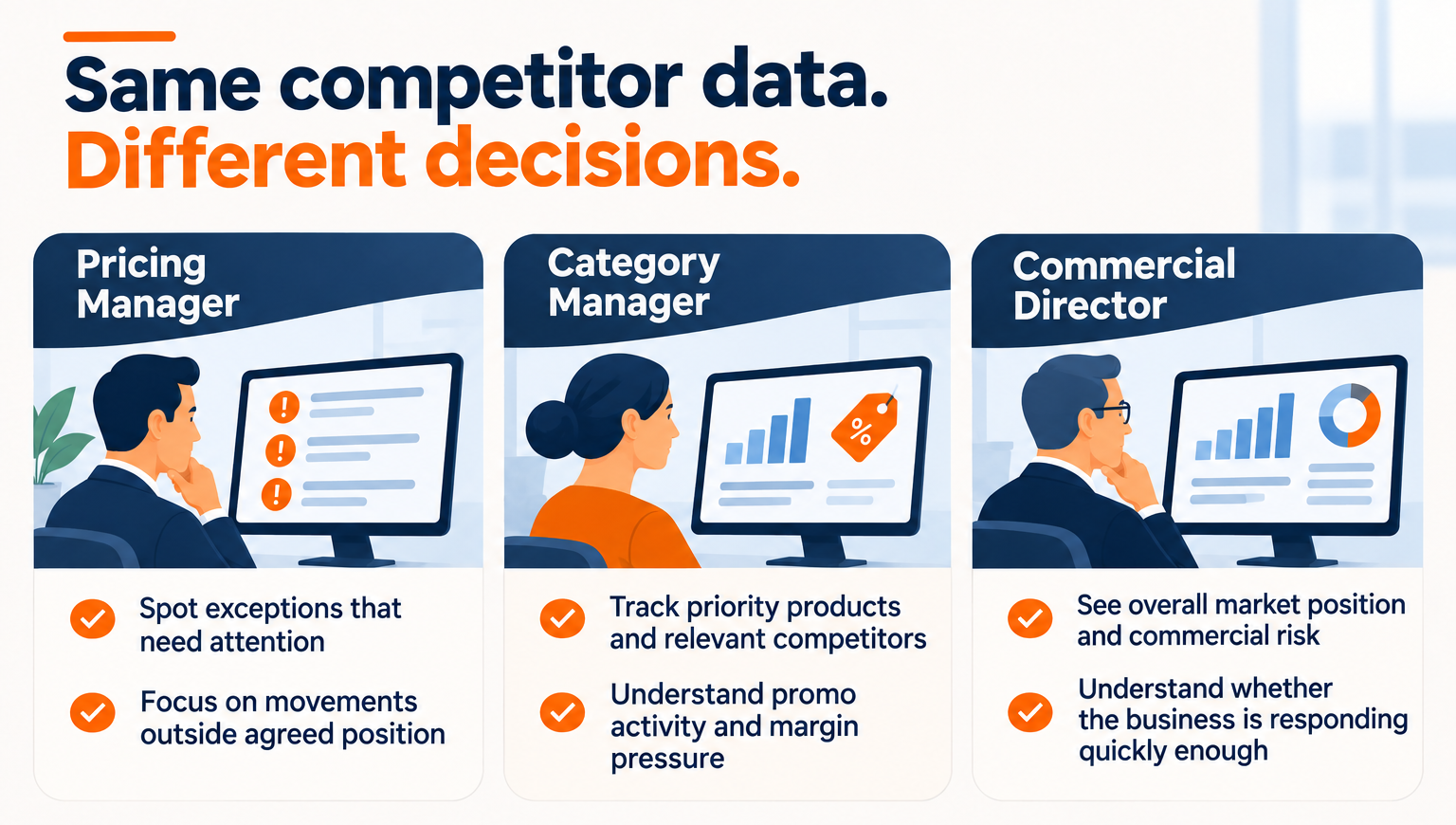
Pricing teams do not always need more competitor data. Sometimes the bigger improvement comes from reducing how much of that data demands attention.
A customer can have strong coverage, reliable matching and a steady flow of competitor movements, but still find the process difficult to manage. If every price change appears important, every alert feels worth checking and every movement needs interpretation, the team can spend a large part of the day deciding what can safely be ignored.
That was the situation in this case. The customer was already receiving a large volume of competitor activity across a broad range. The issue was not visibility. The problem was that too much work still happened after the data arrived.
The opportunity was therefore not to collect more information. It was to narrow the field and make it easier to see which movements genuinely deserved a decision.
Product Priority Was the First Filter
The first place to look was the product range itself.
Not every product deserved the same level of attention. Some lines were commercially important, highly visible or closely linked to customer price perception. Others carried more margin or sat within strategically important categories. There were also plenty of products where competitor movements were worth recording but unlikely to justify an immediate response.
Once the range was segmented more clearly, the picture began to change. Competitors were still moving prices across the catalogue, but a much smaller proportion of those movements were taking place on products that genuinely mattered to the team at that moment.
That was the first reduction in noise. The market had not become quieter. The team had simply become clearer about where its attention was most valuable.
Competitor Relevance Narrowed the Picture Further
The next layer was competitor relevance.
The customer already had a sensible competitor set, but not every competitor carried the same commercial weight across every category or product.
One retailer might be particularly influential in one category and largely irrelevant in another. A marketplace seller could appear aggressive on price but have little impact on the products that mattered most. Another competitor might only need close attention on a relatively small group of high visibility lines.
Once those differences were reflected in the way movements were prioritised, the number of signals requiring attention reduced again.
The same market activity was still there. The difference was that the team no longer had to treat every competitor movement as equally important.
Stock Changed the Meaning of Some Price Moves
Availability provided another important filter.
A competitor may suddenly appear cheaper on a priority product, which can look like an obvious reason to review price. Once stock is taken into account, however, the situation can look very different.
If that competitor is out of stock, has limited availability or cannot fulfil in the same way, the commercial pressure to respond may be much lower than the headline price suggests.
Without that context, the team could spend time reviewing a movement that does not represent a meaningful competitive threat. In some cases, reacting too quickly could mean reducing price and giving away margin when the lower competitor offer was not genuinely available to customers.
Adding stock context helped separate real competitive pressure from price movements that only appeared urgent at first glance.
Promotions Needed to Be Treated Differently
Promotional activity created another source of noise.
A temporary price reduction can look exactly the same as a permanent move if the team only sees the new price. Commercially, the two situations are very different.
The customer was seeing movements that appeared significant in the moment but were actually short term promotions. Once temporary promotional activity could be distinguished from more structural price changes, the decision became easier.
Some movements still needed action. Others simply needed monitoring until the promotion ended.
The aim was not to hide activity from the team. It was to help them understand what kind of activity they were looking at before deciding whether it deserved a response.
Thresholds Helped Focus the Final View
The final step was deciding how large or important a movement needed to be before it reached the top of the team’s list.
A small movement on a lower priority line may not justify the same attention as a significant move on a KVI. The same applies where a competitor changes price but the retailer remains comfortably within its intended market position.
By refining thresholds around the products and competitors that mattered most, the customer was able to reduce the number of movements that required immediate review.
At that point, the process looked very different from where it had started.
There were still hundreds of competitor movements happening in the background. The difference was that the team no longer had to treat hundreds of them as decisions.
The Biggest Improvement Was Not More Data
This is the part I think matters most.
Nothing dramatic happened to the amount of market activity. Competitors were still changing prices, promotions were still launching and stock positions were still moving.
What changed was how much of that activity reached the team as something that required thought.
The question moved from “What changed?” to “What changed that matters?”
That is a much more useful starting point for a pricing team.
Attention Is a Commercial Resource
Pricing teams only have so much time in the day.
If that time is spent checking low priority products, movements from marginal competitors, unavailable offers or short term promotions, there is less capacity left for the decisions that can genuinely affect margin, competitiveness and trading performance.
That is where the value of prioritisation becomes much clearer.
The objective is not to create a smaller dataset. The objective is to create a smaller decision set.
The business can continue monitoring the wider market while making sure human attention is concentrated on the signals where judgement is most valuable.
From Hundreds of Movements to the Few That Deserved Action
By the end of the process, the customer was not necessarily seeing less of the market. They were seeing it in a way that was much easier to use.
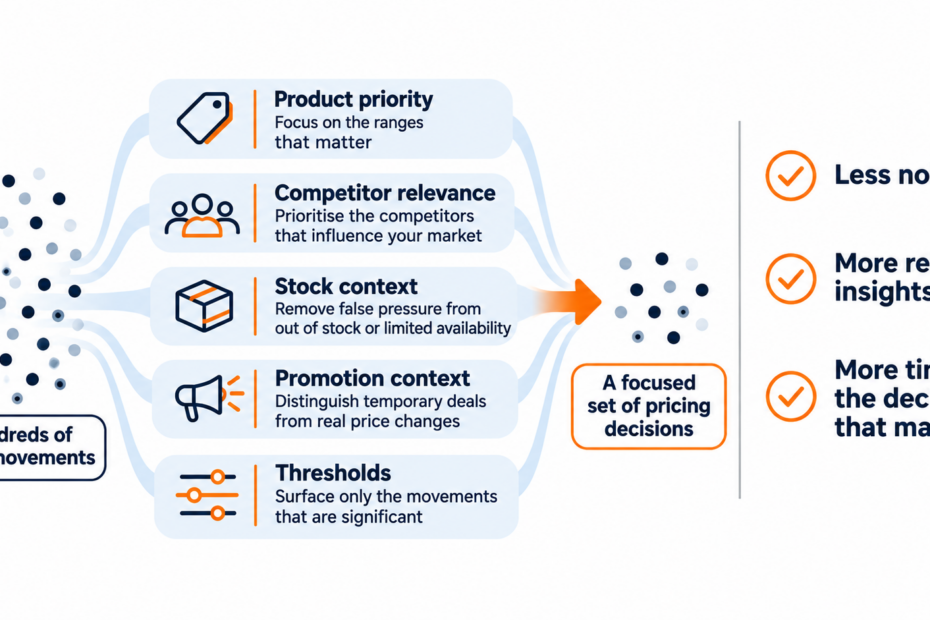
Product priority helped separate important products from lower value activity. Competitor relevance reduced the weight given to signals that were unlikely to influence the decision. Stock information removed false pressure from unavailable offers. Promotion context helped distinguish temporary activity from more meaningful changes, while thresholds surfaced movements that were significant enough to deserve attention.
What started as hundreds of market movements became a much smaller group of genuine pricing decisions.
That is where price intelligence becomes much more useful. The value is not simply in showing everything that is happening. It is in helping the team understand what deserves attention first.
In my experience, some of the biggest improvements come when teams stop measuring success by how much competitor activity they can see and start looking at how effectively that activity is reduced into the decisions that actually matter.