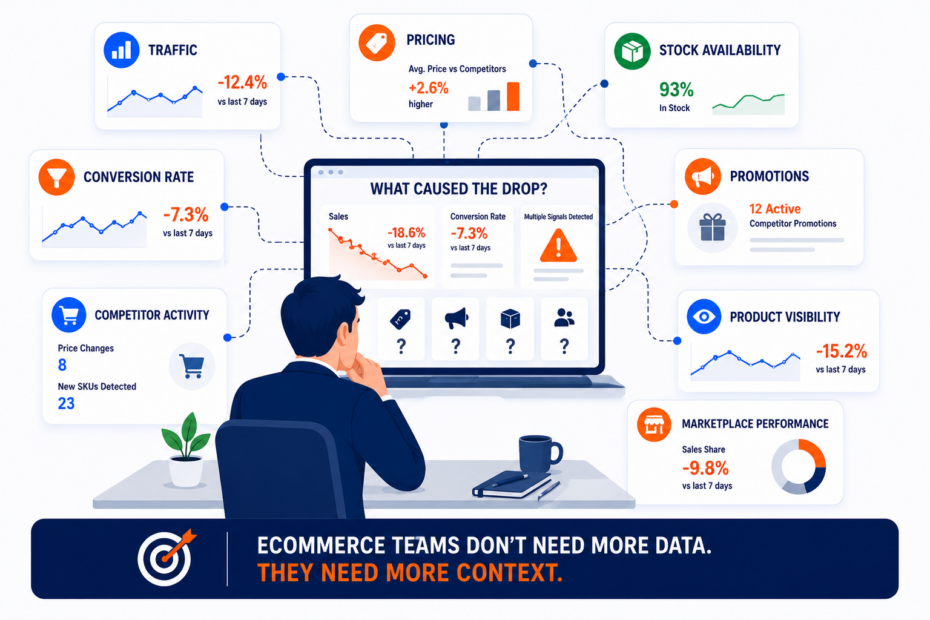
Ecommerce teams have never had more data available to them. Traffic data sits in one platform, conversion metrics in another, product performance is monitored through analytics tools, pricing is tracked separately, and stock information often comes from entirely different systems. Competitor activity can require another set of reports again.
On paper, this level of visibility should make decision-making easier. Teams have access to more information than ever before and can monitor performance in near real time.
In reality, many ecommerce professionals would argue the opposite.
When online performance shifts, the first challenge is rarely deciding what to do. It is understanding what happened. Before any action can be taken, teams often need to work through a long list of possibilities. Was the issue caused by pricing? Did traffic decline? Was stock availability affected? Did a competitor launch a promotion? Has product visibility changed? Is there a content issue impacting conversion?
Only once these questions have been answered can the conversation move towards action. The problem is that by the time the diagnosis is complete, the market may already have changed again.
More Data Hasn’t Necessarily Made Decisions Easier
Most ecommerce teams are not struggling because they lack information. If anything, they have the opposite problem.
The volume of data available today is unprecedented. Teams can monitor customer behaviour, conversion performance, pricing movements, stock levels, and competitive activity in more detail than ever before. Yet having access to information does not automatically make decision-making easier.
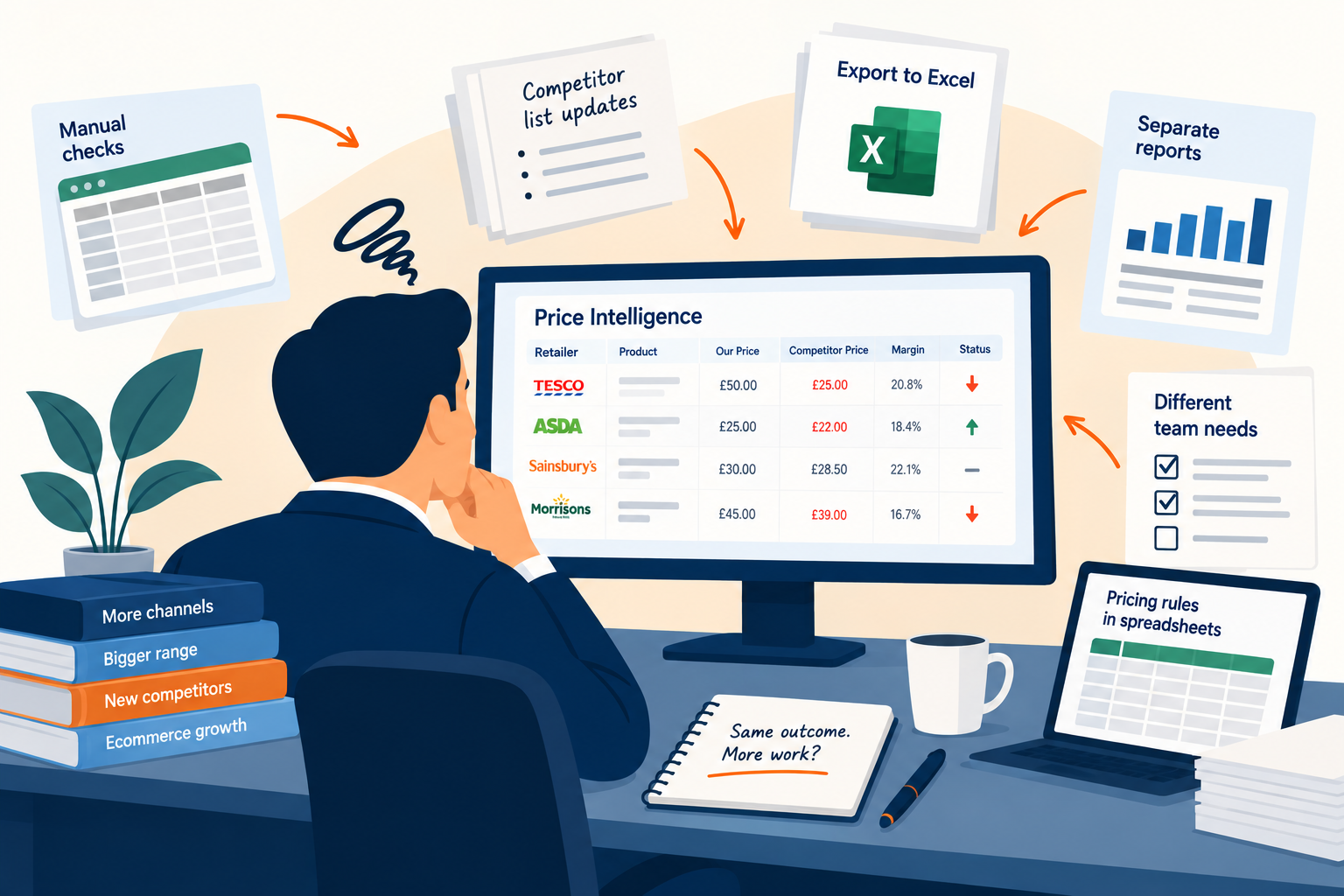
The challenge is that the information needed to explain performance is often fragmented across multiple systems, reports, and teams. Understanding a drop in conversion, for example, may require input from analytics platforms, stock systems, pricing reports, competitor monitoring tools, paid media platforms, and category teams before a complete picture emerges.
Each source contributes part of the story, but none provides the full answer. As a result, ecommerce teams spend significant amounts of time connecting signals rather than responding to them.
The Hidden Cost of Diagnostic Work
This pattern is familiar across many ecommerce functions.
Performance shifts. Reports are reviewed. Teams investigate multiple potential causes. Discussions focus on understanding what happened before any decisions can be made about what happens next.
None of this work is unnecessary. Understanding performance is a critical part of managing an ecommerce operation. The problem is the amount of time it consumes.
Every hour spent diagnosing performance is an hour not spent improving it. Over time, this creates a subtle but important challenge. Teams become highly effective at explaining results after they happen but slower at influencing outcomes while they are still changing.
That distinction matters because ecommerce operates in a fast-moving environment. Customers do not wait for internal investigations to finish and competitors do not pause their activity while teams build context around performance shifts.
The Signals Behind Performance Rarely Exist in One Place
One of the biggest reasons ecommerce teams become trapped in diagnostic mode is that performance changes are rarely driven by a single factor.
A decline in sales could be linked to pricing, but it could just as easily be connected to competitor promotions, stock availability, reduced product visibility, marketplace activity, paid media performance, or changes in customer demand. In many cases, several of these factors are happening simultaneously.
The challenge is that these signals are often reviewed independently. Internal performance data tells one story. Competitor pricing tells another. Stock data sits elsewhere. Promotional activity may be managed through a separate process entirely.
When these signals remain disconnected, teams are forced to build context manually. The investigation itself becomes part of the workflow, and decision-making slows as a result.
Why Competitor Activity Is Often Identified Too Late
This challenge becomes particularly visible when competitor activity is involved.
Many ecommerce teams monitor competitor pricing, but fewer have a complete view of competitor promotions, stock availability, product visibility, and wider market activity at the same time. This creates blind spots that can make performance changes difficult to interpret.
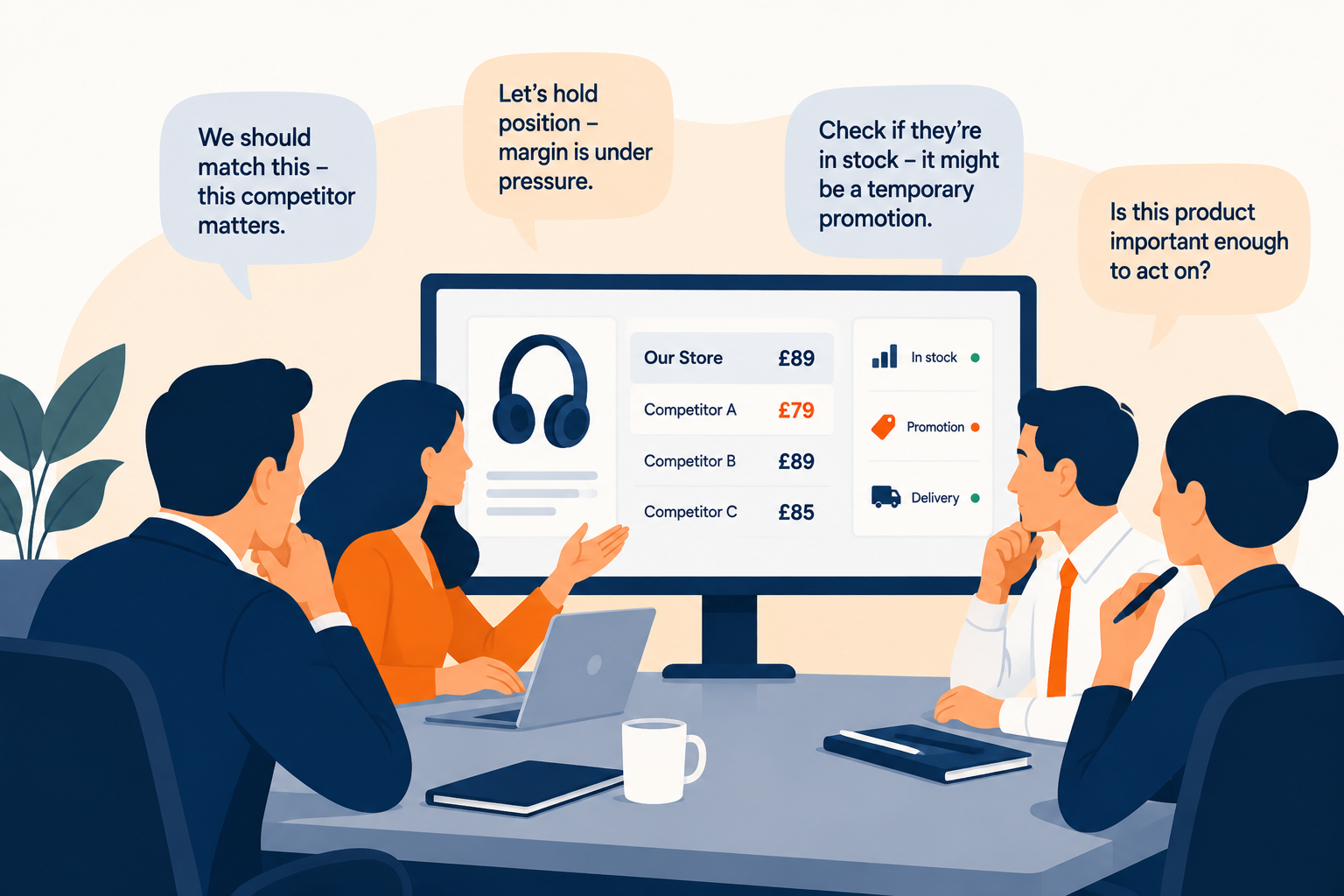
A competitor may not have lowered their prices at all. Instead, they may have launched a more attractive promotion. A conversion decline may have little to do with price competitiveness and more to do with improved product visibility elsewhere. Equally, a competitor’s lower price may be far less significant if they are struggling with stock availability.
Without this broader context, teams can easily spend time reacting to the wrong signals or investigating issues that are commercially irrelevant. Valuable time is lost simply trying to identify what matters.
Why Ecommerce Teams Need More Context, Not More Dashboards
When faced with these challenges, many organisations respond by adding more reporting. Another dashboard is created. Another report is circulated. Another source of data is introduced.
Unfortunately, this rarely solves the underlying problem.
More information does not necessarily create more clarity. In many cases, it increases the amount of analysis required before a decision can be made.
The issue is not visibility alone. It is context.
Ecommerce teams do not need endless reports explaining what changed. They need decision-ready information that helps them understand why something changed, whether action is required, and what the commercial implications might be.
That difference is significant. One approach creates more analysis. The other supports action.
What Better Looks Like
The strongest ecommerce teams are not necessarily the teams with the most data. They are often the teams that can connect the right signals quickly and consistently.
When competitor pricing, promotional activity, stock availability, price position, and internal performance metrics are viewed together, something important happens. The time spent diagnosing performance decreases and the confidence to act increases.
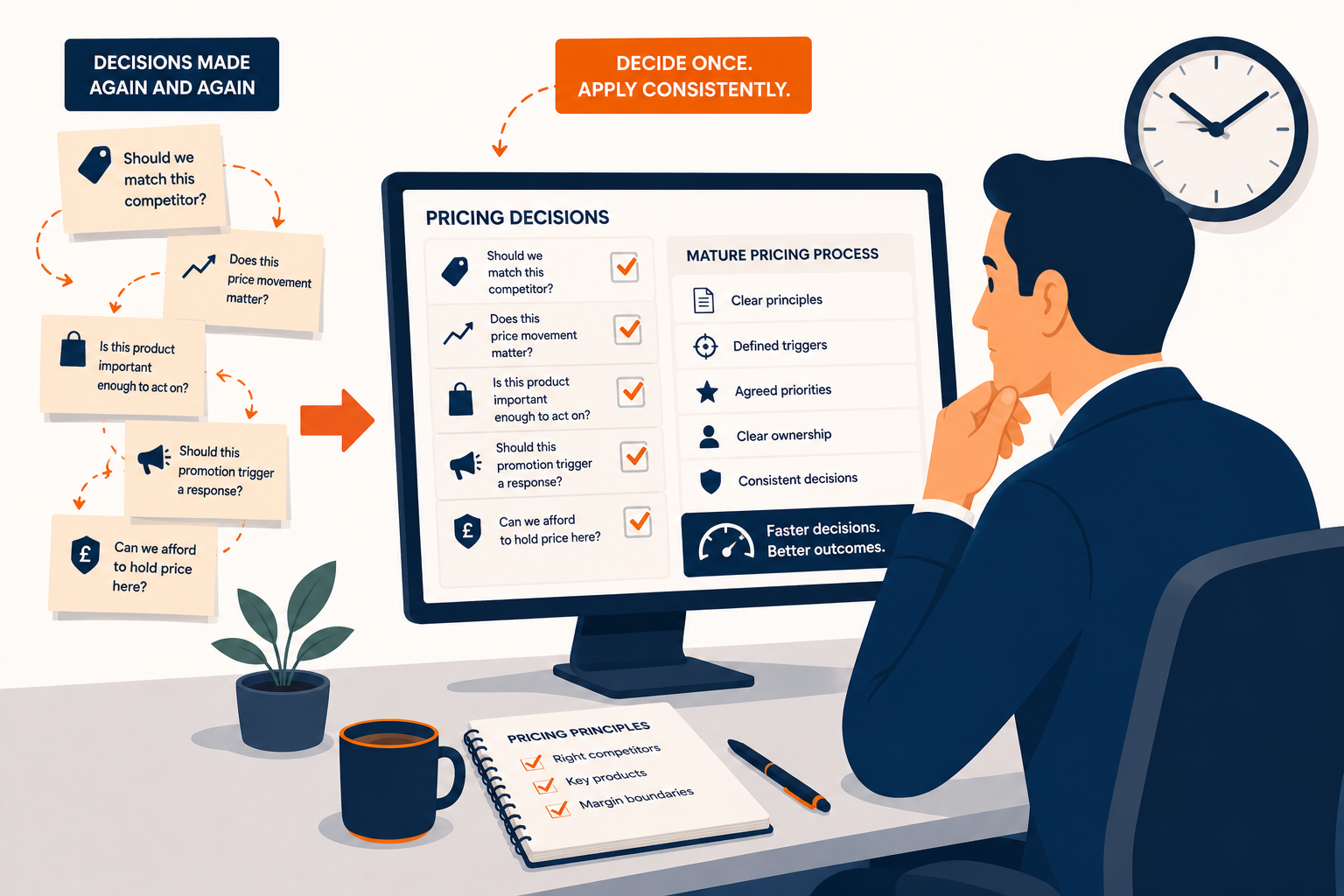
Instead of chasing information across multiple systems or waiting for input from different teams, ecommerce professionals can focus on identifying risks and opportunities earlier. Discussions become more commercial and less investigative. Decisions become clearer because the context is already visible.
At that point, data stops being something that requires constant interpretation and becomes something that actively supports decision-making.
The Real Goal Is Faster Commercial Decisions
Ecommerce performance is not improved by reporting. It is improved by decisions.
The faster teams can move from signal to understanding, the faster they can move from understanding to action. That capability is becoming increasingly important as online retail becomes more competitive, more transparent, and more dynamic.
Competitors can change prices instantly. Promotions can launch overnight. Customer behaviour can shift within hours. In that environment, the ability to diagnose performance quickly becomes a competitive advantage.
But the ability to act quickly becomes an even bigger one.
A Better Question for Ecommerce Teams
Many ecommerce teams still ask whether they have enough data, enough reporting, or enough visibility.
Those questions still matter. However, they are no longer the most important ones.
A better question is this:
How much time does the team spend investigating performance versus improving it?
Most ecommerce professionals already know the process when performance changes. Reports are opened, data is reviewed, different teams are contacted, competitor activity is checked, and stock levels are investigated. Only then can decisions begin.
The challenge is that ecommerce moves quickly. Customers do not wait for investigations to finish and competitors do not pause their activity while teams build context.
The ecommerce teams that operate most effectively are rarely the ones with the most dashboards. They are the ones that can connect the right signals, understand what matters, and move confidently from insight to action.
Because ultimately, ecommerce performance is not improved by understanding what happened yesterday.
It is improved by acting on what needs to happen next.