Most pricing rules do not start life as rules. They usually start with the same commercial decision being made manually, again and again.
A competitor moves. Someone checks the product, looks at stock, checks whether the price change is promotional, reviews the current market position and decides whether to react. A few days later, the same situation appears again and the team goes through much the same process.
Eventually, the question changes.
Instead of asking, “What should we do this time?”, the more useful question becomes, “Do we already know how we want to handle this?”
That is usually where a pricing rule begins.
It Usually Starts With Repeated Judgement
Take a simple example. A key competitor reduces the price of an important product.
The first time it happens, the team needs to look at the wider context. Is the competitor in stock? Is the price move temporary? How significant is the gap? Is the retailer still within the position it is comfortable holding? What would matching the competitor do to margin?
The team considers those factors and makes a decision. Perhaps the conclusion is that the business will only react when the competitor is in stock, the movement is not part of a short promotion and the new price takes the product outside an agreed market position.
At this stage, the decision is still based on judgement. But if the same logic keeps appearing every time a similar situation occurs, something important has changed.
The business is no longer solving a completely new problem. It is repeating an answer it already understands.
The Pattern Matters More Than the Individual Movement
Repeated patterns are often the clearest sign that a pricing rule could be useful.
A team may notice that it consistently gives less weight to competitors that are out of stock. It may regularly decide not to respond to short term promotions. It may hold price whenever the current position remains comfortably within an agreed range. It may also respond much more quickly when a particular competitor moves on a small group of priority products.
None of these examples necessarily started as formal rules. They began as commercial judgement.
The rule comes later, once the team has enough confidence that the same logic should apply consistently in similar situations.
That is an important distinction because the strongest rules are usually discovered within the pricing process itself rather than invented separately from it.
Rules Should Reflect Commercial Intent
Pricing rules are sometimes treated as though they are simply technical instructions.
A useful rule should represent a commercial decision the business has already made.
For example, a retailer may decide that if a key competitor moves below its price on a priority KVI, is in stock and exceeds an agreed price gap, the product should be reviewed. It may decide that short term promotional prices should not trigger an automatic response, or that out of stock competitors should carry less weight in the decision.
The same principle can apply when the business is still within its intended market position. In that situation, the agreed action may simply be to hold rather than react.
The value comes from the fact that the commercial thinking has already happened. Technology is not deciding what the strategy should be. It is helping the team apply that strategy more consistently.
Consistency Is Often the First Benefit
Before a rule is established, the same situation can produce different responses depending on who is looking at it.
One person may react immediately. Another may decide to hold. Someone else may spend time checking exactly the same factors that have already been considered dozens of times in the past.
A rule gives the team a clearer starting point. It does not necessarily remove judgement, but it reduces how often people need to rebuild familiar decisions from scratch.
This becomes increasingly valuable as the pricing operation grows.
A process that works well when one experienced person is making decisions can become much harder to manage when several people are making similar calls across thousands of products and multiple competitors. Clear rules help preserve the underlying commercial logic as more people become involved.
Not Every Pricing Decision Should Become a Rule
There is an equally important point on the other side of this.
Just because a decision has happened more than once does not mean it should automatically be formalised.
Some pricing situations remain highly dependent on context. A strategically important competitor entering a new category may need a closer look. A major promotional event may require different thinking from normal trading. Supply disruption may suddenly change the market. A particularly visible product may carry wider customer perception implications that make a standard response inappropriate.
Human judgement still matters.
The objective should be to separate predictable decisions from genuine exceptions, rather than trying to turn every possible pricing scenario into a rule.
In a strong process, rules handle the situations the business already understands well and people remain focused on the areas where interpretation and commercial judgement add the most value.
Good Rules Usually Need More Than One Condition
Simple logic such as “competitor cheaper, reduce price” is rarely enough.
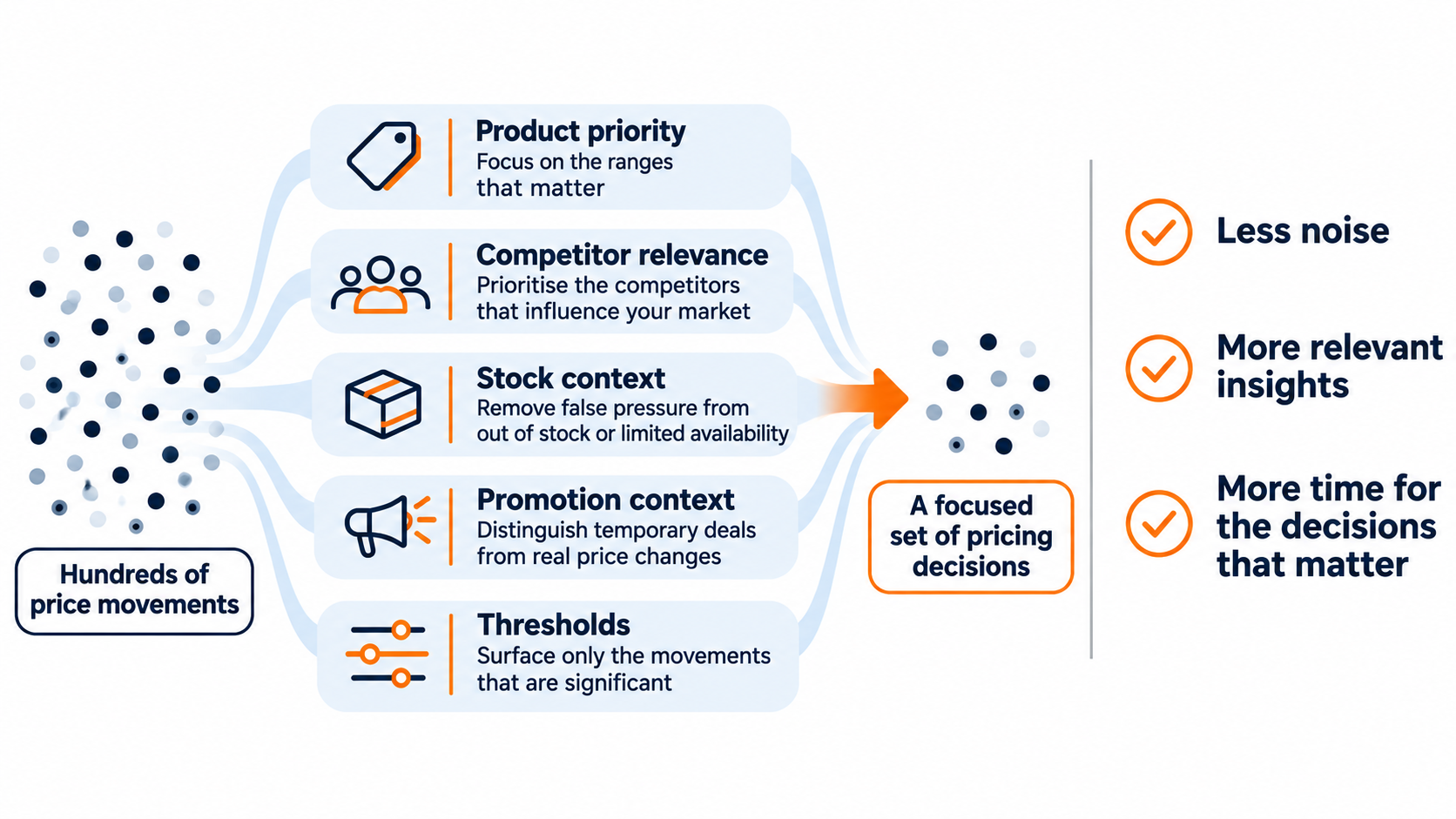
A commercially useful rule normally combines several pieces of context. Competitor relevance matters. Product importance matters. Stock and promotional status matter. Current market position and margin boundaries matter as well.
That means a rule may only become relevant when several conditions are true at the same time.
A key competitor may need to move below the current price on a priority product, be in stock, not be running a temporary promotion and exceed an agreed gap before the movement deserves attention.
That is very different from responding every time a lower competitor price appears.
It also explains why pricing rules tend to become more useful as the business develops a better understanding of how it already makes decisions.
A Rule Does Not Have to Change a Price
There is an important stage between fully manual decision making and automated price changes.
A rule can simply help determine what deserves attention.
It might reduce the priority of movements from less relevant competitors, remove out of stock offers from an operational view, distinguish short term promotions from more structural changes or highlight products that have moved outside an agreed pricing position.
The final commercial decision can still sit with the pricing team.
In these situations, the value of the rule is that it removes some of the repetitive checking that would otherwise happen before a decision is made.
For many retailers, this can be a sensible place to start because it improves prioritisation while keeping people firmly in control of the outcome.
Automation Should Come After the Logic Is Clear
Once a rule has been used consistently and the team is comfortable with its boundaries, some decisions may become suitable for automation.
At that point, the business should already understand which competitors matter, which products require closer attention, where the commercial thresholds sit and what margin boundaries need to be protected. It should also know which exceptions still require human judgement.
Automation then becomes much easier to apply responsibly.
The system is not being asked to invent the pricing strategy. It is executing a decision process that the business has already defined.
That difference matters.
Automation works best when it removes predictable work from the pricing process, rather than replacing the judgement that should still sit with the team.
How Many Pricing Decisions Are You Making Twice?
This is one of the most useful questions a pricing team can ask.
How many decisions are being made today that have effectively been made before?
If the same competitor movement repeatedly triggers the same checks, the same discussion and broadly the same outcome, there may be an opportunity to capture that logic and make it easier to apply next time.
The purpose is not to automate everything.
It is to avoid losing experienced commercial judgement every time a familiar situation comes back around.
A good pricing rule turns a repeated decision into something the wider team can use consistently.
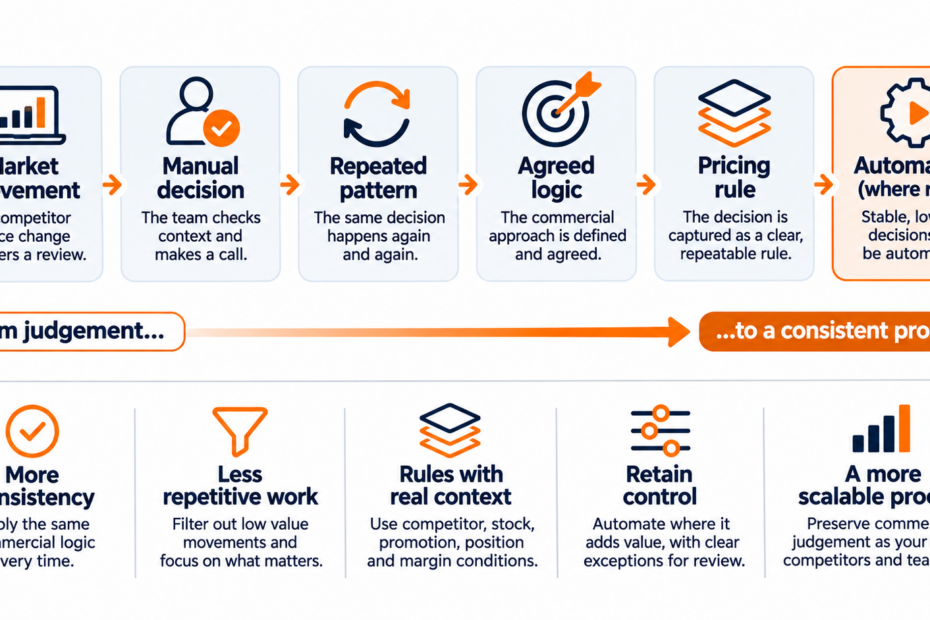
From Judgement to a Repeatable Process
The journey from manual decision making to a useful pricing rule is usually gradual.
It starts with a market movement and an individual decision. Over time, the team recognises a repeated pattern. The commercial logic becomes clearer, the boundaries are agreed and that logic can then be formalised into a rule. The team can focus its attention on the exceptions that still deserve closer consideration.
Each stage earns the next one.
That is why the strongest pricing rules are rarely created in isolation. They emerge from the decisions teams are already making and the experience they build over time.
The opportunity is simply to recognise when the same judgement is being repeated often enough that it no longer needs to be rebuilt from scratch.