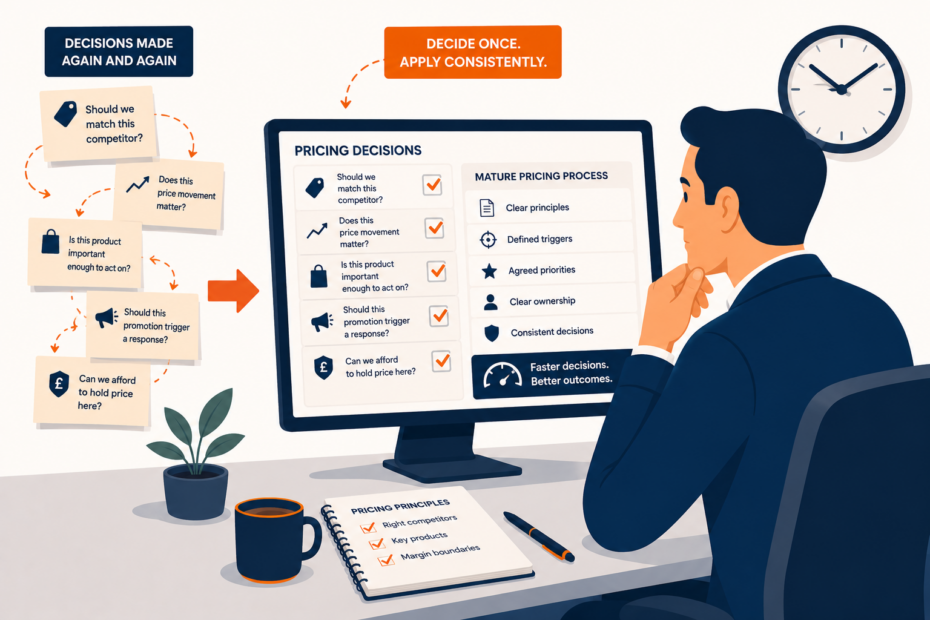
Pricing teams make hundreds of decisions, but many of them are really the same decision appearing in a slightly different form. Should we match this competitor? Does this price movement matter? Is this product important enough to act on? Should this promotion trigger a response? Can we afford to hold price here?
These are completely normal questions. What is less useful is having to debate them from scratch every time they appear. That is where pricing maturity starts to become visible.
A mature pricing process does not remove judgement from the team. It reduces the number of decisions that need to be rediscovered by creating clearer principles around what matters, when action is required and who owns the response.
Repeated Decisions Create Hidden Friction
Retailers often focus on the visible parts of pricing activity. They look at how many competitor prices are being monitored, how quickly prices are updated, how many reports are being produced and how much of the range is under review.
Those measures can be useful, but there is another one that is rarely discussed: how often is the team having the same pricing conversation again?
A competitor drops its price and the team debates whether to match. The following week, another competitor moves and a similar discussion happens again. A Key Value Item changes position and the team considers how important the movement is, only for another product to create almost the same question several days later.
On the surface, these look like different decisions. In practice, the underlying question is often the same: what deserves action and what does not?
When those principles have not been agreed, routine market movements repeatedly consume time and attention that could be spent on genuinely difficult commercial decisions.
The Cost Is More Than Time
Repeated decisions do not simply slow teams down. They can also create inconsistency.
Two category managers may respond differently to the same type of market movement. One team may react immediately to a competitor change while another holds position. A promotion in one category may trigger a response while a similar situation elsewhere is treated differently.
Commercial judgement will always be important, and pricing should never become a completely mechanical process. The problem appears when there are no shared principles guiding that judgement.
Without a consistent starting point, every new pricing movement becomes another fresh debate. More meetings, manual checking and internal discussion follow, while outcomes increasingly depend on who happens to be looking at the data.
Over time, this can make the pricing process difficult to scale because consistency depends more heavily on individuals than on an agreed approach.
Mature Teams Decide Some Things Once
One of the clearest signs of pricing maturity is that teams begin to remove unnecessary decisions from the process.
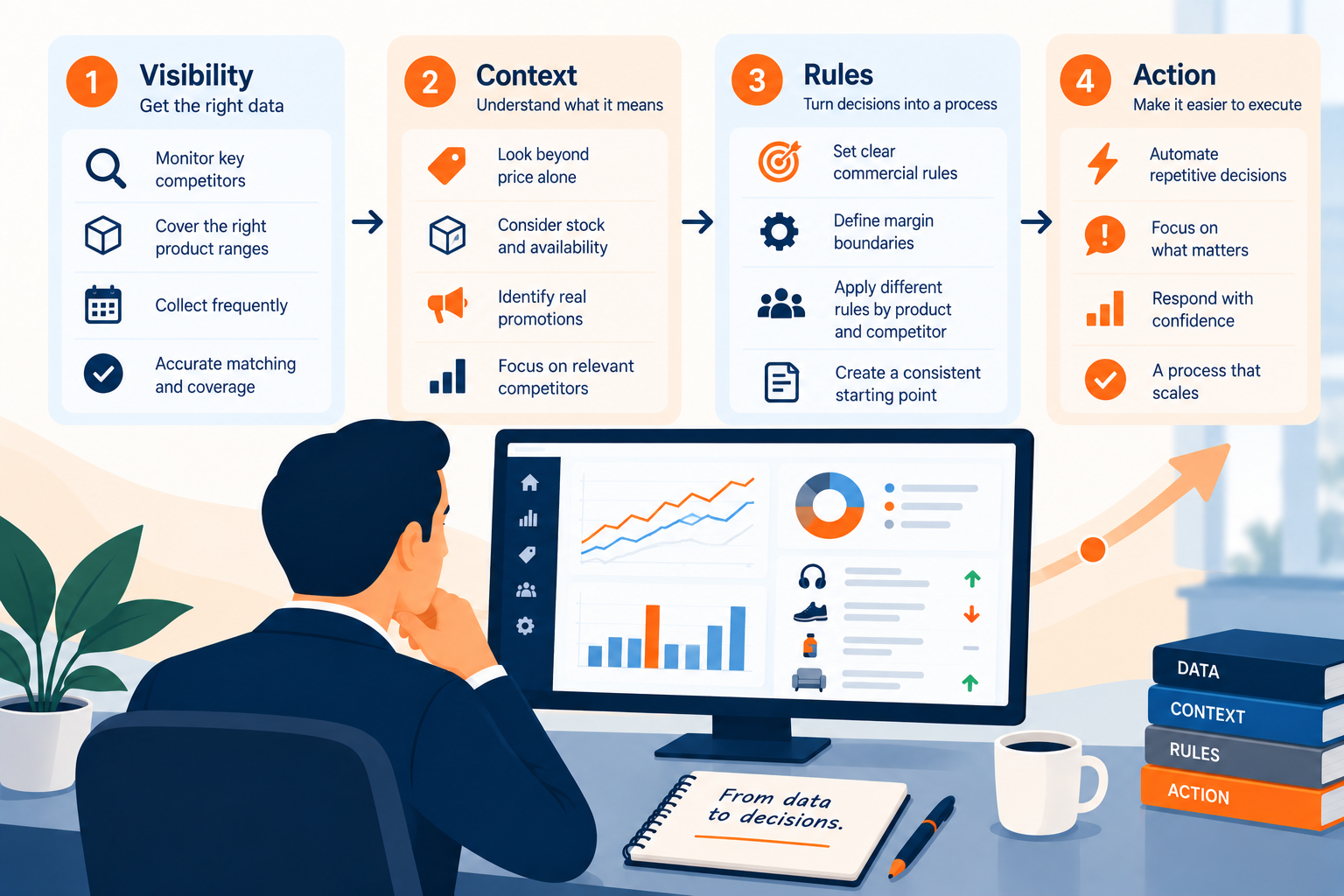
They agree which competitors matter most, define which products deserve the greatest attention and establish when a competitor movement should trigger a review. They also clarify margin boundaries and create clearer principles around promotions, escalation and ownership.
This does not mean every decision becomes automatic. It means the business stops treating predictable situations as completely new problems.
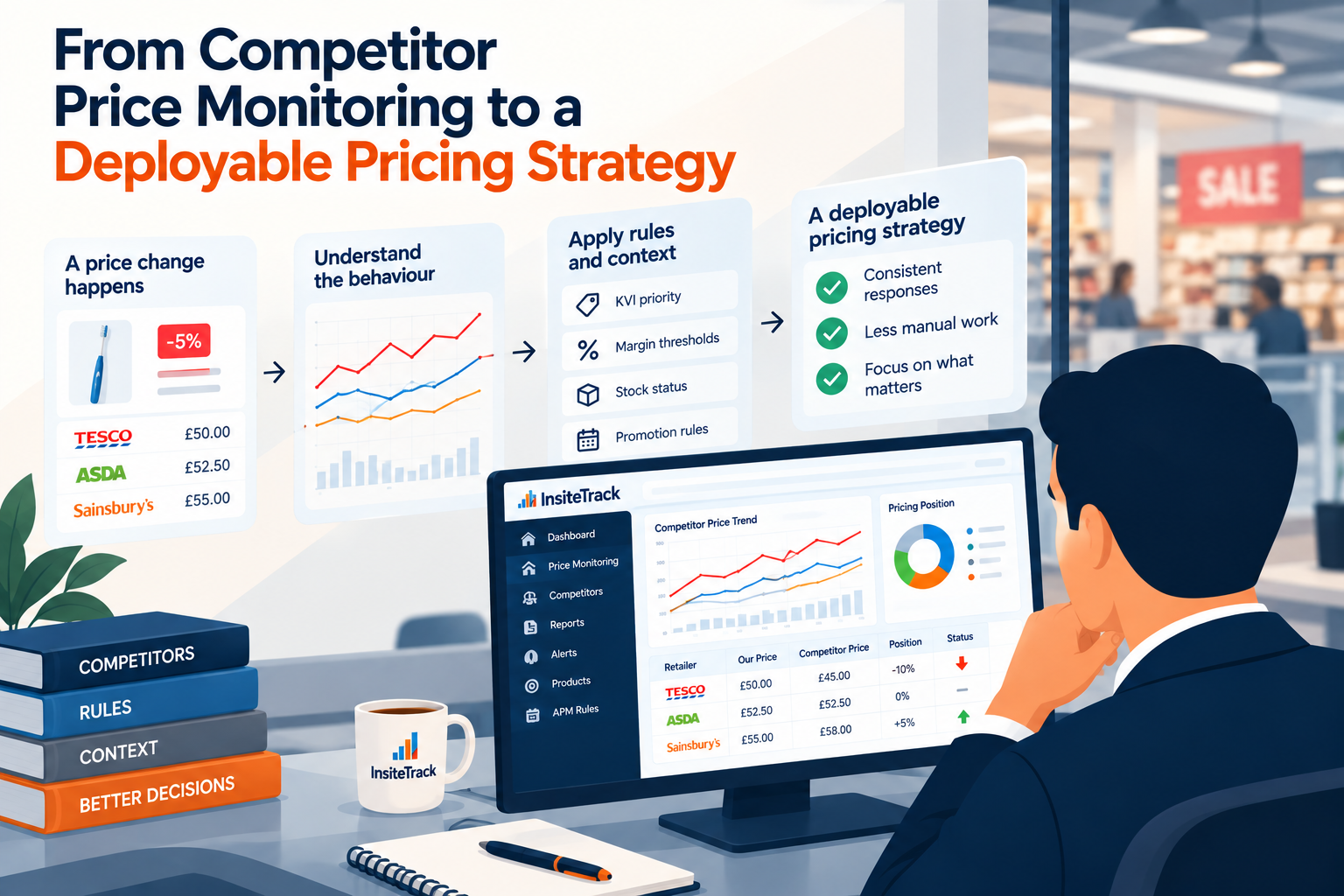
When a competitor changes price, the discussion no longer needs to begin with, “Should we match?” The team can instead ask whether the situation meets the conditions where it would normally respond and whether there is any reason the usual approach should change.
That creates a much stronger starting point for commercial judgement.
Clearer Principles Can Improve Decision Speed
Retailers understandably want faster pricing decisions, and the instinctive response is often to provide teams with faster data or more automation. Both can help, but decision speed also comes from removing uncertainty before the decision needs to be made.
If a pricing manager already understands which competitors are commercially relevant, less time is spent deciding whether a movement deserves attention. If Key Value Items have been clearly identified, the team can prioritise them immediately. If margin thresholds are understood, certain options can be ruled out before a lengthy debate begins. Clear ownership also means people know who is responsible when a decision needs to be made.
The process becomes faster because fewer questions need answering from the beginning.
This is different from simply asking teams to move more quickly. The objective is to create enough clarity that decisions can be made efficiently without becoming reactive.
Consistency Does Not Mean Rigidity
There is a risk that pricing rules and agreed principles are interpreted as inflexible, but that should not be the objective.
Markets change, competitors behave differently and commercial priorities evolve. A mature pricing process still needs to allow experienced teams to apply judgement when a situation requires it.
The difference is that judgement sits on top of a shared framework. The team understands the normal response while retaining the ability to make an exception when the commercial context justifies it.
This makes decisions more consistent without turning them into automatic responses. It also makes exceptions easier to understand and explain. When the business chooses not to follow its usual approach, there should be a clear commercial reason for doing so.
That combination of consistency and flexibility is much more valuable than either extreme.
Repeated Debates Often Reveal Missing Decisions
If a pricing team keeps returning to the same debate, the repetition can be useful information in itself. It may indicate that a wider decision has never actually been made.
Perhaps the business has never agreed which competitor is genuinely most relevant within a category. Product importance may not have been clearly defined. Margin boundaries could be unclear, or there may be no agreed response to temporary competitor promotions. In other situations, ownership may change depending on who notices the movement first.
The repeated operational debate is often only the symptom. The underlying issue is that the business has never resolved the broader principle.
This is why mature pricing teams do not simply try to make repeated discussions faster. They ask whether some of those discussions should need to happen repeatedly at all.
Resolving the underlying question once can remove dozens of smaller decisions later.
Pricing Knowledge Should Become Shared Knowledge
A significant amount of pricing capability naturally exists in individual experience.
An experienced pricing manager may know instinctively which competitors matter. A category manager may understand which products customers are most likely to compare. A Commercial Director may have a strong sense of how much margin pressure the business is prepared to accept in different circumstances.
That experience is valuable. The risk appears when the pricing process depends entirely on those individuals being available.
If the same situation produces a very different outcome depending on who is making the decision, the process lacks consistency and becomes harder to scale.
Pricing maturity therefore involves capturing enough of that experience to give the wider team a common starting point. This may mean clearer product priorities, agreed competitor groups, documented pricing principles or more visible decision rules.
The objective is not to replace expertise. It is to make that expertise easier for the wider organisation to apply consistently.
The Best Rules Reduce Noise
Not every pricing principle needs to lead to an action. Some of the most useful rules help teams decide what does not deserve their time.
A small movement from a low relevance competitor may not require an immediate review. A short term promotion might only need monitoring. A price difference on a low visibility product may be commercially acceptable, particularly if responding would create unnecessary margin loss.
By agreeing these principles in advance, teams can reduce the amount of noise reaching the decision stage.
Attention can then move towards situations where human judgement genuinely adds value, such as commercially important competitor changes, key products, meaningful shifts in customer value or unusual market conditions.
The goal of pricing maturity is not to create more decisions. It is to make fewer unnecessary ones and give greater attention to the decisions that genuinely matter.
Better Pricing Processes Create Better Conversations
Reducing repeated decisions also changes the quality of internal commercial conversations.
Instead of repeatedly asking whether a competitor matters, teams can focus on what that competitor movement means. Rather than debating whether a product is important, they can discuss the commercial consequence of changing its price. When ownership is already clear, the conversation can move directly towards the available options rather than spending time establishing who should act.
This produces a more useful decision process. Teams spend less time establishing the basics and more time applying commercial judgement to the circumstances in front of them.
It can also improve alignment between pricing, category, ecommerce, trading and commercial teams because they are working from a more consistent set of priorities.
The value is therefore not simply greater speed. It is better quality discussion around the decisions that remain.
Pricing Maturity Is About Making Decisions Easier to Repeat
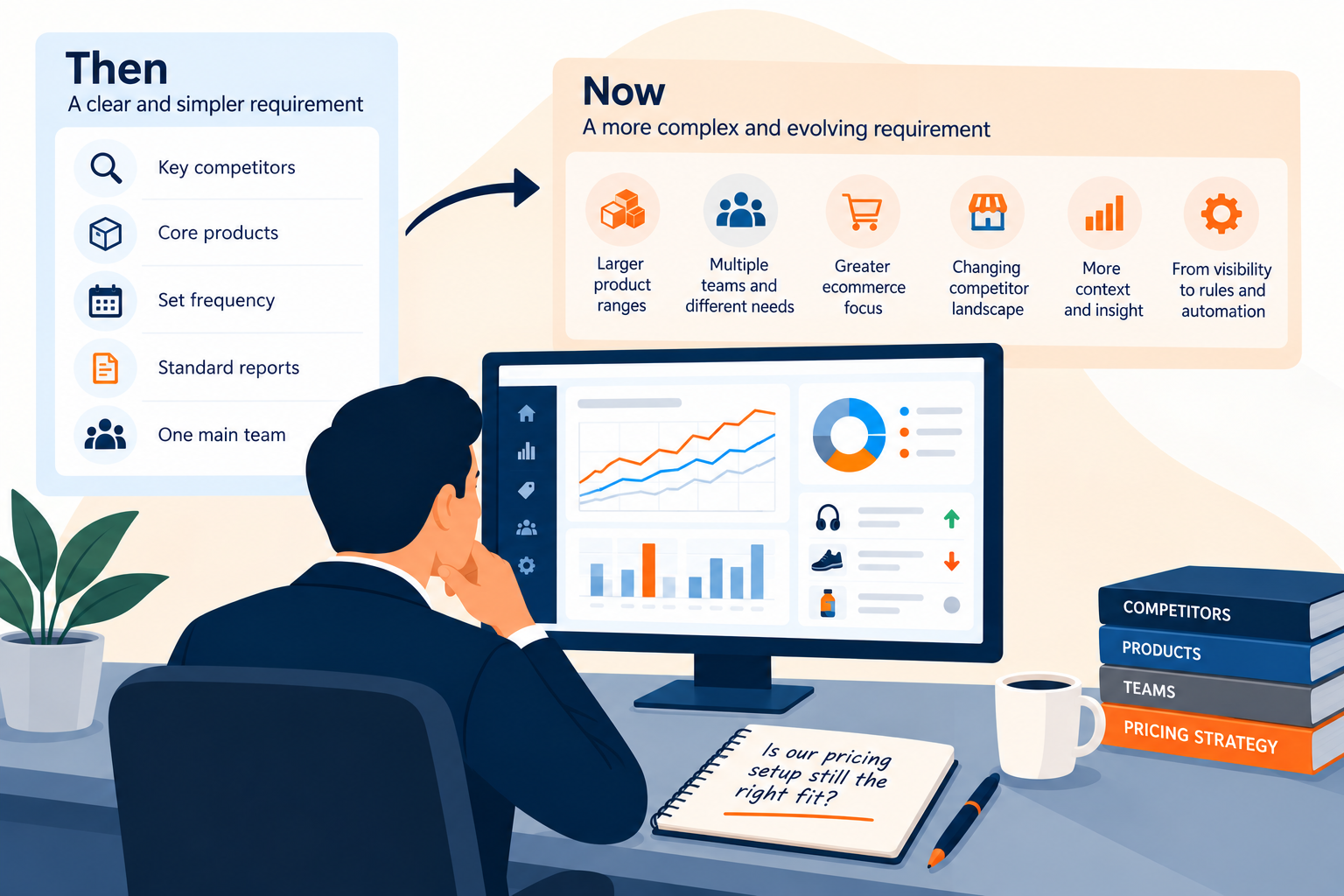
Pricing maturity is sometimes associated mainly with sophisticated technology or automation. Those capabilities can certainly support it, but one of the simplest ways to recognise maturity is to look at how repeatable the decision process has become.
If the same market situation appears tomorrow, would the team broadly know what to do? Would different people be likely to reach a similar conclusion? Would they know which information needs reviewing, who owns the decision and when an exception to the normal approach is justified?
The more confidently a retailer can answer those questions, the less dependent the pricing process becomes on repeated debate.
This also makes the organisation more resilient. Decisions are less reliant on a handful of experienced individuals and easier to maintain as teams, ranges and market complexity grow.
The Retail Pricing Intelligence Maturity Assessment
Retailers will always need to make pricing decisions, and commercial judgement should remain an important part of that process. The opportunity is to stop using that judgement on questions the business could already have answered.
If teams repeatedly debate the same competitor movements, products, margin thresholds or promotions, the answer may not be another report or a faster meeting. It may be to resolve the underlying principle, clarify the priority and make ownership clearer.
That allows teams to focus their time on the situations where the answer genuinely is not obvious.
A mature pricing process does not simply help a business make more decisions. It helps the organisation avoid making the same decision twice.
If you are unsure how repeatable, trusted and embedded your current pricing process is, the Retail Pricing Intelligence Maturity Assessment provides a practical starting point. It takes around five minutes and helps identify your current maturity stage, the areas creating friction and where the next improvement may have the greatest impact.

How Mature Is Your Pricing Intelligence?
Take our 5-minute assessment to see how trusted, usable and embedded your pricing intelligence is today. You’ll receive a personalised summary with your maturity stage, key focus areas and practical next steps.