The world of Google Shopping is undergoing one of its biggest structural changes in years. Google is retiring the legacy Content API for Shopping and replacing it with the new Merchant API, with the final shutdown scheduled for August 18, 2026. The new Merchant API introduces a more scalable architecture, richer automation capabilities, improved inventory management and greater control over product data.
For most retailers, the immediate focus is migration. However, the real opportunity lies beyond simply replacing one API with another.
The retailers that will gain the greatest advantage from the Merchant API are those that combine it with real-time price intelligence to create a more responsive and profitable Google Shopping strategy.
The Problem with Traditional Shopping Optimisation
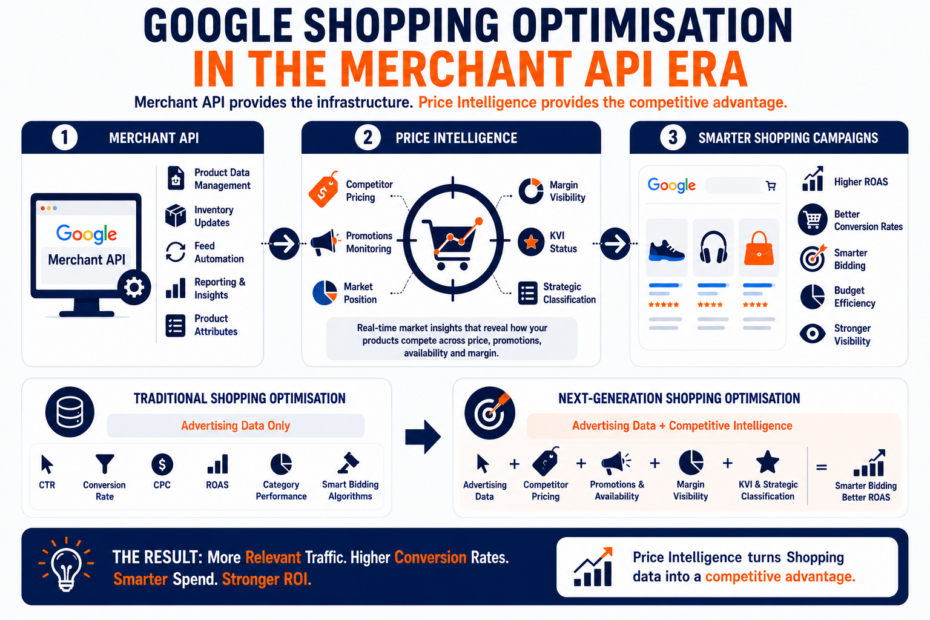
Most Google Shopping campaigns are still optimised using only internal advertising metrics:
- Click-through rate
- Conversion rate
- Historical ROAS
- Product category performance
- Smart bidding algorithms
While these metrics are important, they ignore one of the most significant drivers of Shopping performance:
How competitive your product pricing is compared with the market.
A retailer can increase bids, expand budgets and optimise campaigns endlessly, but if their product is significantly more expensive than competitors, conversion rates will remain under pressure.
The Merchant API creates a stronger foundation for managing product data, but retailers still need external market intelligence to make smarter commercial decisions.
Why Price Intelligence Matters More Than Ever
Google Shopping is fundamentally a comparison shopping platform.
Consumers can instantly compare:
- Price
- Delivery options
- Availability
- Promotions
- Brand reputation
In many retail categories, price position directly influences conversion rates.
This means that two products with identical advertising metrics may deserve very different bidding strategies.
The New Opportunity Created by Merchant API
The Merchant API is designed to improve how retailers manage and automate product information at scale. It provides enhanced access to product management, inventory updates, reporting and feed automation.
This creates an opportunity to enrich product data with commercial intelligence.
Rather than simply pushing product attributes such as:
- Brand
- Category
- Availability
- Margin bands
Retailers can also introduce:
- Price competitiveness
- Margin goals
- Key Value Item (KVI) status
- Strategic product classification
This allows Shopping campaigns to become significantly more intelligent.
Using Price Intelligence to Drive Campaign Structure
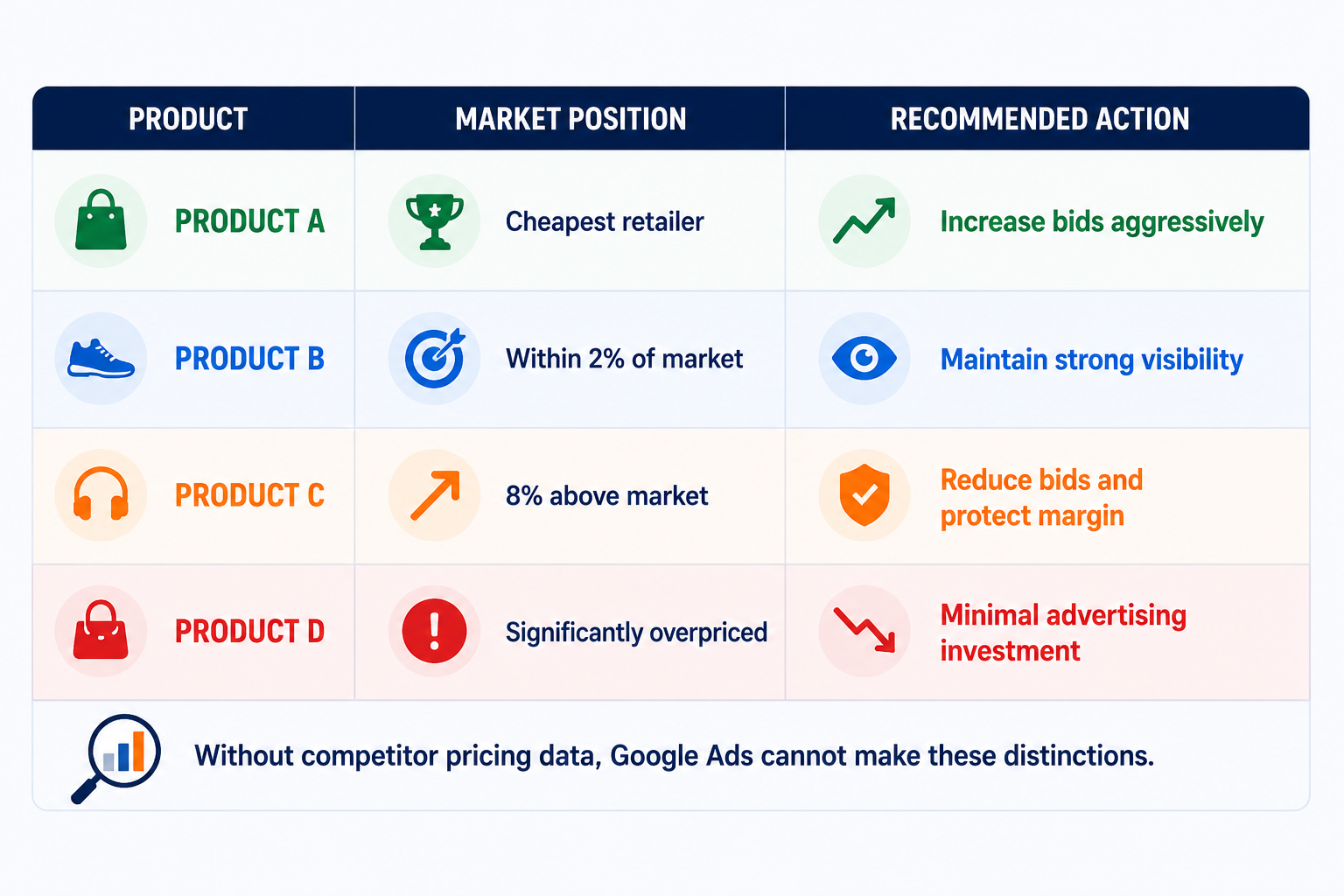
A highly effective approach is to classify products into competitiveness segments.
Aggressive Segment
Products that are:
- Cheapest in market
- Within 1–2% of lowest competitor
- High margin
These products receive:
- Higher bids
- Increased budget allocation
- Premium Shopping visibility
Competitive Segment
Products:
- Within 3–5% of competitors
- Consistent converters
These products remain core campaign drivers.
Defensive Segment
Products:
- Slightly overpriced
- Lower conversion probability
These receive more conservative bidding.
Low Priority Segment
Products:
- Significantly overpriced
- Margin constrained
- Poor conversion history
These products maintain visibility but consume minimal budget.
Query Sculpting for Higher Intent Traffic
One of the most powerful applications is combining price intelligence with Shopping campaign structure.
Retailers can use campaign priorities and negative keyword sculpting to direct:
- Generic searches into low-bid campaigns
- Product-specific searches into premium campaigns
- High-intent traffic toward competitively priced products
This creates a much stronger alignment between:
Consumer intent + market competitiveness + advertising investment
The result is a more efficient acquisition strategy.
What We Observed in Retail Testing
Recent testing across three retail businesses demonstrated a consistent pattern.
Products that were competitively priced delivered:
- Higher quality search traffic
- Improved conversion rates
- More efficient Shopping spend
- Significant ROAS improvements
By aligning bidding decisions with real-time market competitiveness rather than historical advertising performance alone, retailers were able to direct spend towards products with the highest probability of conversion.
The result was not simply lower CPCs.
It was a measurable improvement in overall Shopping efficiency.
Preparing for the Future
The Merchant API migration is mandatory for retailers using Content API integrations, but it should not be viewed as a compliance exercise. Google is positioning Merchant API as the future platform for product management, automation and scalable feed operations.
Forward-thinking retailers should use this transition as an opportunity to rethink how Shopping campaigns are managed.
The next generation of Shopping optimisation will not be driven solely by advertising data.
It will combine:
- Merchant API automation
- Product feed intelligence
- Competitor pricing data
- Margin visibility
- Real-time bidding strategies
Retailers that integrate these capabilities will be best positioned to maximise visibility, improve conversion rates and deliver stronger ROAS in an increasingly competitive Shopping environment.
At InsiteTrack, we believe the future of Google Shopping lies in combining real-time price intelligence with automated feed and campaign management.
The Merchant API provides the infrastructure; competitive intelligence provides the advantage.
If you’d like to hear more about how we can help you take advantage of this trend, lets have a chat.