Two weeks ago, we explored a simple idea: most retailers already have pricing data. Competitor monitoring is widespread, dashboards are commonplace, and market visibility is more accessible than ever before. The real differentiator is no longer access to information. It is whether that information helps teams make better decisions.
But there is a second question that naturally follows.
If pricing intelligence only creates value when it improves decision-making, who owns the capability that turns intelligence into action?
This is where many retailers hit a ceiling. They invest in pricing technology, improve visibility, and expand reporting. Yet pricing decisions still feel slower than they should. The issue is no longer data. It is capability.
Most Retailers Think They Have a Technology Problem
When pricing decisions feel difficult, the instinctive response is often to look for more technology. A better dashboard, more competitor coverage, additional reporting, or new automation capabilities all seem like logical solutions. After all, if teams need better decisions, surely they need better information.
The reality is more complicated. Many retailers already have access to more pricing information than they can realistically consume. The challenge is not seeing the market. The challenge is deciding what to do about it.
This creates a common cycle. New tools generate more visibility, but they also create more interpretation. Additional dashboards create additional analysis. More reporting often leads to more discussion rather than more action. The organisation becomes better informed, but not necessarily better equipped to respond.
The Hidden Gap Between Intelligence and Capability
One of the biggest misconceptions in retail pricing is that pricing intelligence and pricing capability are the same thing.
They are not.
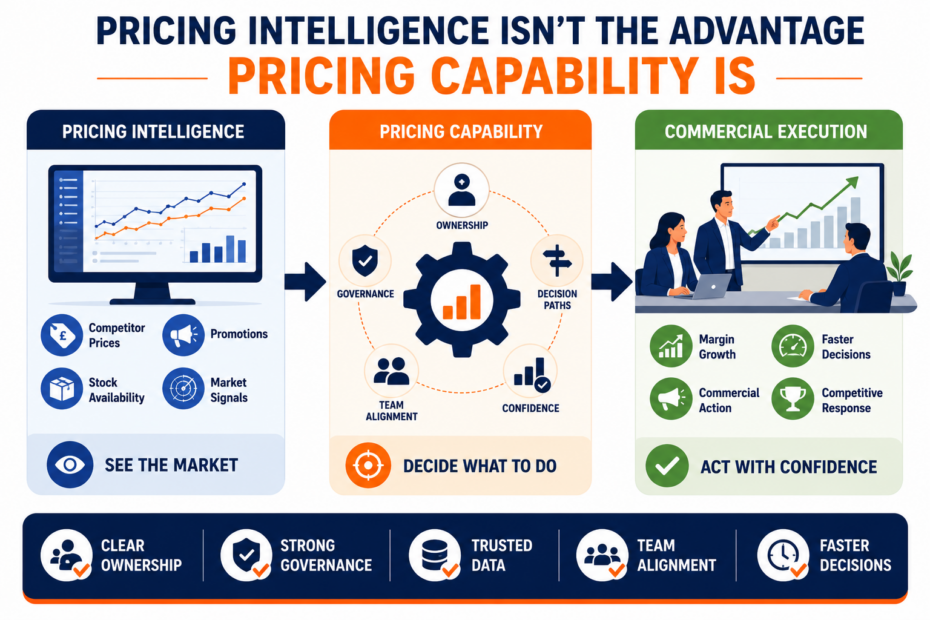
Pricing intelligence helps retailers understand what is happening in the market. Pricing capability determines what happens next.
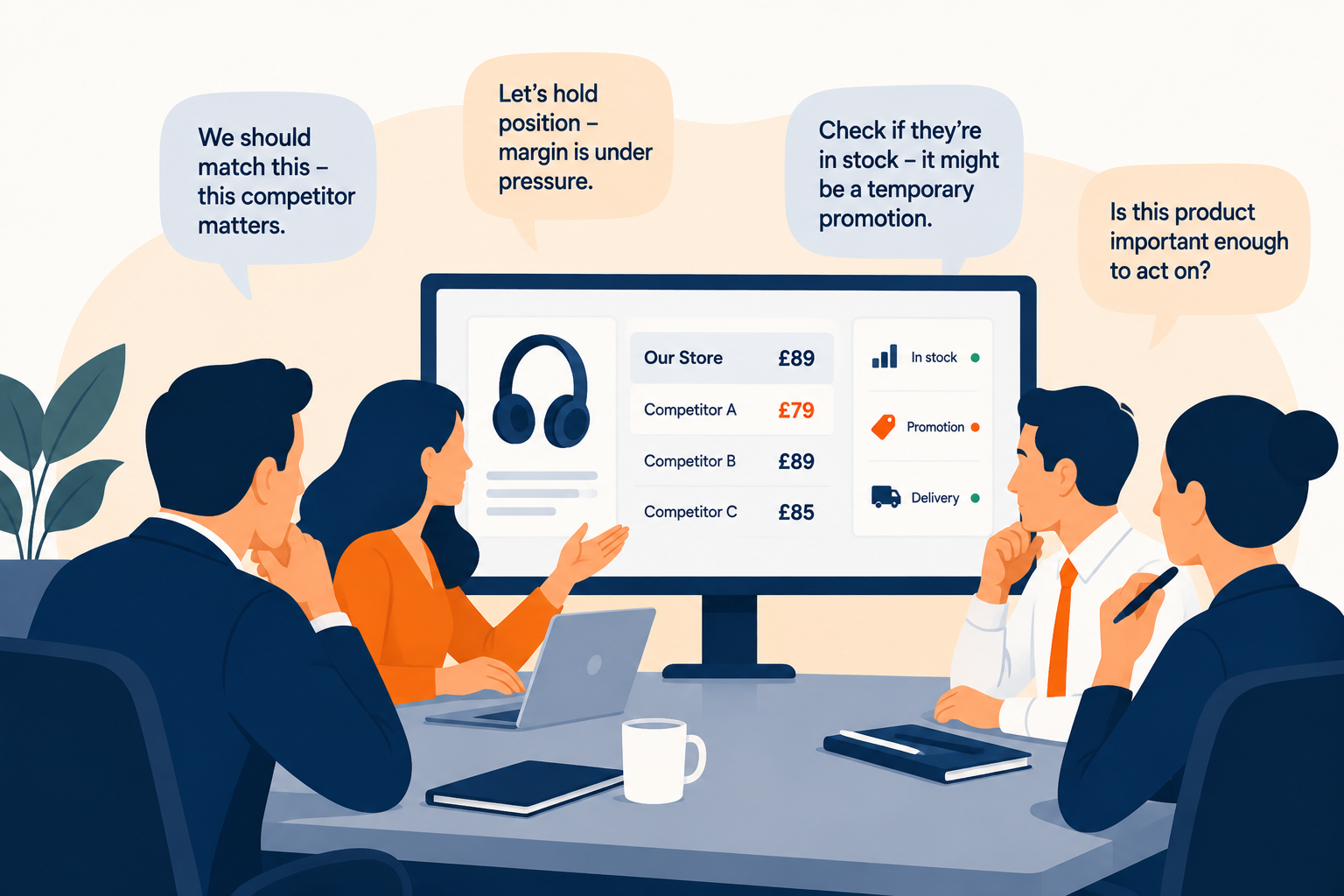
A retailer may have excellent visibility into competitor pricing, promotions, stock availability, and price position. It may be able to identify competitive threats quickly and monitor market changes in real time. Yet if decision ownership is unclear, workflows are fragmented, or teams lack confidence in the information available, action still slows down.
The result is a familiar pattern. Teams can see the market moving, but they cannot move with it. This is why many retailers still feel reactive despite significant investments in pricing technology. The intelligence exists. The capability around it does not.
Pricing Has Escaped the Pricing Team
Part of the challenge is that pricing no longer sits neatly within a single function.
Historically, pricing was viewed as a specialist responsibility belonging to pricing teams, category managers, or trading functions. Today, pricing influences almost every commercial outcome retailers care about.
It affects margin resilience, promotional effectiveness, customer perception, conversion rates, Google Shopping performance, competitive positioning, and channel consistency. Pricing decisions increasingly influence finance, marketing, ecommerce, operations, customer experience, and wider commercial strategy.
This means pricing capability can no longer be viewed as a departmental responsibility. It is becoming an organisational capability that requires alignment across multiple teams.
Why Some Retailers Move Faster Than Others
One of the most interesting observations in retail pricing is that the retailers moving fastest do not always have the most sophisticated technology.
In many cases, they have access to very similar data as everyone else. What differentiates them is how the organisation is structured around that intelligence.
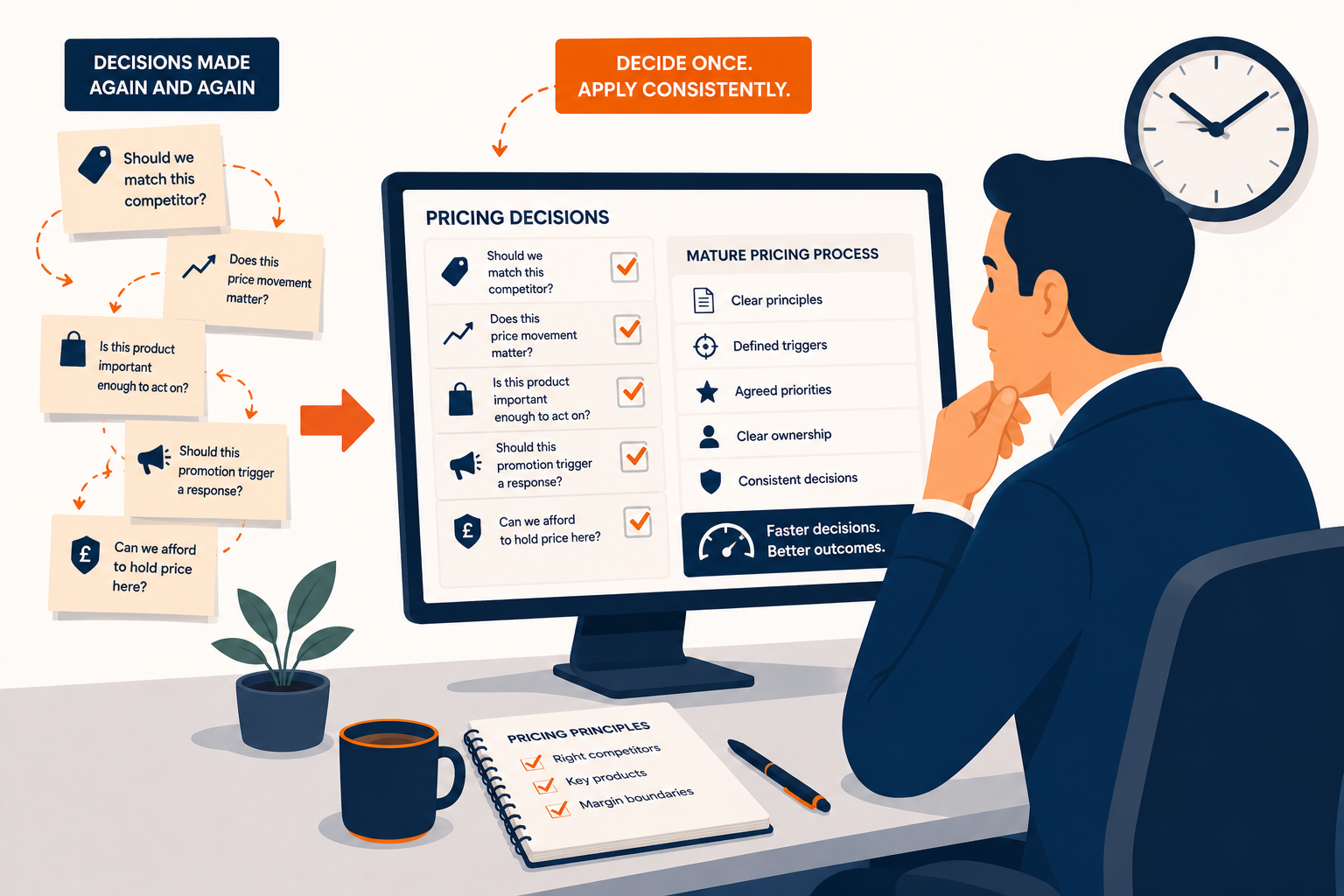
Ownership is clearer. Decision pathways are shorter. Commercial priorities are understood. Teams know when they can act independently and when escalation is required. Instead of debating every signal, they focus on responding to the ones that matter.
This is what pricing capability looks like in practice. It is not more dashboards or more alerts. It is a clearer route from insight to action.
Pricing Capability Is Really About Governance
Governance is often misunderstood as control. In reality, effective pricing governance creates speed.
Strong governance provides clarity around decision-making. It establishes margin guardrails, defines ownership, clarifies escalation points, and aligns pricing decisions with broader commercial objectives.
Without governance, every pricing decision becomes a discussion. With governance, teams understand the framework they are operating within and can act confidently inside clearly defined boundaries.
This confidence matters because most pricing delays are not caused by a lack of information. They are caused by uncertainty. Uncertainty about whether action is justified. Uncertainty about risk. Uncertainty about who owns the decision. Effective governance removes much of that uncertainty and enables faster, more consistent execution.
What Pricing Capability Looks Like
Retailers that build strong pricing capability tend to share a number of common characteristics.
They trust their pricing intelligence because data quality is high and competitor coverage is reliable. They align pricing, trading, and commercial teams around a common view of the market. They focus attention on the signals that genuinely matter rather than overwhelming teams with noise. They establish clear ownership, defined decision pathways, and consistent approaches to escalation.
Importantly, they embed pricing into wider commercial planning rather than treating it as a standalone activity.
The result is not necessarily more pricing changes. It is greater confidence in the decisions being made. The goal is not speed for the sake of speed. It is confidence without hesitation.
Why This Matters More Than Ever
Retail competition has become increasingly transparent. Customers can compare prices instantly, competitor promotions are visible in real time, and marketplaces continuously reshape expectations around value and availability.
In this environment, the gap between seeing a signal and acting on it becomes commercially significant. Retailers that can convert intelligence into action quickly gain an advantage. Those that cannot often find themselves reacting after the opportunity has already passed.
This is why pricing capability is emerging as such an important competitive differentiator. Not because it creates better data, but because it creates better decisions.
A Better Question for Leadership
Many retailers still ask questions such as:
Do we have enough pricing data?
Do we have the right tools?
Do we have sufficient market visibility?
These questions still matter, but they are no longer the most important ones.
The better question is whether the organisation has the capability to consistently turn pricing intelligence into action.
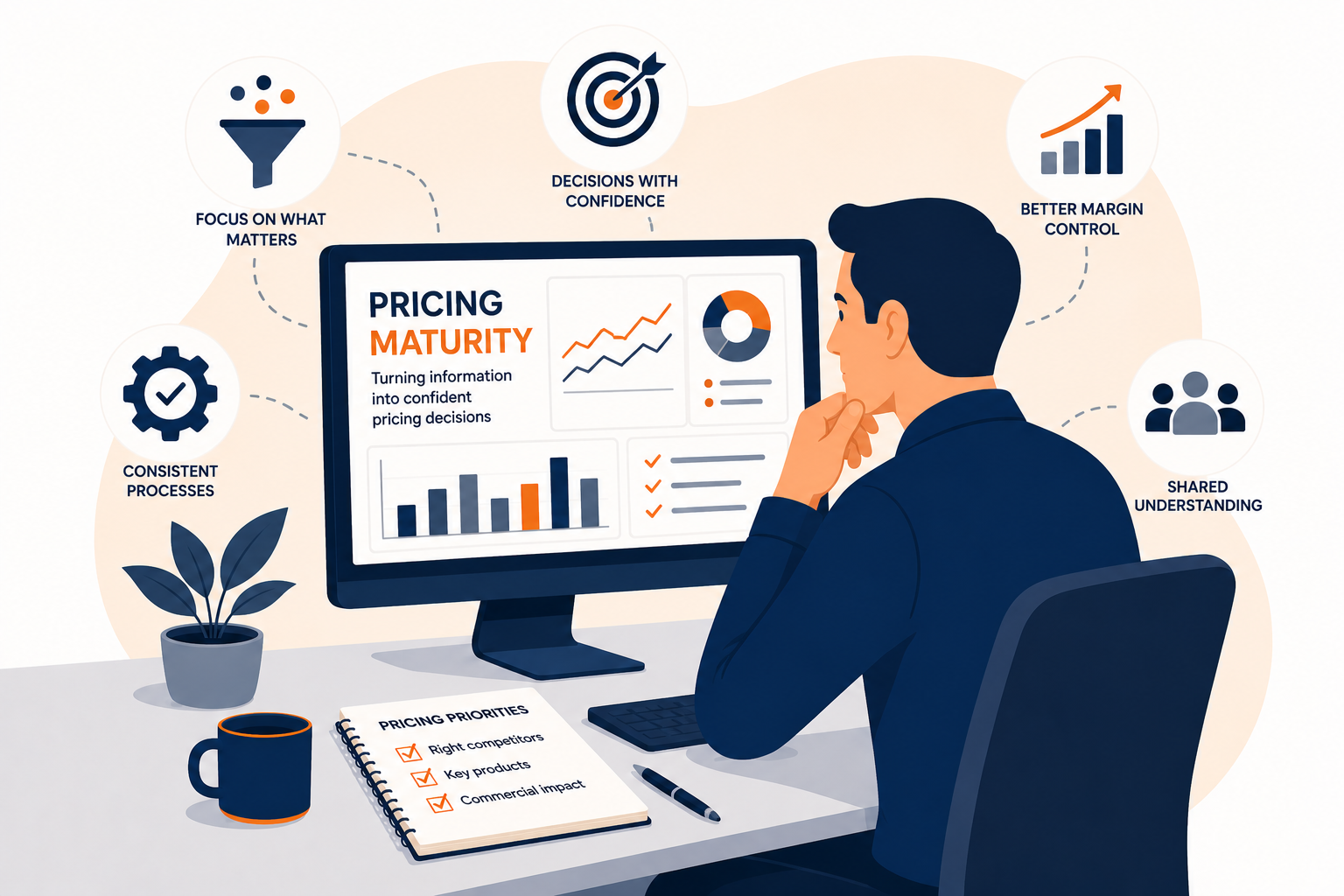
Because pricing maturity is no longer determined by what a business can see. It is determined by what a business can do with what it sees.
The Shift From Intelligence to Capability
The retail industry has spent years improving pricing visibility. For most retailers, that journey is largely complete. Competitor pricing can be monitored, market movements can be tracked, and opportunities can be identified faster than ever before.
The next phase of pricing maturity is different.
It is about execution. It is about governance. It is about ownership. And ultimately, it is about capability.
Because pricing intelligence is not the goal.
Pricing capability is.
And increasingly, that capability is what separates retailers that react to the market from retailers that shape it.