Most pricing problems do not appear suddenly.
Margin erosion rarely arrives overnight. Conversion declines rarely happen in a single moment. Competitiveness does not disappear all at once. Instead, the warning signs emerge gradually, often weeks before the commercial impact becomes visible in reporting.
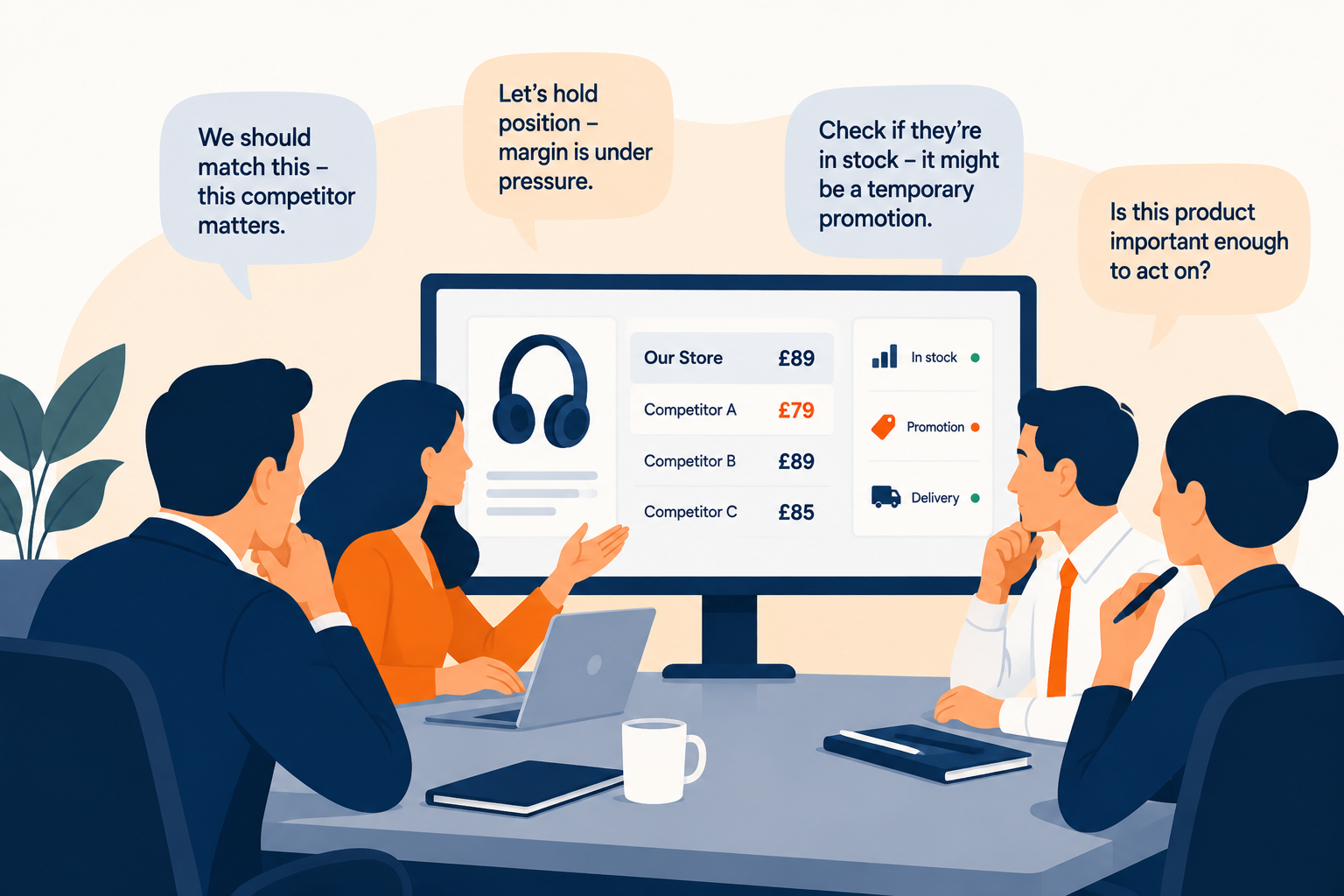
A competitor quietly changes its promotional behaviour. Stock availability shifts across the market. A handful of highly visible products begin drifting out of position. Local competitors become more aggressive in specific regions.
Individually, these signals often look insignificant.
Collectively, they reshape performance.
The challenge is that many retail teams only react once the impact appears in sales, margin, or conversion reports. By that stage, the underlying market behaviour driving the problem has often been developing for some time.
This is where pricing intelligence becomes far more valuable than simple price monitoring. The retailers that consistently outperform are rarely the ones with the most data. They are the ones that recognise the right signals before everyone else.
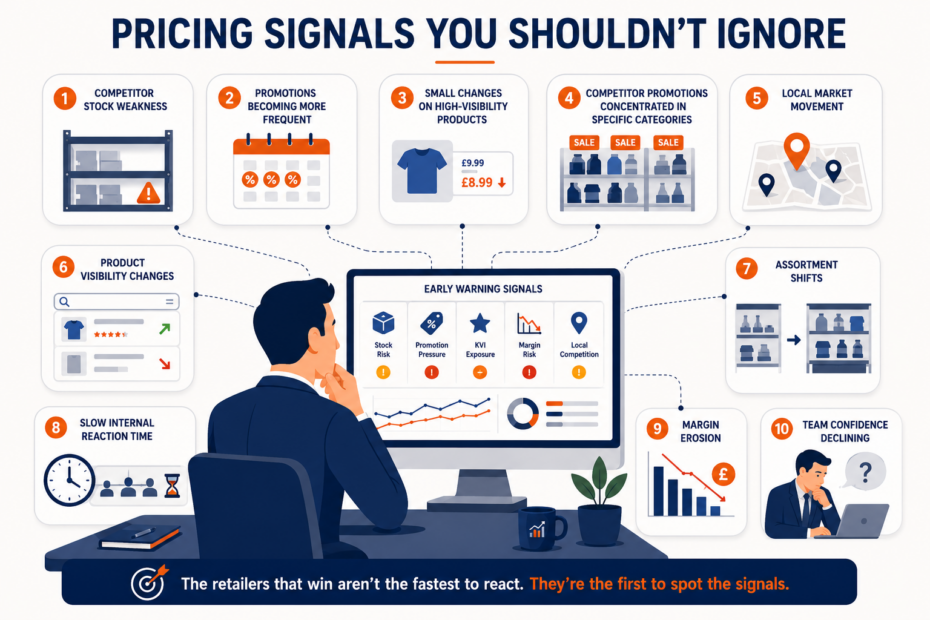
1. Competitor Stock Weakness
One of the most overlooked pricing signals in retail is competitor stock availability.
Many retailers focus heavily on competitor price movement while paying far less attention to whether competitors can actually fulfil demand consistently. A competitor may appear cheaper on paper, but if stock levels are weak, fragmented, or frequently unavailable, the competitive threat changes significantly.
Strong pricing teams understand that stock availability influences pricing power. In some situations, weak competitor stock creates opportunities to protect margin or even strengthen pricing position rather than reacting defensively with discounting.
The problem is that many retailers only notice competitor stock weakness after conversion patterns have already started to change.
2. Promotions Becoming More Frequent
Promotional pressure rarely escalates overnight.
Instead, it builds gradually. A competitor extends promotions more often. Discount cycles become shorter. Multi-buy offers become more common. Marketplace sellers begin increasing promotional activity across visible products.
These changes often appear well before margin pressure becomes obvious internally.
Retailers that assess promotions in isolation frequently miss these behavioural shifts. Over time, this creates a dangerous blind spot because once promotional dependency becomes embedded within a category, changing customer expectations becomes significantly harder.
3. Small Changes on High-Visibility Products
Many retailers spend too much time focusing on category averages and not enough time monitoring the products customers actually notice.
A relatively small group of highly visible products often shapes customer perception far more than the wider range. These Key Value Items frequently determine whether customers perceive a retailer as competitive.
A competitor only needs to become visibly stronger on a handful of high-traffic products to begin shifting perception.
The challenge is that these changes often look insignificant in reporting because overall category competitiveness appears stable. Customers, however, do not experience pricing through averages. They experience it through individual moments, comparisons, and highly visible products.
4. Competitor Promotions Concentrated in Specific Categories
Not every promotion matters equally.
When competitors repeatedly focus promotional activity within the same categories, they are often signalling strategic intent. This could indicate growth priorities, inventory pressure, category investment, or an effort to reshape customer perception in a particular area of the market.
Retailers that only monitor promotional depth often miss the wider competitive story.
Understanding where competitors are concentrating their promotional effort can reveal far more than simply knowing how much discount they are offering.
5. Local Market Movement
Many pricing decisions are still made using broad national views of competitiveness.
The reality is that stores compete locally.
A category may appear stable at a national level while specific regions become increasingly exposed to local competitor activity, aggressive promotions, or marketplace pressure.
Customers experience value locally, not nationally. This creates a significant visibility gap for retailers that lack insight into regional competitiveness. Often, exposure is only identified once performance differences begin appearing across locations or territories.
6. Product Visibility Changes
Pricing is not just about price.
Visibility matters.
Competitor products gaining stronger placement in search results, marketplaces, paid media campaigns, or category pages can quietly influence customer behaviour before pricing performance changes become visible internally.
Retailers often focus heavily on price position while underestimating the role visibility plays in competitiveness. This becomes particularly important in eCommerce and Google Shopping environments, where visibility and pricing directly influence one another.
A product does not always need to be the cheapest option to win. It needs to be visible and competitively positioned at the moment the customer is making a decision.
7. Assortment Shifts
Competitor assortment changes are another signal that often goes unnoticed.
A competitor expanding its range may indicate strategic investment in a category. Reducing assortment may signal operational pressure, weaker commitment, or changing priorities.
These changes frequently influence customer perception before pricing changes themselves do.
If a competitor suddenly expands aggressively around key branded products or significantly broadens category coverage, they may be attempting to reposition how customers perceive value in that area of the market. Retailers that only monitor prices can miss these wider competitive shifts entirely.
8. Delayed Internal Reaction Time
One of the most important pricing signals is internal rather than external.
How long does it actually take your business to react once the market moves?
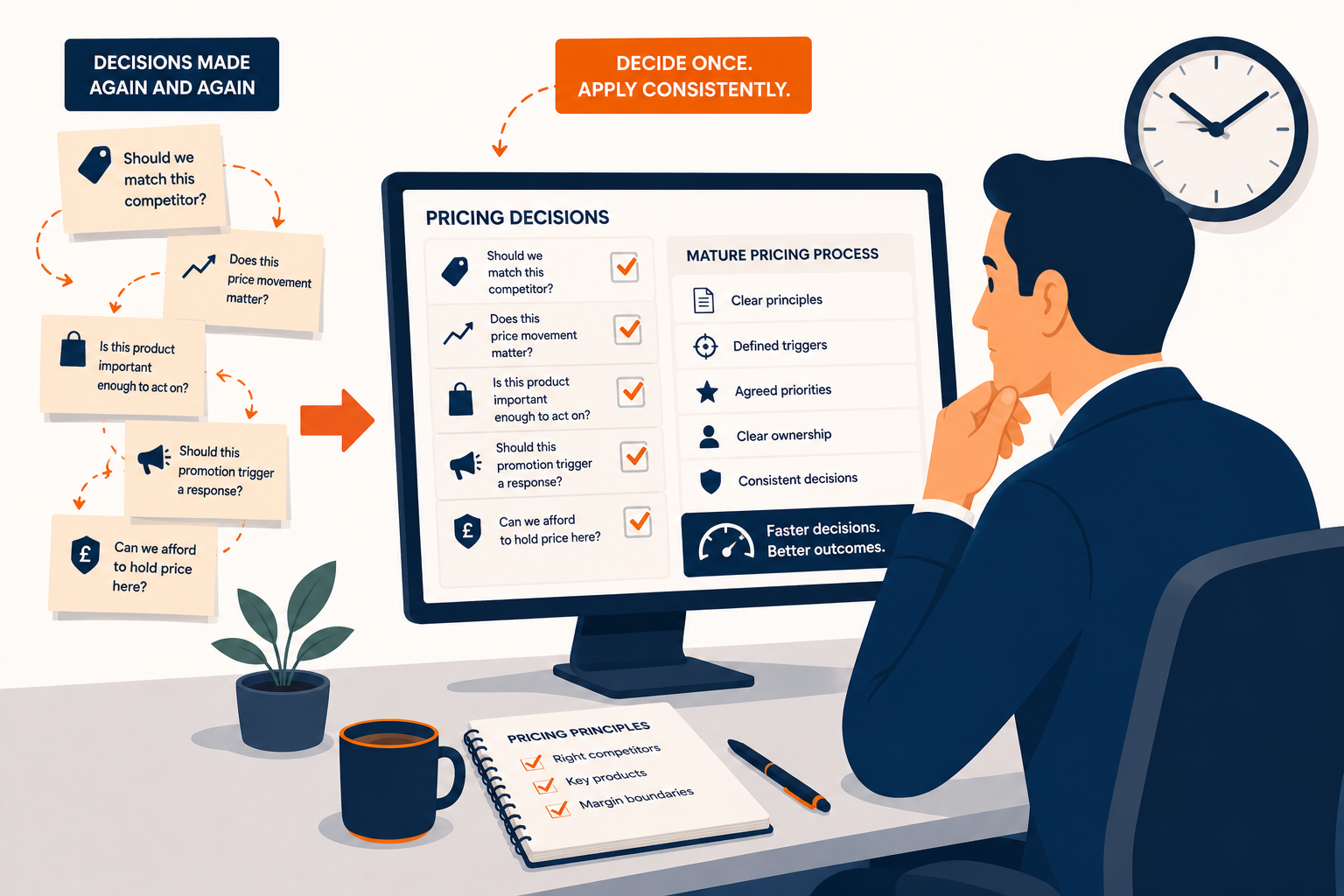
Many retailers focus heavily on competitor behaviour while ignoring the operational friction within their own pricing process. If competitor movements trigger multiple rounds of validation, interpretation, reporting, and approvals before action can happen, the business is already operating behind the speed of the market.
This is often where pricing maturity becomes visible.
Not in the quality of dashboards.
In the speed and confidence of execution.
9. Margin Erosion Hidden Behind “Successful” Promotions
Some of the most dangerous pricing signals hide behind positive sales performance.
Promotions can increase volume, drive traffic, and create short-term revenue spikes while quietly weakening profitability underneath.
This is why retailers increasingly need visibility into true promotional impact rather than promotional activity alone.
A promotion that appears commercially successful in isolation may actually be masking weaker demand, excessive discounting, or deteriorating full-price performance. The earlier these patterns are identified, the easier they are to address.
10. Teams Losing Confidence in the Data
The final signal is often the most important.
When teams begin hesitating before acting on pricing information, confidence has already started to erode.
That hesitation often appears before major pricing issues become visible operationally. Pricing teams begin manually validating competitor matches. Category managers question alerts. Commercial leaders request additional reporting before decisions are approved.
The issue is rarely effort.
It is confidence.
And once confidence in pricing intelligence weakens, reaction speed slows across the entire organisation.
The Retailers That Win Usually See the Signals Earlier
Most pricing problems are visible before they become financially obvious.
The challenge is that many retailers are still structured to react after the impact appears rather than when the warning signs emerge.
That is why pricing intelligence matters.
Not simply because it provides visibility into competitor pricing, but because it helps teams understand context, identify meaningful signals early, and act with confidence before performance deteriorates.
The retailers that outperform are rarely the ones reacting to the market fastest after the damage appears.
They are the ones identifying the signals earlier than everyone else.