
Most retailers would say they use data to plan promotions.
Fewer could say, with confidence, that they use price intelligence to drive them.
That distinction matters.
Promotions are not just trading events.
They are pricing decisions with consequences for:
• Margin
• Customer perception
• Stock flow
• Paid media efficiency
• Future promotional expectations
The uncomfortable question is not whether promotions are planned.
It is whether they are being shaped by the right signals.
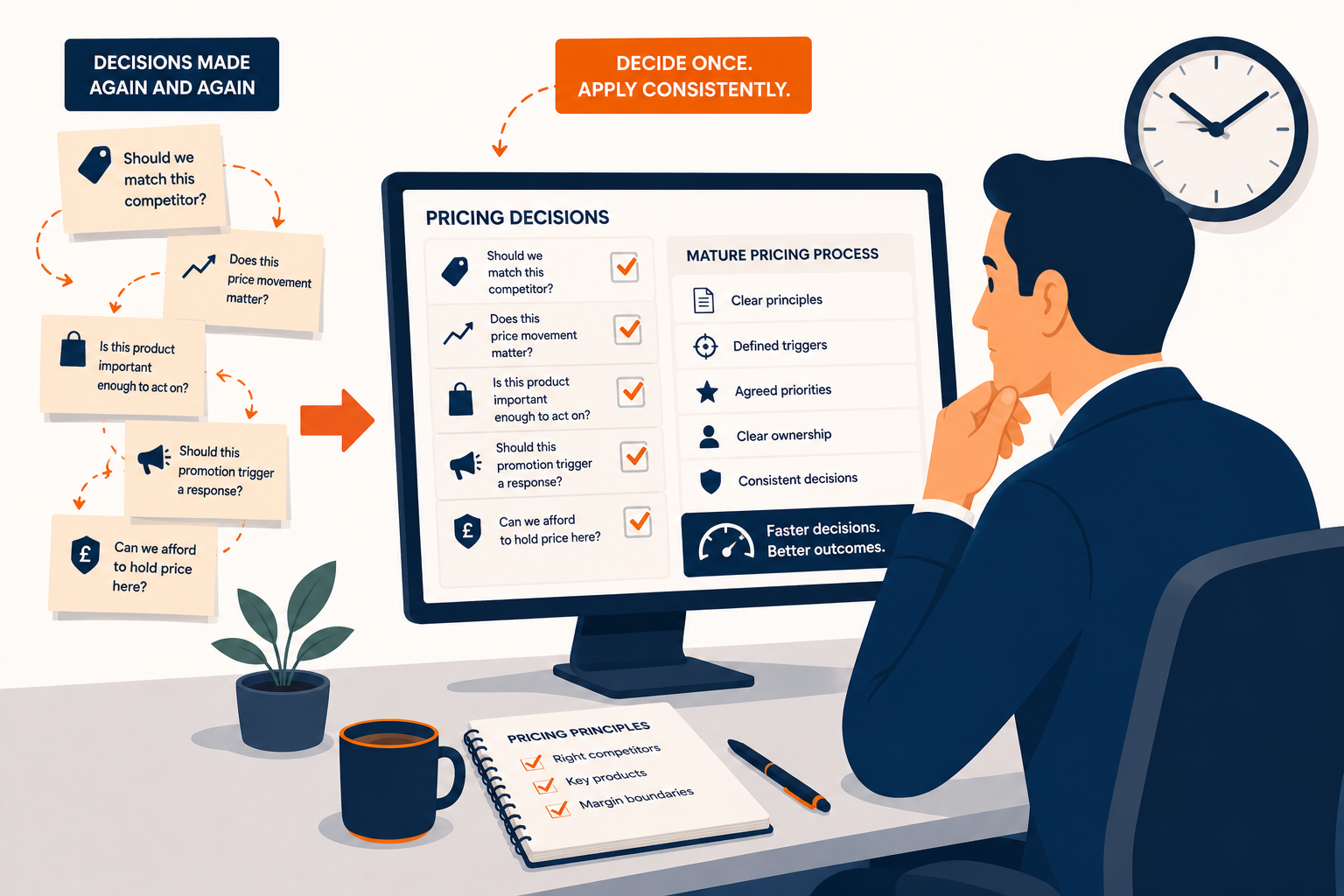
If competitor pricing, competitor promotions, stock availability, price position, and profitability are not considered together, the promotion may be active, but the decision behind it is only partially informed.
Promotions Are Often Built on Pressure, Not Visibility
There are always reasons to promote.
• Sales targets need support
• Stock needs moving
• Traffic needs boosting
• A category feels soft
• A competitor becomes aggressive
None of these are invalid.
But many promotional decisions begin with internal urgency and only later look outward for justification.
Teams ask:
Should we run something?
Before asking:
What is actually happening in the market?
That creates weak decision-making.
Stronger promotional strategy starts with market visibility, not internal pressure.
A Strong Promotional Strategy Is Bigger Than Discount Depth
Good promotions are not defined by how deep the discount is.
They are defined by how well the decision aligns with:
• Competitor pricing behaviour
• Competitor promotional activity
• Your stock position
• Margin tolerance
• Product visibility and price perception
• Channel role, including Google Shopping and paid search
The promotion itself is only one part of the decision.
The advantage comes from understanding the context around it.
Self-Assessment: What Is Driving Your Promotions?
Before focusing on tactics, ask a more direct question.
When a promotion is approved, what drives the decision first?
• Competitor pricing and promotional visibility
• Market stock pressure
• Defined margin thresholds
• Clear product-level price position
• Paid media performance and competitiveness
• Or internal pressure to stimulate demand
Most organisations use some of these inputs.
Few use them together.
That is where decision quality breaks down.
A promotion can look sensible in isolation, but once full context is layered in, the decision often changes.
Competitor Prices Alone Are Not Enough
One of the most common mistakes is reacting to price without context.
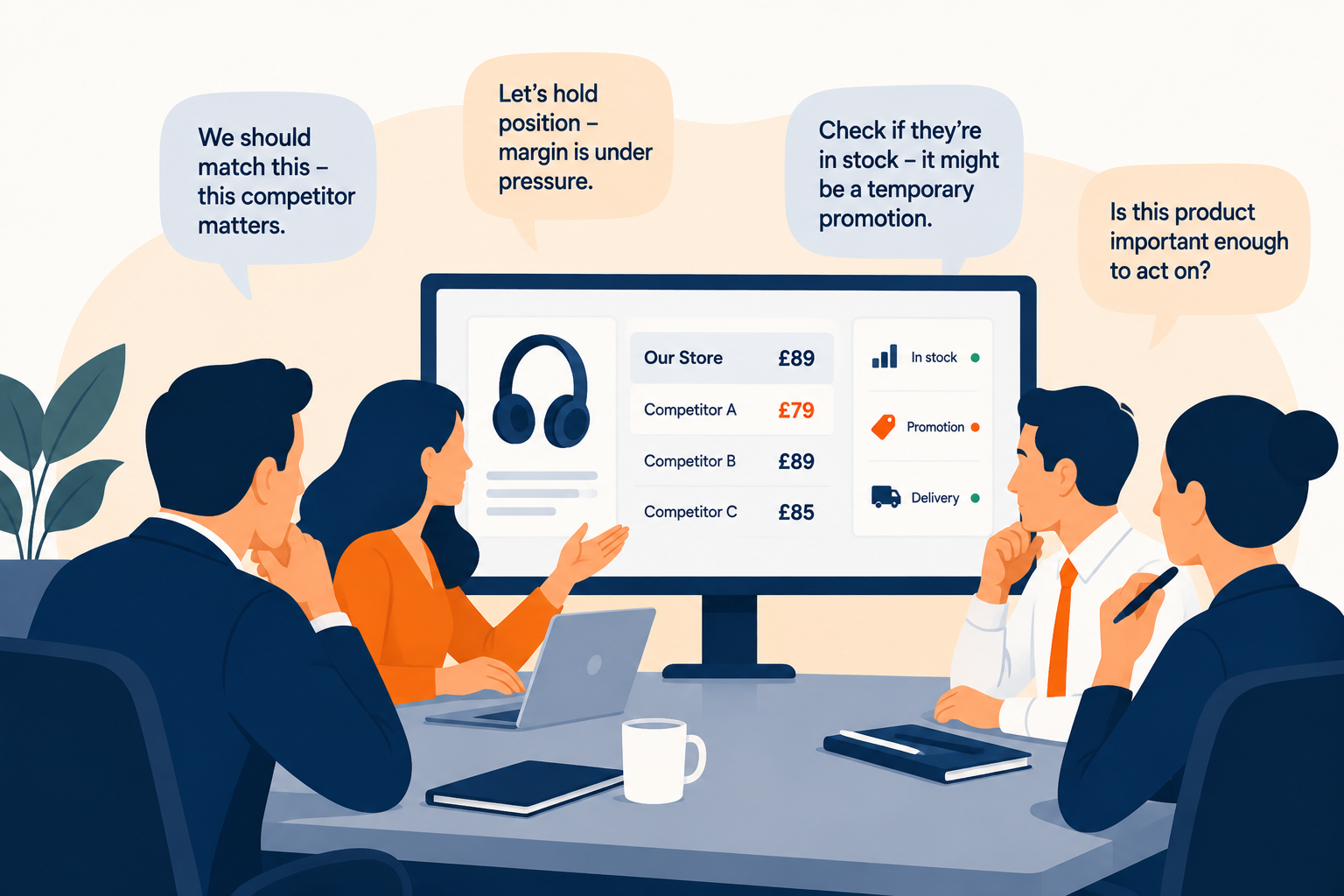
A competitor appears cheaper → a discount is launched.
A category looks exposed → a promotion is pushed live.
Shopping performance drops → pricing is adjusted.
But the real situation may be different.
• The competitor may be out of stock
• The discount may be short-term or bundled
• The price gap may only matter on a few key products
• The issue may not be price at all
Reacting to price alone creates risk.
It leads to unnecessary discounting or missed opportunities.
Better decisions come from asking:
What is actually happening in the market?
Price Position Should Lead Promotional Decisions
Another critical question:
Do you know your true price position before promoting?
Not broadly.
Not from a weekly report.
But by:
• Product
• Category
• Channel
Without this, promotions become blunt.
Retailers discount widely when the issue is narrow.
They create noise across the range when only a few products drive perception.
A stronger approach focuses on:
• Where you are already competitive
• Where you are exposed on high-visibility products
• Where competitors are actively promoting
• Where margin can be protected
This is the difference between activity and strategy.
Promotions and Google Shopping Are Connected
Promotions and paid media should not be managed separately.
They are directly linked.
If Google Shopping performance depends on price competitiveness, then promotional decisions must account for:
• Visibility
• Click efficiency
• Conversion impact
• Margin trade-offs
This raises a key question:
When you launch a promotion, do you understand what it means for Shopping performance?
If not, decisions are fragmented.
A promotion may increase conversion but reduce margin unnecessarily.
A stronger price position may improve performance without additional discounting.
Better decisions come from connecting pricing and media.
What Good Looks Like in Practice
Retailers using price intelligence effectively do not run more promotions.
They run better ones.
Typically, this includes:
• Clear visibility of competitor pricing and promotions before launch
• Understanding competitor stock position, not just price
• Product-level margin awareness
• Defined roles for different products
• Shared visibility across pricing, trading, and media teams
• One operational view instead of fragmented reports
The value is not more data.
It is clearer decision-making.
A Better Challenge for Leadership
Promotions are often treated as an execution challenge.
In reality, the bigger question is simpler.
Are promotions driven by market evidence or internal pressure?
Because if decisions are not shaped by price intelligence, they are made without full context.
And when context is fragmented:
• Decisions slow down
• Confidence drops
• Margin risk increases
Retailers do not always need more promotions.
They need better decisions about when, where, and why to run them.