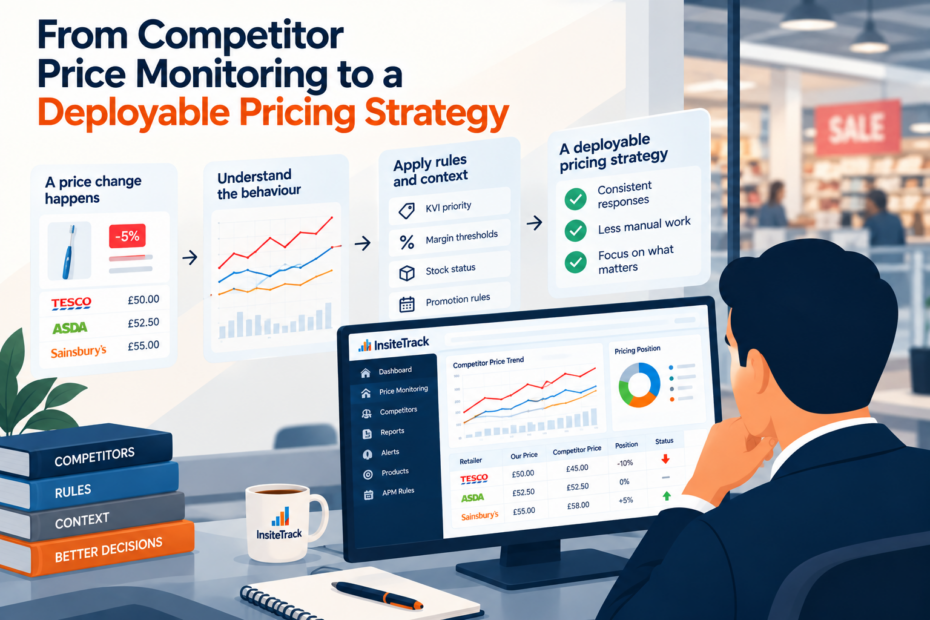
Most competitor pricing workflows begin in the same place. A competitor changes price, the movement is detected, someone checks the context and the team decides whether to respond. That is useful because it gives the business visibility and helps prevent important market movements from being missed. But if the process stops there, the business is still reacting to individual events one at a time.
The bigger opportunity is to understand the behaviour behind those movements well enough that the response does not need to be reinvented every time. Competitor activity can reveal patterns around timing, promotions, stock, category focus and relative price position. Those patterns can then inform how the business normally wants to respond. This is where competitor price monitoring starts becoming a deployable pricing strategy.
A Price Change Tells You What Happened
An individual price movement is only one data point. A competitor might drop by 5%, another might increase price, a promotion may appear for a weekend, or a product may return to stock at a different position. Each event can matter, but on its own it tells you relatively little about how that competitor normally behaves. The more useful insight appears when those individual movements are viewed as part of a wider pattern.
A competitor may regularly lead price reductions in one category but follow the market elsewhere. Another may promote heavily around particular trading periods, while a third repeatedly returns to the same relative position after short term discounting. Once those behaviours become visible, the team can start to understand what a movement is likely to mean rather than simply recording that it happened. That creates a much stronger basis for commercial decision making.
Behaviour Is More Useful Than Isolated Movement
Repeated behaviour helps build a more realistic picture of each competitor. One retailer we worked with found that a competitor appearing aggressive on headline price was also frequently unavailable on the products where that price advantage looked strongest. Another client saw that a marketplace seller regularly undercut the wider market, but only across a relatively narrow part of the range. In both cases, the raw price data was accurate, but the commercial interpretation changed once the behaviour around it was understood.
This matters because not every competitor movement should influence pricing in the same way. The useful question is not simply who is cheapest at a particular moment. It is what that competitor normally does, how relevant they are to this product or category, and whether the latest movement actually changes the commercial position. That moves the discussion from observation towards strategy.
Competitor Relevance Should Shape the Response
A mature pricing process should not treat every competitor equally. Some competitors may matter heavily on Key Value Items, while others are relevant only within particular categories, channels or customer segments. Certain competitors can have a strong influence on customer price perception, while others have very little impact on the final buying decision. The response should reflect those differences.
For example, a retailer may choose to follow a key national competitor closely across a defined group of high visibility products, but only within agreed margin limits. Another competitor may be monitored without being followed automatically because its prices move too frequently or unpredictably. A third may only matter when it is in stock and offering a genuinely comparable customer proposition. The important point is that competitor relevance becomes part of the pricing logic rather than simply another column in a report.
Patterns Can Become Pricing Rules
Once the business understands which competitors matter, which products deserve attention and which types of movement normally justify action, those principles can begin to become rules. The rules may be simple, such as following a particular competitor on defined KVIs within a minimum margin threshold. They may also incorporate stock status, promotion type or the size of the price gap. The objective is to capture decisions the business has already made rather than invent new ones through automation.
For one client, the useful shift came when recurring pricing conversations were identified and formalised. The same questions were being asked repeatedly about competitor stock, short term promotions and acceptable price gaps. Once the preferred response became clear, there was little value in reconstructing that logic every time. The rule allowed the team to spend more time on exceptions where commercial judgement genuinely mattered.
Rules Make Strategy Repeatable
One of the biggest challenges in pricing is inconsistency. Different people can see the same competitor movement and interpret it differently depending on their experience, priorities or understanding of the category. Judgement is important, so variation is not automatically a problem. However, when the same type of situation repeatedly produces different responses simply because different people are involved, the strategy becomes difficult to scale.
Rules create a consistent starting point without removing the ability to make exceptions. They make the expected response clearer and allow the team to understand where discretion is genuinely required. This becomes increasingly important as ranges grow, more categories are added and responsibility is spread across larger teams. A pricing strategy becomes much more useful when it can be applied consistently rather than living primarily in individual knowledge.
This Is Where Automation Starts to Make Sense
Automation is most effective when the strategy is already understood. It should not decide what the business wants its pricing approach to be. It should execute the parts of that approach that are predictable, repeatable and already commercially agreed. Where the same decision is being made repeatedly within clear boundaries, there is often little value in requiring manual intervention every time.
If a retailer knows that a particular competitor should be followed on certain products within agreed margin limits, that logic can potentially be automated. If a temporary promotion should normally be observed rather than matched, the process can reflect that too. If an out of stock competitor should not influence the price, there is little reason for someone to repeatedly reach the same conclusion manually. The objective is not to automate everything, but to remove repetitive decisions so people can focus on situations where judgement genuinely adds value.
Better Strategy Comes From Better Context
Competitor pricing should rarely be viewed in isolation. A price move may look significant until availability is considered, while an aggressive promotion may look much less important once its likely duration is understood. A competitor may appear highly relevant across the market but only overlap meaningfully on a small part of the range. Without that context, teams can react to movements that do not actually deserve action.
We have seen client situations where adding stock, promotion and product priority information completely changed the interpretation of a competitor move. What initially looked like a clear reason to reduce price became a decision to hold once the wider market position was understood. That is where context protects both decision quality and margin. It allows teams to distinguish genuine commercial signals from activity that is simply noise.
From Monitoring the Market to Deploying the Strategy
There is an important difference between tracking competitor prices and using competitor behaviour to shape how pricing decisions are made. Monitoring tells you what changed, while analysis helps explain what that change means in the wider context. Rules define how the business normally wants to respond, and automation can then execute some of those responses consistently. Each stage moves the business closer to turning competitor pricing data into action.
For many established retailers, access to competitor pricing data is no longer the difficult part. The greater challenge is deciding which signals deserve attention, what the normal response should be and where human judgement is still required. That is where price intelligence becomes more commercially useful. The goal is not simply to see the market faster, but to understand it well enough that the pricing strategy becomes easier to execute repeatedly and with greater confidence.