I have yet to meet a retailer who says, “We don’t monitor competitors.”
I have met many who say, “We don’t fully trust what we’re seeing.”
And even more who struggle to articulate their pricing strategy beyond “stay competitive.”
After years working alongside commercial and pricing teams, one pattern repeats itself.
The issue is rarely access to competitor prices. The issue is pricing maturity.
Pricing maturity is the ability to turn trusted market visibility into disciplined, strategically aligned pricing decisions that protect margin and strengthen competitive position. It is not about data volume. It is about structure, integration, and confidence.
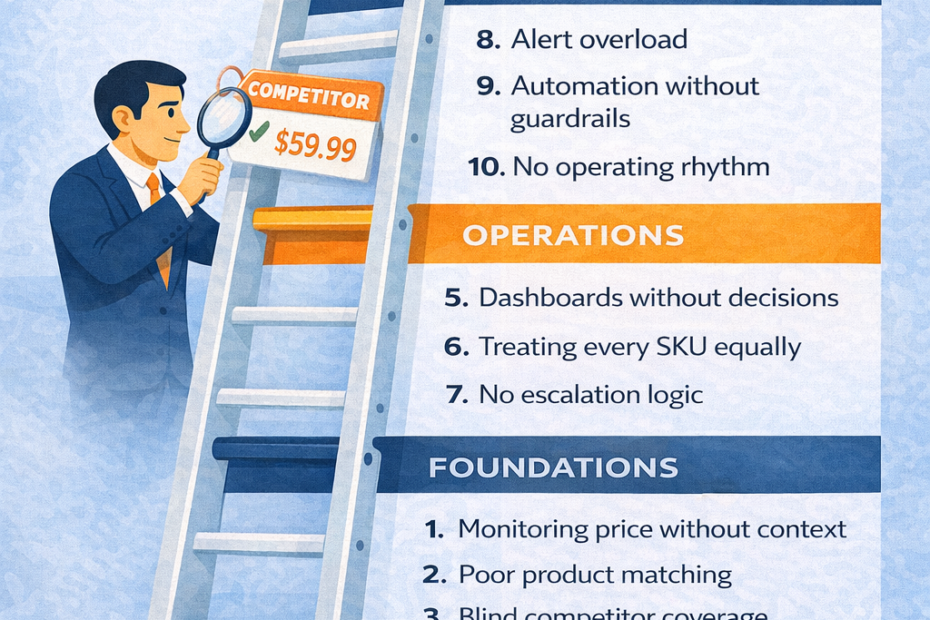
Across retailers, the same pattern emerges. As pricing maturity increases, specific mistakes fall away. What appears to be a tooling problem is often a structural one. The journey typically unfolds in stages.
Stage 1: Foundational Pricing Maturity — When Monitoring Feels Noisy
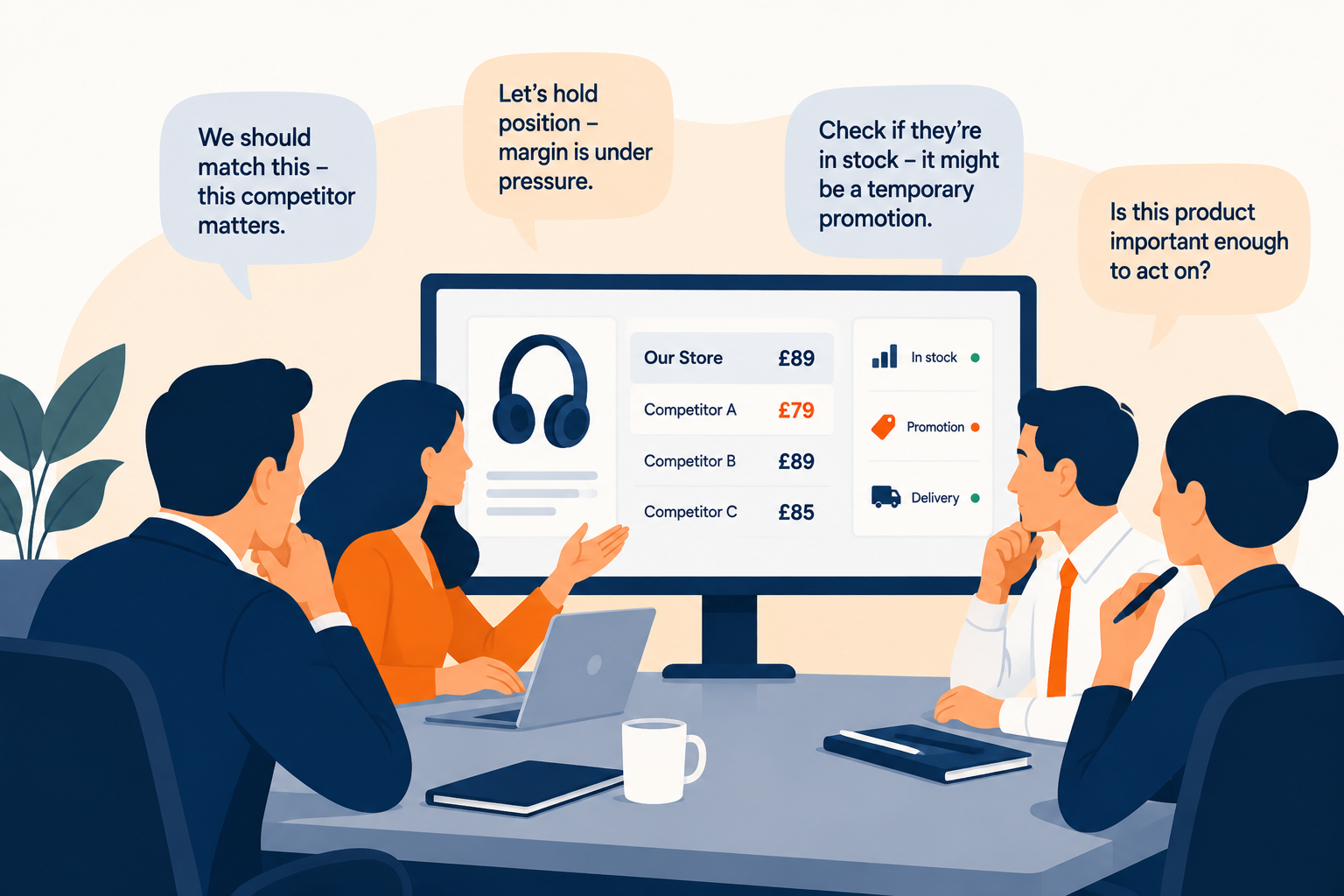
At the foundational level, retailers believe they have visibility because they have competitor prices. But visibility without context creates noise.
One common mistake at this stage is confusing data access with data confidence. Retailers collect competitor prices but ignore promotional mechanics, stock availability, and historical movement. Price drops are reacted to without understanding whether they are tactical, short-term, or driven by availability distortions. In several cases, retailers have sacrificed margin reacting to prices that were technically lower but commercially irrelevant.
Pricing maturity begins when price is viewed alongside promotion and availability rather than in isolation.
Another foundational issue is poor product matching. If like-for-like comparisons are inconsistent, every alert becomes questionable. Teams spend time debating whether products are truly comparable instead of acting. In one retailer, weekly pricing discussions consumed hours not because the data was wrong, but because no one fully trusted the matching logic behind it. Monitoring existed. Confidence did not.
Narrow competitor coverage also limits early pricing maturity. Monitoring only a small competitor set or single channel creates blind spots. Marketplaces, online-only players, and assortment shifts can reshape price perception quietly. Retailers often believe they are competitive until a broader view reveals exposure.
Finally, many retailers treat monitoring as static. Competitor lists, rules, and thresholds are rarely revisited. As markets evolve, monitoring remains anchored to outdated assumptions. At this stage, monitoring feels busy but unstable. Reports circulate, spreadsheets grow, and yet decisions remain debated.
Foundational pricing maturity stabilises data trust, contextual visibility, and competitive completeness.
Stage 2: Operational Pricing Maturity — When Monitoring Drives Action
Once data becomes reliable, pricing maturity moves into execution.
A common mistake at this stage is producing dashboards instead of enabling decisions. Insight exists, but behaviour does not change. The most mature retailers simplify reporting and design outputs around action triggers rather than visualisation. In one implementation, replacing multiple dashboards with a focused daily summary aligned to priority products materially improved response speed.
Another operational challenge is treating all products equally. Not every SKU shapes customer perception. Key Value Items anchor value in the customer’s mind. Retailers who spread monitoring effort evenly dilute focus. Pricing maturity introduces disciplined prioritisation, ensuring effort is concentrated where perception and competitive risk are highest.
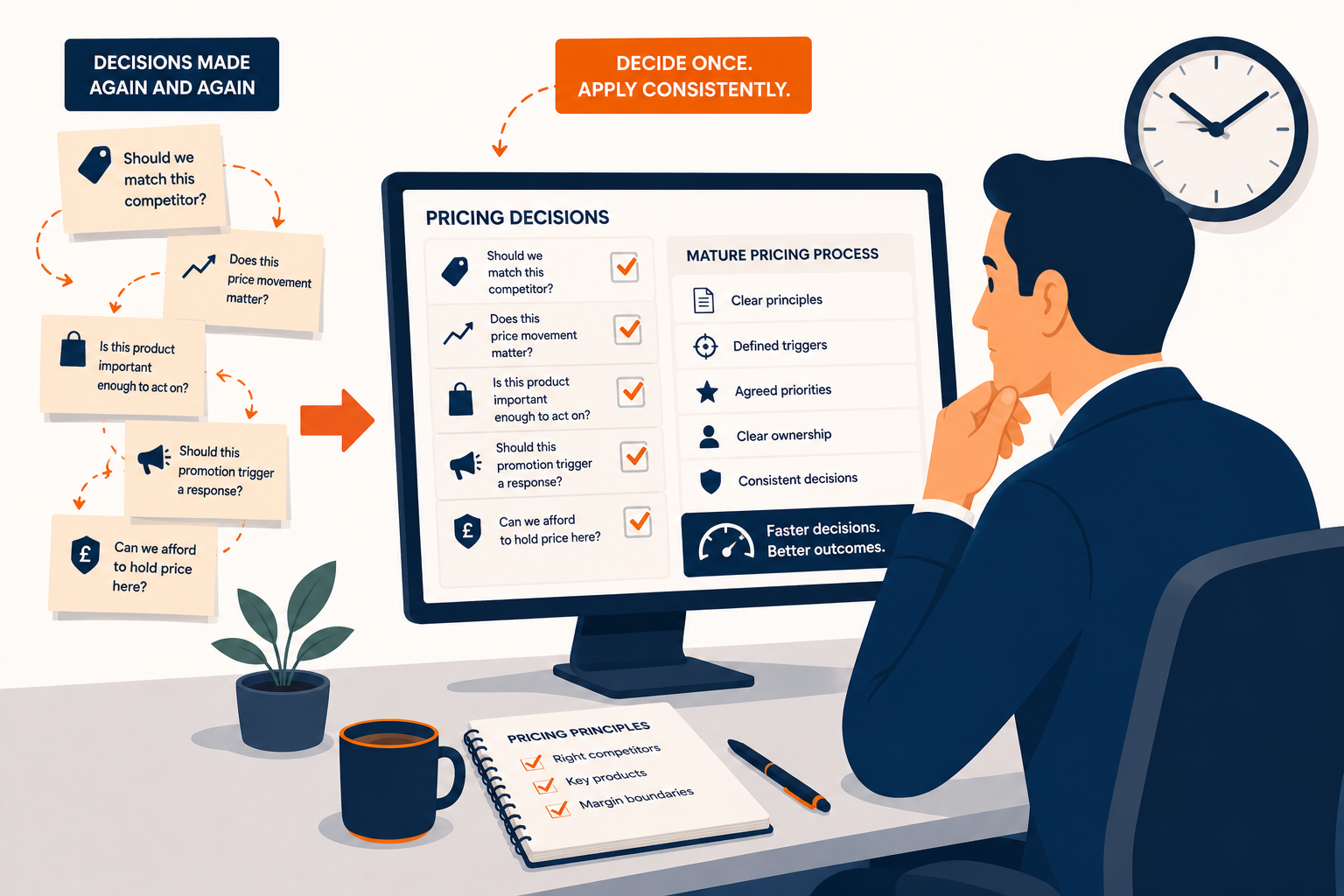
Monitoring without governance is also a sign that pricing maturity is incomplete. Without defined escalation paths or thresholds, internal debate replaces process. Mature organisations clarify who acts, when they act, and what triggers intervention. Monitoring shifts from analytical reporting to behavioural execution.
At this stage, pricing maturity reduces friction and accelerates decision confidence.
Stage 3: Optimised Pricing Maturity — When Discipline Replaces Reaction
Advanced pricing maturity is not about more data. It is about control.
Alert overload is a common optimisation failure. Too many alerts create fatigue; too few create exposure. Mature monitoring designs signals deliberately so that alerts highlight meaningful change rather than every fluctuation.
Automation without guardrails is another risk. While automation increases speed, blunt rules can undermine confidence. Retailers hesitate if automated changes appear disconnected from margin protection. In one example, configurable business rules integrated with ERP systems allowed automation within visible profitability boundaries. Confidence increased because governance was clear.
Finally, many organisations lack operating rhythm. Ad hoc monitoring guarantees reactive behaviour. Mature retailers embed cadence into pricing management through daily signal reviews, defined KVI oversight, and structured follow-up cycles. Monitoring becomes calm. Decisions feel intentional rather than urgent.
Optimised pricing maturity replaces reaction with discipline.
The Pricing Maturity Shift
Most pricing teams are not underperforming. They are simply earlier in the pricing maturity curve.
At the foundational stage, noise dominates. At the operational stage, workflow stabilises. At the optimisation stage, discipline replaces reaction.
As pricing maturity increases, a consistent pattern appears. Internal debate reduces. Confidence improves. Margin risk becomes visible earlier. Pricing strategy becomes clearer and more defensible.
Price monitoring is not a feature. It is a capability. And capability is built progressively.
Why Pricing Maturity Compounds Over Time
Pricing maturity is not built overnight. It evolves through structured processes, governance clarity, and accumulated experience.
Retailers that progress fastest are rarely those who simply acquire more data. They are those who deliberately build capability and work with partners who understand how to guide the journey from noise to discipline.
Pricing maturity compounds. As it increases, pricing shifts from reactive execution to controlled strategy.
That is when pricing stops feeling chaotic.
And starts feeling intentional.
Where Are You On The Ladder?
Pricing maturity is easier to improve when you know where your process stands today. To help with this, we’ve created a short Retail Pricing Intelligence Maturity Assessment that shows whether your pricing intelligence is trusted, understood and embedded enough to support confident decisions. In around 5 minutes, you’ll receive a personalised summary with your current stage, key focus areas and practical next steps.