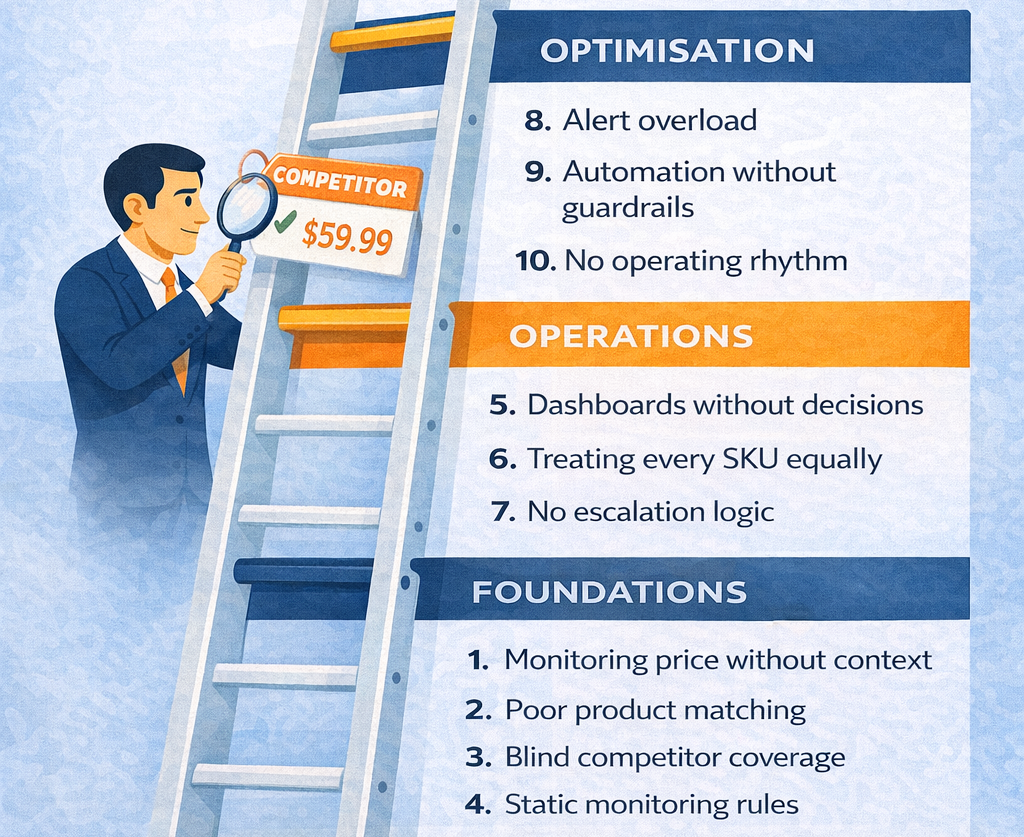

Price monitoring is rarely absent in retail organisations. Competitor prices are scraped, reports circulate internally, dashboards exist, and pricing reviews are scheduled. Yet pricing still feels reactive. Teams hesitate before acting, alerts are questioned, and internal debate replaces confidence.
At this stage the issue is not effort. It is maturity. Foundational price monitoring often creates activity without clarity. Retailers believe they have visibility because competitor prices are available. But visibility without structure, validation, and context produces noise. This is where pricing maturity begins.
Mistake 1: Confusing Data Access With Data Confidence
Collecting competitor prices is not the same as understanding the market.
Many retailers monitor headline price while ignoring promotional mechanics, stock availability, historical movement, and channel variation. A competitor appears cheaper, but the product is out of stock. A price drop looks aggressive, but it is part of a short-term bundle. A promotion seems deep, but the mechanic limits its real commercial impact.
Without context, price movements trigger unnecessary reactions and margin pressure.
We have seen retailers respond to competitor pricing that was technically lower but commercially irrelevant. The result was avoidable margin erosion.
Mature price monitoring shifts the lens. Price is viewed alongside promotion and availability. Competitive movements are evaluated against history, not in isolation.
In one engagement, once competitor pricing was analysed alongside promotional mechanics and stock availability, a retailer we worked with uncovered a very different opportunity. Instead of focusing solely on where competitors were cheaper, they identified a consistent pattern. A group of high-margin products where competitor stock levels were frequently low or inconsistent.
Rather than reacting defensively across the range, they built a structured list of these products. When competitors were out of stock or weakly positioned, they leaned in. Prices were held confidently and, in some cases, adjusted upward within clear guardrails. Visibility was supported with targeted promotion.
The result was not just margin protection. It created incremental revenue growth driven by disciplined confidence.
That shift did not come from more data. It came from context. Confidence begins when data is contextualised.
Mistake 2: Poor Product Matching Undermines Trust
Like-for-like accuracy is the foundation of pricing confidence.
If SKU matching is inconsistent or partially automated without validation, every alert becomes suspect. Teams spend time debating whether the comparison is fair rather than discussing the decision itself.
In one instance, fragmented SKU mapping forced category managers to manually validate competitor matches before reacting. Monitoring technically existed, but it slowed decisions rather than accelerating them.
When matching logic is trusted and validated, debate reduces. Monitoring becomes a shared truth rather than a point of contention.
Data confidence starts with comparability.
Mistake 3: Narrow Competitor Coverage Creates Blind Spots
Retail competition rarely sits neatly within a fixed competitor set.
Marketplaces introduce new sellers daily. Online-only competitors shift pricing dynamically. Assortment changes alter perceived value. Range depth can influence price perception as strongly as price itself.
Retailers often monitor a limited competitor list and assume visibility is complete. It rarely is.
Exposure frequently appears from unexpected channels or emerging sellers rather than established competitors.
Foundational maturity means broader, more dynamic coverage. Not monitoring everything indiscriminately, but ensuring competitive exposure is not artificially narrowed.
You cannot defend what you do not see.
Mistake 4: Treating Monitoring as Static
Markets evolve. Monitoring structures often do not.
Competitor lists remain unchanged for years. Matching logic is rarely revisited. Alert thresholds are set once and forgotten. Channels expand while monitoring frameworks remain anchored to older assumptions.
As competitive behaviour shifts, monitoring must evolve with it.
Retailers at the foundational stage often believe their system is complete because it once worked. But maturity requires ongoing calibration. Competitor sets should be reviewed. Product coverage should adapt to range shifts. Alert thresholds should reflect changing commercial priorities.
Monitoring that does not evolve quietly loses relevance.
Why Stage One Often Feels Busy But Uncertain
When retailers operate at the foundational stage of pricing maturity, pricing teams often feel overloaded.
Spreadsheets circulate. Dashboards multiply. Alerts trigger. Reviews happen.
Yet decisions still feel slower than they should.
That tension is the signal. The issue is not the volume of data. It is trust, context, and structure.
Foundational maturity stabilises three critical elements:
• Data is validated and comparable
• Competitive signals are contextualised
• Coverage reflects real market exposure
When these foundations are in place, monitoring stops feeling noisy. It begins to feel stable.
What Foundational Pricing Maturity Changes
Once Stage 1 foundations are stabilised, several things shift.
Internal debate reduces because the data is trusted. False alarms decrease because signals are contextualised. Competitive exposure becomes clearer because coverage reflects the real market.
Most importantly, pricing teams begin to act with greater conviction.
Stage 1 does not deliver automation or optimisation. It delivers clarity.
And clarity is what allows the next stage of pricing maturity to begin.
The First Step In Pricing Maturity
Many retailers believe they need more dashboards, more feeds, or more frequent reviews.
Often, what they need is stronger foundations.
Price monitoring maturity does not begin with speed. It begins with trust.
When data is validated, contextualised, and complete, many of the most common pricing frustrations disappear naturally.
The journey from reactive pricing to confident pricing does not start with optimisation.
It starts here.