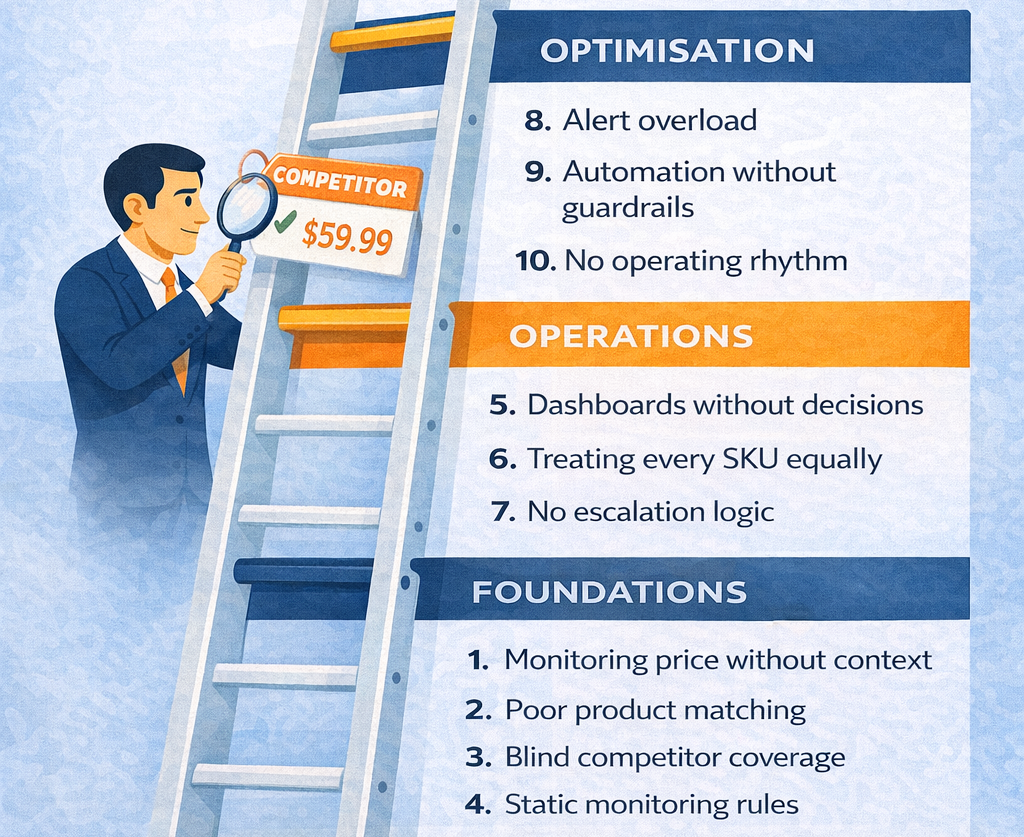

Most retailers monitor competitor prices, but far fewer pay attention to the competitor signals that appear long before the price changes. These early indicators often reveal far more about competitor strategy, stock pressure, promotional planning and shifts in market confidence than the final price point ever could.
Retailers who learn to recognise competitor signals gain a significant advantage. They understand what is happening behind the scenes, anticipate changes sooner and act before the market reacts. This is the difference between reactive price monitoring and strategic pricing intelligence.
Below are the competitor signals that reveal intent long before a price change occurs, along with how retailers can use these insights to make more confident and informed pricing decisions.
Shifts in Stock Levels and Availability
Stock levels are one of the strongest competitor signals for predicting future pricing moves. When a competitor’s inventory falls quickly, it often indicates rising demand or a strategic focus on that category. When stock levels rise or remain static for long periods, it may reflect slow sell-through or preparation for future discounting.
Monitoring competitor stock levels helps retailers understand whether a competitor is preparing for clearance, maintaining value or responding to normal stock fluctuations. This context is essential for avoiding unnecessary reactions.
Changes in Product Ranges and Assortment
Adjustments in product assortment reveal far more than competitors intend to communicate. New product additions can indicate expansion in a category or a new value proposition. Removed products often signal declining demand, range clean-up or preparation for promotional activity.
Tracking these assortment changes allows retailers to identify emerging threats, anticipate shifts in category focus and understand where competitors may become more aggressive.
Adjustments to Product Titles, Descriptions and Metadata
Competitors frequently update product content before they update pricing. Revised titles, enhanced descriptions or refreshed metadata are often early signs of an upcoming promotional push or a shift in product positioning.
Retailers who monitor content updates gain insight into which products competitors are prioritising, along with how aggressively they may compete in the coming weeks.
Promotional Rhythm and Frequency
Promotional activity often follows patterns. Competitors tend to discount at predictable points in the trading cycle, such as end-of-quarter periods, seasonal transitions or stock clearouts. Even when discount depth or mechanics change, the timing usually remains consistent.
Understanding this rhythm helps retailers prepare for upcoming promotions and avoid overreacting to one-off events that are part of habitual competitor behaviour.
Movements in Related Categories or Bundles
Competitors rarely adjust pricing in a single area without influencing adjacent categories. A sudden increase in promotional activity for accessories can signal an upcoming price change for core items. Shifts in bundles, attachments or complementary products also point to broader category strategies.
Spotting these competitor signals enables retailers to respond strategically across categories, rather than reacting to isolated changes.
Variations in Delivery Costs, Lead Times and Service Promises
Delivery pricing and service levels significantly influence customer perception. When a competitor reduces delivery fees or improves lead times, it increases perceived value even without adjusting product prices.
Retailers who only monitor price may misinterpret the competitive landscape. Tracking these wider value signals provides a more accurate view of competitiveness.
Patterns in Customer Reviews and Sentiment
Customer feedback can reveal important competitor signals. Rising review volume may indicate increased demand or improved positioning. A decline in sentiment may signal issues with product quality or service, which can lead to future price reductions or clearance activity.
Monitoring review trends helps retailers better understand competitor performance and anticipate how pricing may shift in response.
Changes in Search Visibility and Ranking
Search visibility is often one of the earliest competitor signals. When competitors increase paid search activity or move up organic rankings, it often reflects renewed investment or category focus. If visibility drops, it may indicate stock issues or retreat.
These movements often occur before price changes, making them valuable predictors of competitor behaviour.
Why Competitor Signals Matter More Than Price Alone
A price change is the final outcome of many internal decisions. By the time the price moves, the opportunity to anticipate and prepare has already passed. Retailers who track competitor signals gain the context required to respond with control rather than react under pressure.
High-quality pricing intelligence provides timely and validated insight across the signals that drive price movements. When teams understand these indicators, they become more proactive, protect margin more effectively and avoid unnecessary pricing reactions.
Stronger Decision Making Through Better Intelligence
Retailers who move beyond simple price monitoring develop a deeper understanding of competitor strategy. Competitor signals reveal the patterns behind market behaviour and help teams make decisions with more confidence.
This leads to benefits such as:
-
Earlier visibility of emerging threats
-
Improved promotional timing
-
More confident pricing decisions
-
Reduced reactive behaviour
-
Better protection of margin
-
Stronger category planning
By understanding competitor signals, retailers move from chasing the market to anticipating it.