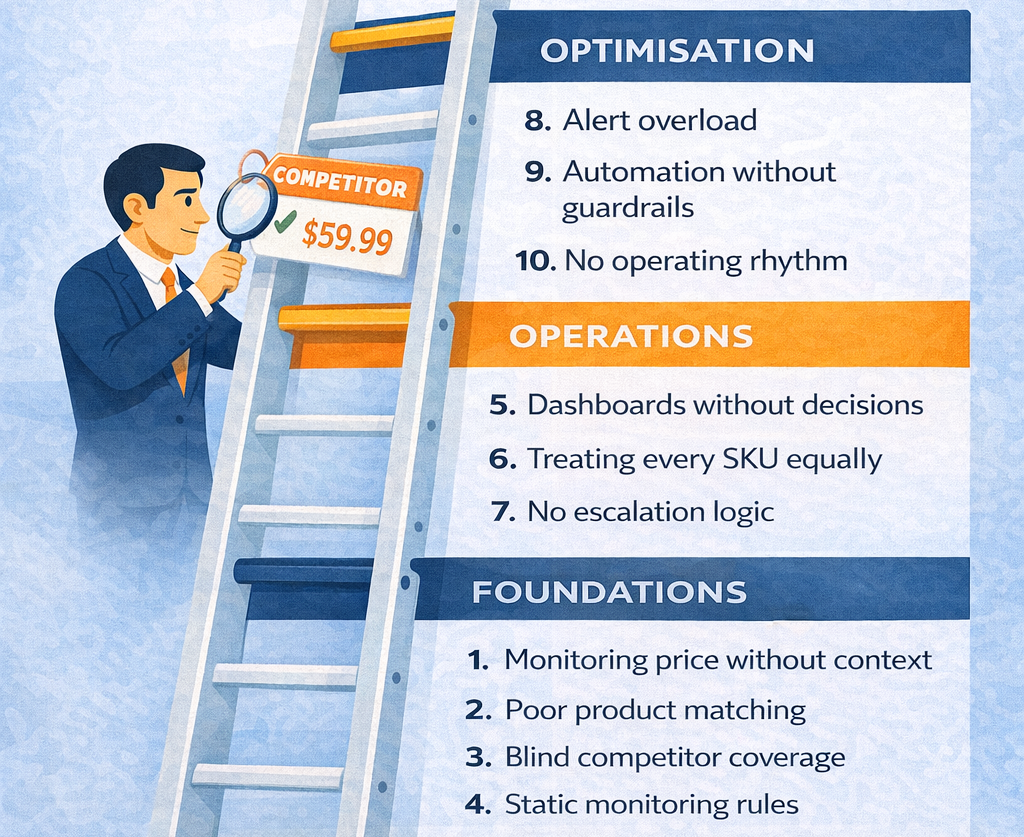

Most retailers believe pricing maturity improves once competitor data becomes reliable. It doesn’t. Reliable data removes noise, but it does not remove hesitation. Stage 2 of pricing maturity begins when monitoring moves from information to execution. This is the operational shift where insight must translate into consistent, confident decisions.
At this stage, data exists. Matching is trusted. Coverage is broader. Yet something still feels slower than it should. Pricing teams have the information they need, but decisions still require discussion. Alerts trigger internal debate and pricing meetings often run longer than expected. That tension signals the transition from foundational maturity to operational maturity.
The Shift From Visibility to Behaviour
In Stage 1, the focus is trust. In Stage 2, the focus is behaviour.
Retailers often assume that once competitor data becomes accurate, pricing performance will improve automatically. Instead, a new challenge appears. Insight accumulates, but decisions hesitate. This is where pricing maturity becomes operational.
Operational pricing maturity is the ability to embed competitor visibility into daily workflow so that the right people act at the right time for the right reasons. Without this shift, monitoring remains observational rather than strategic.
Mistake 1: Producing Dashboards Instead of Enabling Decisions
A common operational trap is dashboard proliferation. Retailers accumulate visualisations, performance views, and competitor summaries with the assumption that more visibility will automatically improve pricing decisions. In practice, it often produces paralysis.
When monitoring requires interpretation before action, response time increases. If dashboards do not clearly indicate what requires intervention, teams default to discussion rather than execution.
We once worked with a retailer whose pricing meetings regularly ran over time. Not because the team lacked data, but because no single view clearly identified which competitor movements required immediate attention. They had multiple dashboards, weekly reports, and exports circulating internally, but no clear operational signal.
Once this was simplified into a structured daily summary highlighting priority competitor movements across key products, the impact was immediate. Meetings shortened, decisions accelerated, and discussions moved from reviewing information to agreeing actions.
Operational maturity often begins by reducing information rather than expanding it. A practical rule we often suggest is simple: every pricing report should answer one question — what requires action today? If the answer is unclear, the output is too complex.
Mistake 2: Treating All Products as Equal
One of the clearest indicators of operational immaturity is equal effort across the entire product range. Not every SKU shapes customer perception and not every product requires rapid reaction, yet many pricing processes distribute monitoring effort evenly.
The result is diluted focus.
Key Value Items anchor customer perception. These products influence price trust, competitiveness, and traffic. When they are not clearly identified and protected, operational noise increases and teams spend time reacting to signals that have limited commercial impact.
In one retailer we supported, pricing alerts were firing across thousands of products every day. Category managers were reviewing large volumes of signals, most of which had little influence on customer perception. After introducing a structured KVI list, the process changed significantly.
Instead of reacting across the entire range, the team focused on a smaller group of high-visibility products that directly shaped price perception. Competitor movements on these products triggered immediate review, while the rest of the range followed a slower cadence.
This reduced unnecessary pricing activity while strengthening competitiveness where it mattered most.
A practical way to introduce this discipline is to segment products into clear roles:
• Products that anchor price perception
• Products that protect margin
• Products that require rapid response
• Products that allow controlled price variance
Operational maturity is not about watching more products. It is about watching the right ones.
Mistake 3: Monitoring Without Governance
Reliable data and prioritisation are not enough without governance. In many organisations, competitor movement triggers the same questions:
Is this significant?
Should we react?
Who owns the decision?
What margin threshold applies?
Without predefined rules, debate replaces process.
We often see pricing teams escalate routine decisions unnecessarily because clear boundaries are missing. Category managers hesitate to act, commercial leaders become involved in everyday pricing decisions, and response time slows.
One retailer we worked with addressed this by introducing a simple decision framework. Instead of asking who should act each time, they defined clear thresholds:
• Minor competitor movement handled at category level
• KVI price gaps escalated within defined timeframes
• Margin guardrails to protect profitability
Once these rules were documented, pricing decisions accelerated because ownership was clear.
Governance does not remove judgement. It removes ambiguity.
The Operational Confidence Gap
At Stage 2, the most common frustration is not data accuracy. It is decision friction. Teams feel they have the information required, but execution still feels slower than expected.
This gap often stems from:
• Overly broad reporting
• Undefined action triggers
• Blurred accountability
• Lack of KVI clarity
• Inconsistent escalation logic
Operational pricing maturity closes this gap by aligning data with behaviour.
Embedding Operational Rhythm
One of the strongest indicators of Stage 2 maturity is rhythm. Immature monitoring feels ad hoc, while mature operational pricing feels structured.
In the most effective organisations we work with, pricing decisions follow a predictable cadence that includes:
• Daily reviews of competitor signals focused on priority products
• Weekly alignment on KVI competitiveness
• Defined thresholds for escalation
• Clear hand-offs between pricing, trading, and commercial leadership
Once this rhythm is embedded, pricing discussions become shorter and more decisive. Decision pathways become clearer and urgency reduces because the process is predictable.
Pricing stops feeling reactive.
What Operational Pricing Maturity Changes
When Stage 2 is fully embedded, several noticeable shifts occur. Internal debate reduces because the data is trusted and ownership is clear. Response time improves without increasing pressure because decisions follow a structured process. Pricing strategy becomes visible in daily behaviour because guardrails and priorities are consistently applied.
Operational pricing maturity does not require complex systems. It requires alignment between data, ownership, and workflow.
A Quick Operational Maturity Diagnostic
To assess whether your organisation has reached Stage 2 maturity, consider the following questions:
• Do pricing reports clearly show what requires action today?
• Are Key Value Items formally defined and actively protected?
• Are escalation paths documented and understood?
• Do pricing discussions focus on execution rather than interpretation?
• Does monitoring feel structured rather than reactive?
If several of these questions feel uncertain, operational maturity may still be developing.
Why Stage 2 Is Often the Longest Stage
Many retailers move quickly through foundational maturity. Far fewer fully embed operational maturity. This stage requires behavioural change rather than system change. It demands clarity of ownership, discipline in prioritisation, and alignment across pricing, commercial, and category teams.
It is less visible than automation but often far more impactful.
Operational pricing maturity is where pricing shifts from observation to control. Stage 3 optimisation only becomes possible once this discipline exists.
Pricing maturity is not a technology upgrade. It is a structured progression.
Stage 1 builds trust.
Stage 2 builds execution discipline.
Stage 3 builds controlled automation.
Retailers who stabilise Stage 2 find that pricing becomes calmer, more deliberate, and strategically aligned. That is when pricing stops feeling reactive and starts feeling intentional.