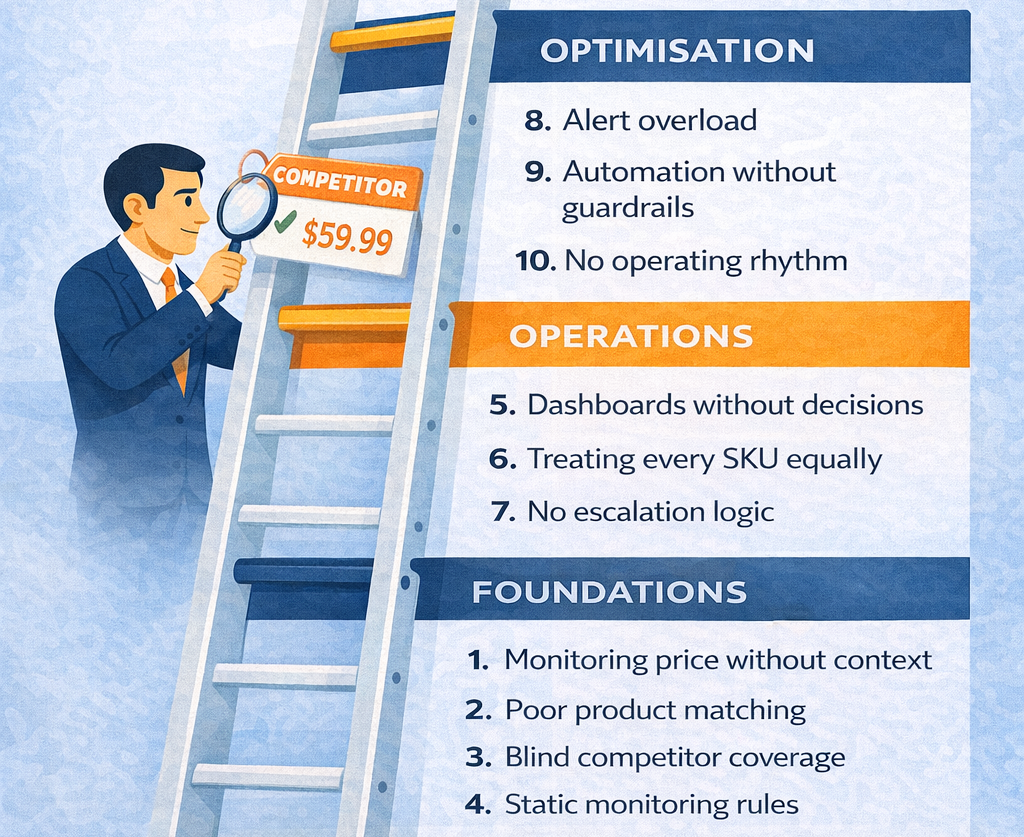

By the time retailers reach Stage 3 of pricing maturity, most foundational challenges have already been addressed. Data is trusted. Product matching is reliable. Competitor coverage is broad. Monitoring fits naturally into daily workflow.
At this point, pricing teams are no longer debating whether the data is correct. They are acting on it.
Yet a different challenge appears.
The question becomes how to manage pricing signals at scale without creating noise, hesitation, or risk.
This is where optimisation begins. Stage 3 is not about collecting more information. It is about building discipline around how pricing decisions happen.
Mistake 8: Alert Overload
As monitoring becomes more sophisticated, many retailers unintentionally create a new problem. Too many alerts.
Every price change triggers a signal. Every competitor movement generates a notification. Every promotion update produces another data point.
At first, this feels valuable. Over time, it becomes overwhelming.
When pricing teams receive too many alerts, one of two things happens. Either every signal is investigated, which slows decision-making, or alerts are gradually ignored.
Neither outcome supports confident pricing.
Disciplined monitoring focuses on meaningful change rather than constant movement. Signals should highlight moments that require attention, not every fluctuation in the market.
Mature pricing environments refine alerts around:
• Key Value Items and high-visibility products
• Significant price gaps against competitors
• Competitor promotions on strategically important products
• Availability shifts that influence customer perception
When alerts are intentional rather than exhaustive, teams spend less time scanning data and more time making decisions.
Mistake 9: Automation Without Guardrails
Automation is often seen as the final step in pricing maturity. But automation without structure introduces a new form of hesitation.
Pricing teams become cautious. They worry that automated rules may trigger changes that undermine margin or create unintended competitive responses.
When automation lacks guardrails, it is either overridden or avoided entirely.
Effective pricing automation is never blind. It operates within clearly defined commercial boundaries.
These typically include:
• Margin protection thresholds
• Maximum and minimum price movement limits
• Rules tied to competitor positioning rather than raw price gaps
• Exceptions for specific products or categories
In one retailer we worked with, automation was only introduced after clear profitability guardrails and product-level priorities were defined. Once those boundaries were visible and understood, automation became trusted rather than feared.
The result was not just faster pricing execution, but greater confidence in every decision.
Automation does not replace judgement. It supports it.
Mistake 10: No Operating Rhythm
Even with reliable data and refined alerts, pricing can still feel reactive if there is no consistent operating rhythm.
Many retailers rely on ad-hoc monitoring. Teams check dashboards when something feels wrong or when time allows.
This creates inconsistent behaviour.
Disciplined pricing teams embed monitoring into a predictable cadence.
Typical structures include:
• Daily signal reviews focused on priority products
• Weekly category-level pricing reviews
• Clear ownership for Key Value Item oversight
• Defined follow-up processes when competitor behaviour shifts
This rhythm removes uncertainty from pricing decisions. Teams know when signals will be reviewed, who owns the response, and how decisions move forward.
Pricing stops feeling urgent and begins to feel controlled.
When Monitoring Becomes Discipline
Stage 3 is where pricing maturity becomes visible in behaviour.
Data is trusted. Workflow is aligned. Signals are refined. Automation operates within clear boundaries.
The result is not necessarily faster pricing decisions.
It is calmer ones.
Instead of reacting to every movement, teams understand which signals matter. Instead of debating alerts, they trust the framework guiding their actions.
Pricing becomes a structured capability rather than a constant reaction.
What Optimised Pricing Environments Look Like
Across retailers operating at this level of maturity, several patterns appear consistently.
- Pricing signals are prioritised rather than overwhelming.
- Automation operates within visible commercial guardrails.
- Teams follow a predictable decision cadence.
- Key products receive disproportionate attention because they shape price perception.
The outcome is greater control.
Retailers at this stage do not necessarily change prices more frequently. They simply avoid the hesitation and noise that slow others down.
The Final Step in the Pricing Maturity Ladder
The progression from foundational monitoring to disciplined pricing capability follows a recognisable path.
- Stage 1 brings clarity and trusted data.
- Stage 2 aligns monitoring with operational workflow.
- Stage 3 introduces discipline, scale, and control.
Each stage removes a different source of friction.
What begins as noisy monitoring evolves into structured pricing intelligence.
And when pricing intelligence is disciplined, pricing decisions stop feeling reactive.
They become deliberate.