Price Tracking Vs
Price Monitoring Vs
Price Intelligence
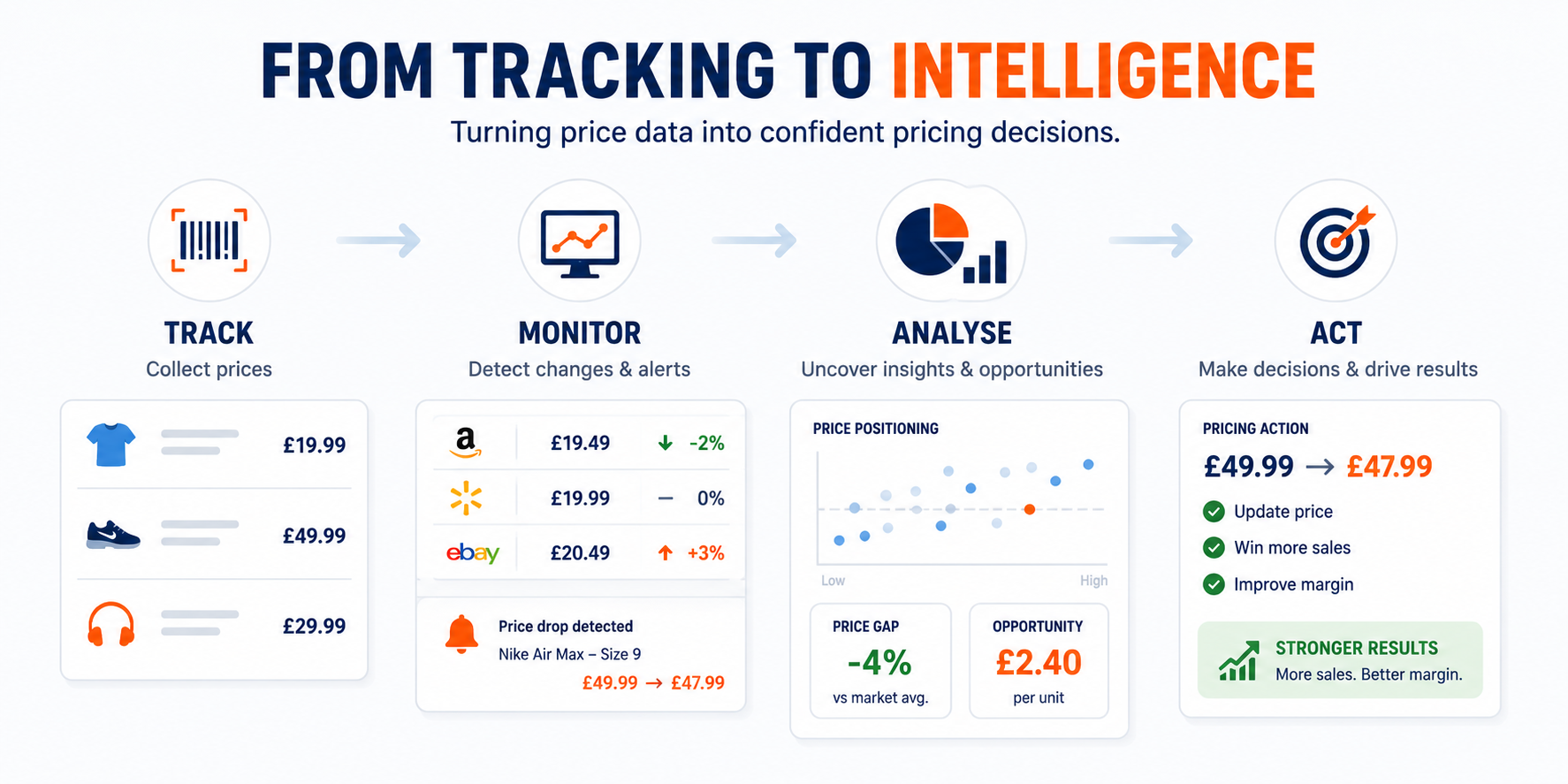
Price tracking, price monitoring and price intelligence are connected, but they are not the same.
Price tracking records competitor prices for selected products. Price monitoring follows pricing changes, promotions, availability and other market signals over time. Price intelligence analyses that information to support pricing decisions, strategy and commercial action.
For businesses managing competitor pricing, these three stages often work together. Tracking provides basic visibility, monitoring shows how the market is moving, and intelligence helps teams understand what those changes mean and when action may be needed.
This guide explains the differences among price tracking, price monitoring, and price intelligence, when each approach is useful, and how they support better competitor pricing decisions.
Quick Comparison: Price Tracking, Price Monitoring and Price Intelligence
Price tracking, price monitoring and price intelligence each support competitor pricing, but they operate at different levels.
| Term | What It Means? | Main Purpose | Best Used For |
|---|---|---|---|
|
Price Tracking |
Recording competitor prices for selected products |
Basic visibility |
Seeing what competitors charge and when prices change |
|
Price Monitoring |
Regularly checking prices, promotions, availability and market movement |
Market awareness |
Understanding competitor activity across products, categories or channels |
|
Price Intelligence |
Analysing monitored data to identify trends, gaps and pricing opportunities |
Commercial action |
Supporting pricing strategy, margin decisions and faster responses |
Price tracking is usually the starting point. It helps businesses see competitor prices at product level.
Price monitoring adds frequency and wider market context. It helps teams understand how prices, promotions and availability change over time.
Price intelligence goes further by turning monitored information into insight. It helps pricing teams decide what action to take, rather than simply showing that a competitor price has changed.
What Is Price Tracking?
Price tracking is the process of recording competitor prices for selected products over time.
It is the most basic layer of competitor pricing visibility. A business may track prices manually in a spreadsheet or use automated tools to collect price changes from competitor websites, marketplaces or ecommerce channels.
Price tracking is useful when a team needs to know what a competitor is charging for a specific product and whether that price has changed. It can help identify simple price movements, historic changes and differences between selected competitors.
However, price tracking on its own is limited. It usually shows what changed, but it does not always explain why the change happened, whether promotions or stock availability affected the price, or what action the business should take next.
What Is Price Monitoring?
Price monitoring is the ongoing process of checking competitor prices, promotions, availability and other market signals.
It goes further than basic price tracking because it is designed to show how the market changes over time. Instead of only recording individual price points, monitoring helps businesses see patterns across products, competitors, categories and channels.
Price monitoring can include regular data collection, alerts, dashboards and reports. It may also track stock status, promotional activity, delivery charges, marketplace changes and historic price movement.
This makes competitor price monitoring useful for businesses that need to react quickly to market changes, manage large product ranges or understand how competitor activity may affect pricing, sales and margin.
What Is Price Intelligence?
Price intelligence is the process of analysing competitor pricing data and market signals to support better pricing decisions.
It builds on price tracking and price monitoring, but it goes further than collecting prices. Price intelligence helps businesses understand what pricing changes mean, where pricing gaps exist, how competitors are positioned, and what commercial action may be needed.
This can include analysing competitor prices, promotions, availability, historic trends, product matches and category-level movement. The aim is to turn market information into clear pricing insight.
Price intelligence is most useful when businesses need to protect margin, improve competitiveness, review pricing strategy or respond more confidently to market changes.
How Price Tracking, Price Monitoring and Price Intelligence Work Together
Price tracking, price monitoring and price intelligence often work as connected stages.
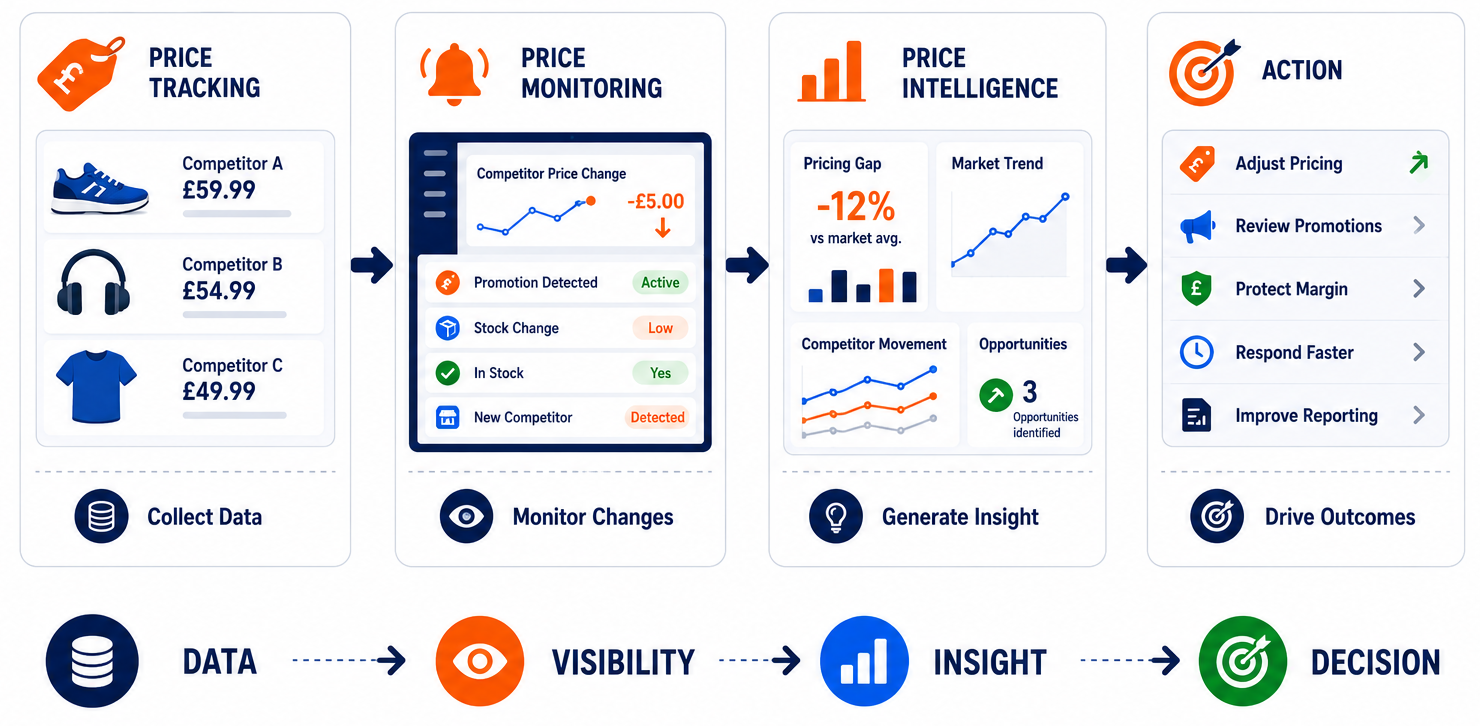
First, businesses track selected competitor prices to understand what specific products cost across the market.
They then monitor those prices over time, alongside promotions, availability, stock changes and other competitor activity.
Next, they analyse the data to identify pricing gaps, market trends, competitor movement and potential risks or opportunities.
Finally, they act by adjusting pricing, reviewing promotions, protecting margin, improving reports or using alerts to respond faster when market conditions change.
This is why price intelligence depends on reliable tracking and monitoring. Without accurate market data, pricing teams have less confidence in the decisions they make.
When Is Price Tracking Enough?
Price tracking may be enough when a business only needs a simple view of selected competitor prices.
This is usually suitable for smaller product ranges, limited competitor sets or markets where prices do not change frequently. In these cases, basic tracking can help teams review individual price changes without needing more advanced reporting or analysis.
Price tracking can also work for occasional pricing checks, simple benchmarking or early-stage competitor research.
However, it becomes less effective when product catalogues grow, competitors change prices regularly, promotions affect the final price, or teams need alerts, reports and wider market context. At that point, price monitoring or price intelligence is usually more useful.
When Do Businesses Need Price Monitoring?
Businesses usually need price monitoring when competitor prices change regularly or when basic tracking no longer provides enough context.
This often happens when a company manages a larger product catalogue, monitors multiple competitors, or operates in categories where promotions, stock availability and delivery costs change frequently.
Price monitoring helps teams move from occasional checks to regular market visibility. Instead of only seeing individual price changes, they can identify competitor movement, pricing patterns and availability shifts across products or categories.
It is especially useful when pricing teams need alerts, dashboards or scheduled reports to respond quickly and avoid relying on outdated competitor information.
When Does Monitoring Become Price Intelligence?
Price monitoring becomes price intelligence when the collected information is validated, analysed and used to support pricing decisions.
Monitoring shows what is happening in the market. Price intelligence explains what those changes mean and whether action is needed.
For example, a competitor price change may not matter on its own. But when it is viewed alongside stock availability, promotions, delivery costs, historic trends and product matching, it can reveal a wider pricing opportunity or risk.
This is where pricing data becomes pricing insight. Instead of only tracking competitor movement, businesses can identify pricing gaps, protect margin, respond to promotions and make more confident commercial decisions.
Why Product Matching and Data Validation Matter
Product matching and data validation are essential because inaccurate comparisons can make price tracking, price monitoring and price intelligence unreliable.
If the wrong products are matched, a business may compare different sizes, variants, bundles, pack quantities or delivery options as if they were the same item. This can create misleading pricing reports and poor commercial decisions.
Data validation helps reduce these risks by checking that prices, products, promotions and availability information are accurate and up to date.
Reliable product matching turns raw competitor information into useful market visibility. Without it, pricing teams may see price changes, but they cannot be confident that those changes reflect a true like-for-like comparison.
What Should Businesses Monitor Besides Price?
Effective price monitoring should include more than headline prices.
A product may appear cheaper or more expensive depending on promotions, stock availability, delivery costs, marketplace sellers or product visibility. These signals can change how competitive a product looks to customers.
Businesses may need to monitor:
| Data Point | Why It Matters |
|---|---|
|
Competitor prices |
Shows direct price position against selected competitors |
|
Promotions and discounts |
Helps identify temporary offers, sale activity and promotional pressure |
|
Multibuy offers |
Shows whether the true value changes when products are bundled or bought in quantity |
|
Stock availability |
Helps explain whether a competitor price is meaningful if the product cannot be purchased |
|
Delivery charges |
Affects the total cost to the customer |
|
Marketplace sellers |
Shows who is selling the product and how prices vary across sellers |
|
Product visibility |
Helps understand whether products are prominent, hidden, featured or promoted |
|
Historic price movement |
Shows how pricing changes over time rather than at one moment |
|
Category trends |
Helps identify wider market movement beyond individual products |
Monitoring these signals gives businesses a clearer view of competitor activity and helps pricing teams make decisions based on the full market picture, not price alone.
Which Approach Does Your Business Need?
The right approach depends on the size of the product range, the speed of market changes and how the information will be used.
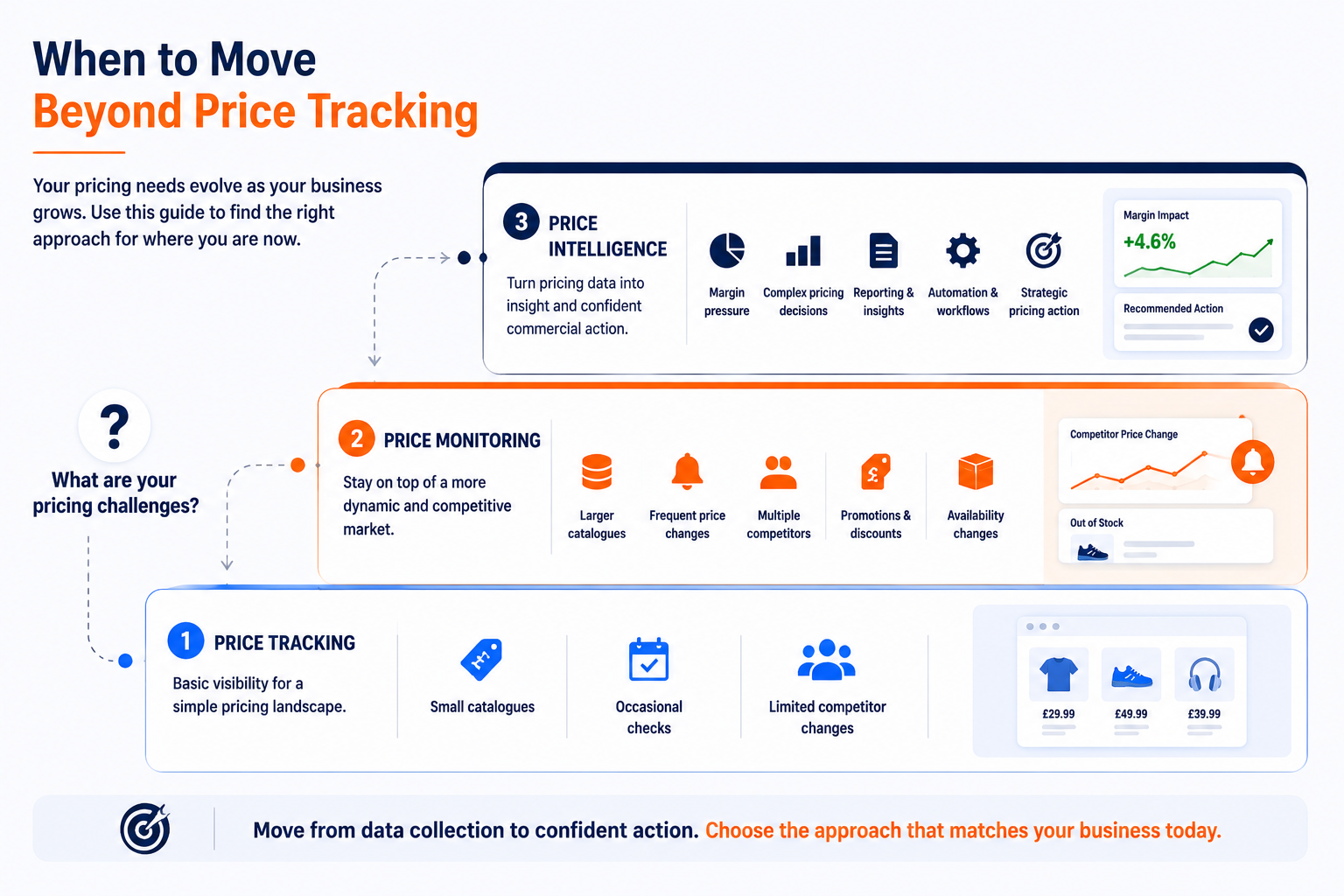
Price tracking is useful for simple visibility. Price monitoring is better when businesses need regular awareness of competitor movement. Price intelligence is the strongest option when pricing teams need to understand market changes and decide what action to take.

How Mature Is Your Pricing Intelligence?
Take our 5-minute assessment to see how trusted, usable and embedded your pricing intelligence is today. You’ll receive a personalised summary with your maturity stage, key focus areas and practical next steps.
Price Tracking vs Price Monitoring vs Price Intelligence
FAQ
Is price tracking the same as price monitoring?
No. Price tracking and price monitoring are related, but they are not the same.
Price tracking records competitor prices for selected products. Price monitoring is broader because it follows pricing changes, promotions, availability and other market signals over time.
Tracking helps show what a competitor charged. Monitoring helps show how competitor activity is changing.
Is price monitoring part of price intelligence?
Yes. Price monitoring is often one of the foundations of price intelligence.
Monitoring provides the market information, while price intelligence adds validation, analysis and commercial context. This helps teams understand what pricing changes mean and whether action may be needed.
Can businesses use price intelligence without price monitoring?
Not effectively. Price intelligence depends on reliable and regularly updated market information.
Without price monitoring, teams may rely on outdated, incomplete or inconsistent data. This makes it harder to identify pricing trends, understand competitor behaviour or make confident pricing decisions.
What is the main difference between price tracking and price intelligence?
Price tracking shows individual price changes. Price intelligence explains what those changes mean.
Tracking may show that a competitor has reduced the price of a product. Price intelligence helps assess whether that change is part of a wider trend, linked to a promotion, affected by availability or relevant to your own pricing strategy.
How often should businesses monitor competitor prices?
Monitoring frequency depends on how quickly prices change, how competitive the category is and how the information will be used.
Some businesses may only need periodic updates, while fast-moving categories may require daily or more frequent monitoring. The right frequency should support pricing decisions without creating unnecessary data noise.
How does product matching affect price monitoring and intelligence?
Product matching affects whether competitor price comparisons are accurate and useful.
If products are matched incorrectly, pricing teams may compare different sizes, models, pack quantities or product variants as if they were the same item. Accurate matching helps ensure monitored data can be trusted and used for pricing analysis.
What does price monitoring include besides price?
Price monitoring can include promotions, discounts, multibuy offers, stock availability, delivery charges, marketplace sellers and historic price movement.
These details matter because the headline price does not always show the full competitive picture. A product may look cheaper at first glance, but delivery costs, availability or promotions can change how competitive it really is.
How much does price intelligence software cost?
The cost of price monitoring and price intelligence solutions usually depends on the number of products being tracked, the competitors included, how often data is updated, and the level of reporting, setup or automation required.
Insitetrack solutions start from £495 per month, with pricing tailored to each business rather than a fixed one-size-fits-all package. For more detail, visit our pricing page.