

Price Intelligence
Software & Tools
For Retailers
What Is Price Intelligence Software?
Price intelligence software helps retailers, brands, and ecommerce teams collect, monitor, validate, and analyse competitor pricing data across websites, marketplaces, and digital channels.
Â
Rather than simply tracking prices, price intelligence tools help businesses understand how products are positioned in the market, where pricing gaps exist, and how competitor activity may affect sales, margin, and overall pricing strategy.
Â
Insitetrack brings relevant pricing information into one place, including competitor prices, your own prices, product information, promotional activity, and historic pricing trends. This gives commercial teams a clearer view of the market and helps them make more informed pricing decisions.
Â
Price intelligence software is especially useful for businesses managing large product catalogues, multiple competitors, and fast-moving categories where prices can change daily or even multiple times throughout the day.
How Does Price Intelligence Software Work?
Price intelligence software works by collecting competitor pricing data, matching products accurately, validating the data, and presenting insights in a format that pricing teams can use.
Â
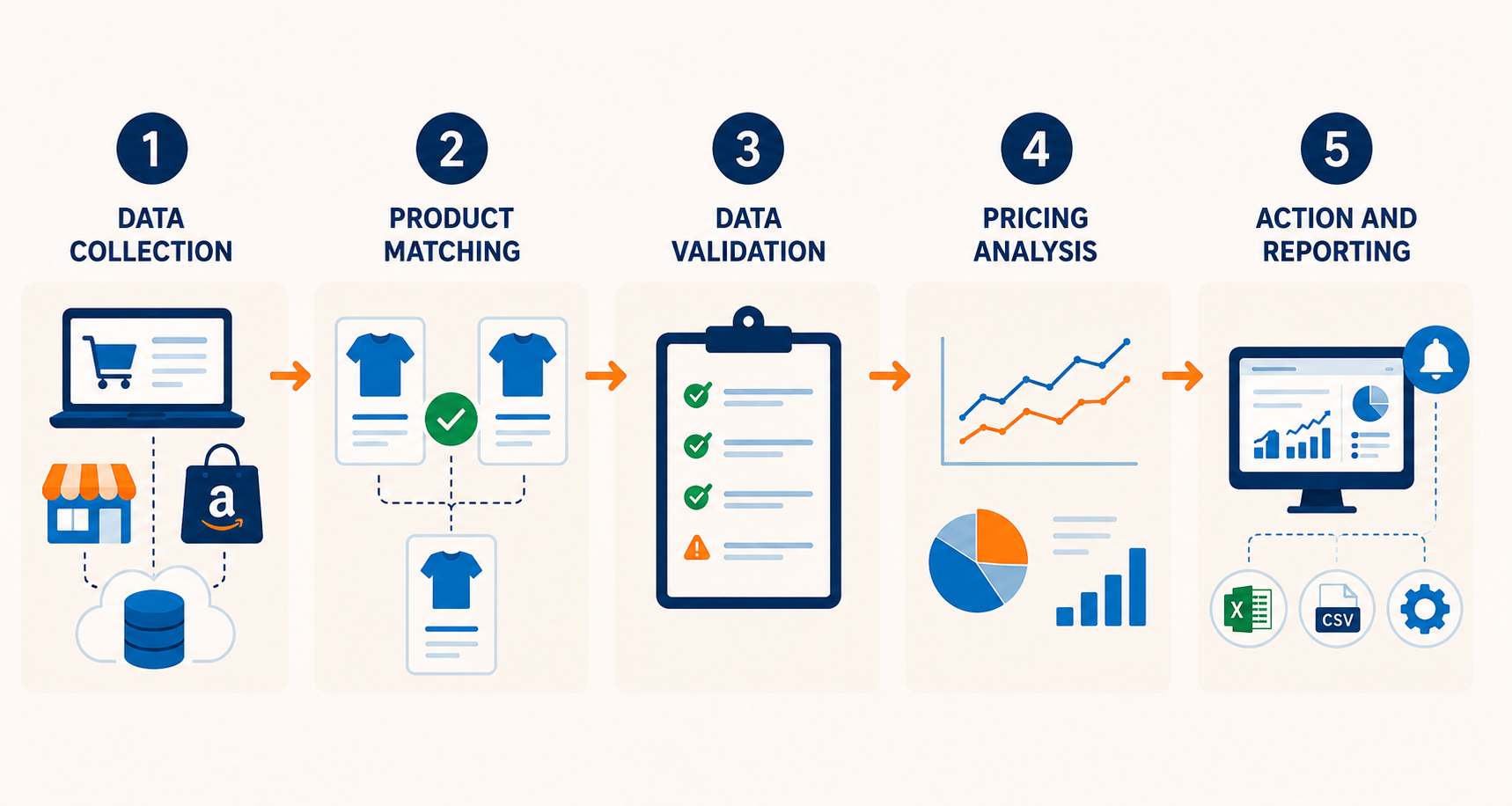
The process can be simplified into five key stages:
Â
1. Data Collection
Pricing data is collected from competitor websites, marketplaces, and other relevant online sources.
This may include product prices, promotions, discounts, stock availability, delivery charges, and product information.
Â
2. Product Matching
Products are matched across competitors so that equivalent or comparable items can be analysed accurately.
Strong product matching is essential because inaccurate matching can lead to misleading pricing comparisons.
Â
3. Data Validation
Collected data is checked and validated to reduce errors, inconsistencies, and outdated information.
This helps ensure pricing teams are working from reliable market data rather than raw, unverified information.
Â
4. Pricing Analysis
The data is analysed to identify price changes, pricing gaps, trends, promotions, and competitor behaviour.
This turns collected data into practical pricing insight.
Â
5. Action and Reporting
Insights are delivered through dashboards, reports, alerts, exports, and integrations so teams can take action quickly.
This may include adjusting pricing, reviewing margin, responding to promotions, or monitoring long-term market positioning.
Price Tracking vs Price Monitoring vs Price Intelligence
Price Tracking
Price tracking focuses on following price changes over time.
It helps businesses see when a product price has changed, how often it changes, and how competitor pricing moves across a specific period.
Â
Price Monitoring
Price monitoring is broader than simple tracking. It gives businesses regular visibility of competitor prices, promotions, and market activity across selected products, categories, or competitors.
This is useful for teams that need to react quickly to competitor pricing changes.
Â
Price Intelligence
Price intelligence goes further by analysing pricing data and turning it into commercial insight.
It helps businesses understand pricing trends, identify opportunities, compare market positioning, and support pricing strategy. Price intelligence combines data collection, validation, reporting, and analysis, rather than only showing raw competitor prices.
Â
The Technical Overview Of Price Intelligence Tools
The technical foundation of price intelligence software is important because the quality of the output depends on the quality of the data being collected, matched, stored, and analysed.
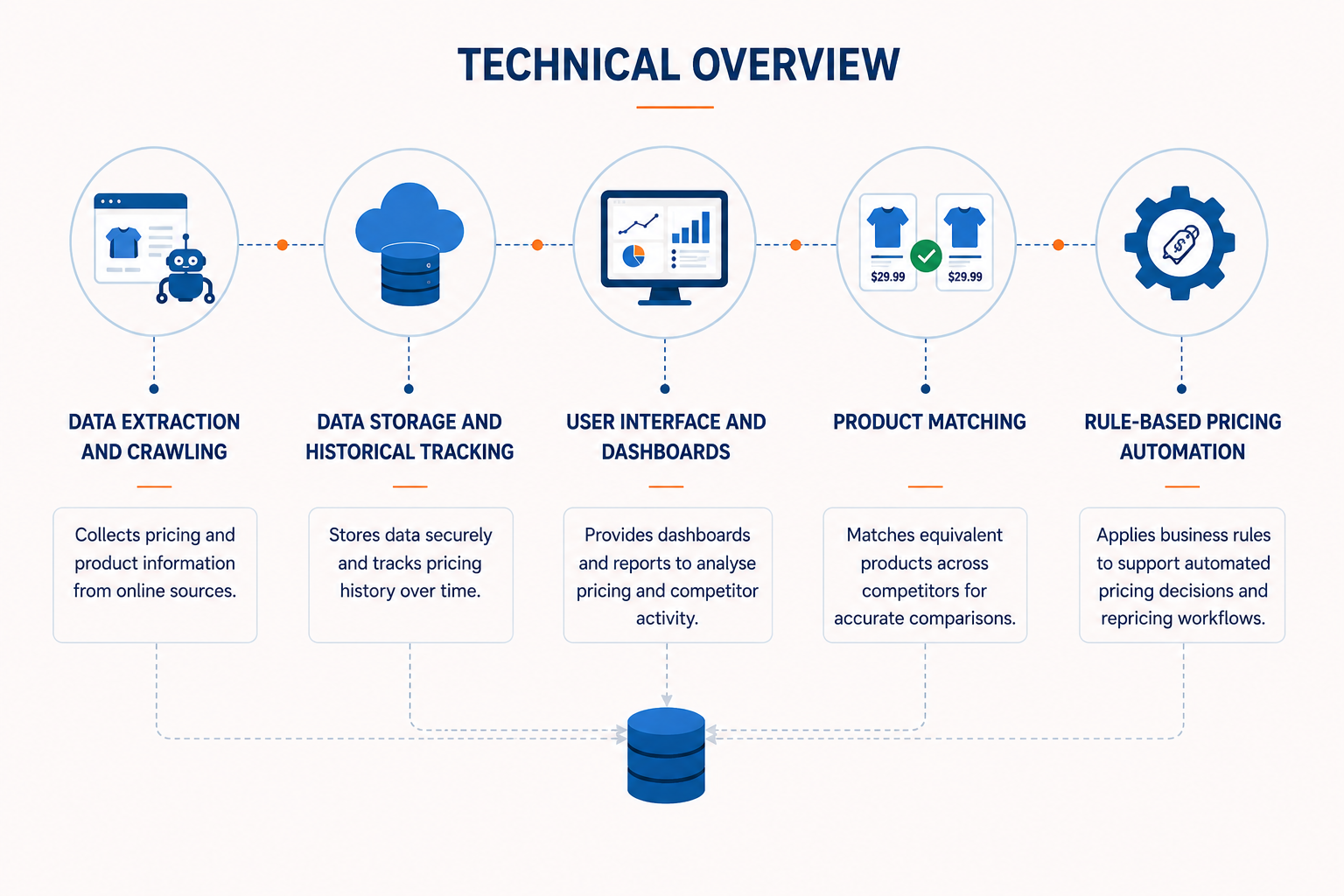
Insitetrack’s pricing intelligence solution includes several core technical components.
Â
Data Extraction and Crawling
Our crawler and extraction technology collects pricing and product information from relevant online sources.
This helps businesses monitor competitor activity across websites, marketplaces, and digital channels without relying on manual price checks.
Â
Data Storage and Historical Tracking
Collected data is stored securely so pricing teams can review current and historic pricing activity.
Historical data makes it easier to identify trends, understand how competitors change prices over time, and compare pricing performance across products or categories.
Â
User Interface and Dashboards
The platform provides a front-end interface where users can analyse pricing data, review reports, and monitor competitor activity.
Dashboards help teams quickly understand where pricing has changed, which competitors have moved, and where action may be required.
Â
Product Matching
Product matching helps identify equivalent or comparable products across different competitors.
This is one of the most important parts of pricing intelligence software because accurate comparisons rely on matching the correct products.
Â
Rule-Based Pricing Automation
Business rules can be used to support pricing automation and repricing workflows.
When implemented with the right safeguards, pricing automation can help teams respond faster to market changes while maintaining control over margin, competitor positioning, and commercial objectives.
Key Price Intelligence Software Features
Price intelligence software should do more than collect competitor prices. It should help teams understand the market, reduce manual work, and support better pricing execution. The Insitetrack platform includes tools designed to support pricing visibility, reporting, automation, and analysis.
Â
Competitor Price Tracking
Track competitor pricing across products, ranges, competitors, and channels.
This helps teams understand how prices change over time and where competitors are adjusting their position.
Â
Automated Data Collection
Automated data collection reduces the need for manual price checking.
This is particularly valuable for businesses managing large catalogues or tracking pricing across multiple competitors.
Â
Pricing Alerts
Alerts can be configured to notify teams when competitor prices change, promotions are launched, or market activity requires attention.
Alerts can be tailored around products, categories, competitors, or specific pricing rules.
Â
Pricing Dashboards
Dashboards provide a clear view of competitor activity, pricing trends, and market position.
This helps commercial teams quickly identify where action may be needed.
Â
Historical Price Trend Reports
Historical reporting allows businesses to review pricing movement over time.
This can help identify seasonal trends, competitor patterns, promotional cycles, and longer-term market changes.
Â
Product and Range-Level Analysis
Pricing data can be reviewed at product, range, category, or competitor level.
This helps teams move beyond individual price checks and understand wider pricing trends across the business.
Â
User Permissions and Access Control
User administration tools allow businesses to manage access levels across teams.
This is useful for organisations where different departments or users need different levels of access to pricing data, reports, or system functionality.
Â
Custom Reports and Exports
Reports can be tailored to different business needs, from daily price tracking to category-level performance reviews.
Data can also be exported or integrated into wider reporting workflows where required.
What Data Should Price Intelligence Tools Monitor?
Effective pricing intelligence does not only look at the product price.
Â
A product’s true competitiveness can be affected by promotions, discounts, delivery costs, stock status, and availability. A competitor may appear cheaper at headline price, but the overall position can change when delivery charges, multibuy offers, or promotional mechanics are included.
Â
Useful data points to monitor include:
Â
- competitor prices
- your own prices
- promotions and discounts
- multibuy offers
- product availability
- stock status
- delivery charges
- marketplace activity
- historic price changes
- category-level trends
Â
Monitoring these signals together gives pricing teams a more complete view of the market.
What Should Retailers Look For in Price Intelligence Software?
Choosing the right price intelligence software depends on how your pricing team works, the size of your product range, and how quickly your market changes.
A strong solution should help you answer three key questions:
Â
Can the data be trusted?
Accurate product matching and validated competitor pricing data are essential. Without reliable data, pricing teams risk making decisions based on incorrect comparisons or outdated market information.
Â
Can the system support your workflow?
The software should offer dashboards, configurable alerts, historic trend analysis, flexible exports, and user permissions so different teams can access the information they need in the right format.
Â
Can it scale with your pricing strategy?
Retailers should look for tools that support automated monitoring, pricing rules, integrations, reporting flexibility, and responsive support. The best price intelligence solutions adapt to your business rather than forcing your team into a fixed, one-size-fits-all workflow.
Benefits of Price Intelligence Software
Saves Time and Resource
Automated monitoring reduces the need for manual price checks, spreadsheet-based tracking, and repeated competitor website reviews. This is especially valuable for businesses managing large product catalogues, multiple competitors, or fast-changing categories where manual tracking quickly becomes difficult to maintain.
Supports Faster Commercial Action
Timely alerts, dashboards, and reporting help teams respond more quickly when competitor prices change, promotions launch, or market conditions shift. In fast-moving retail and ecommerce categories, this helps commercial teams focus on the actions that matter most.
Improves Market Visibility
A strong pricing intelligence platform gives teams clearer visibility of competitor activity across products, ranges, categories, and channels. This helps businesses understand where they sit in the market, which competitors are changing position, and where pricing pressure is increasing.
Improves Data Accuracy and Confidence
A well-built pricing solution combines automated extraction, product matching, validation, and reporting to reduce the risk of acting on incorrect or outdated information. This is especially important when competitor websites change, products are listed differently, or promotions affect how prices should be interpreted.
Supports Pricing Strategy
Historical data, competitor trends, and category-level reporting help teams move from short-term price checking to more strategic pricing management. This gives pricing teams a clearer view of market behaviour across products, seasons, channels, and competitors.
Helps Protect Margin
Pricing analytics support margin management by helping teams understand when a price change is necessary and when it may not be. By combining competitor pricing, promotions, availability, and historic trends, teams can make more balanced decisions without relying only on discounting.
Price Intelligence Software for Different Retail Environments
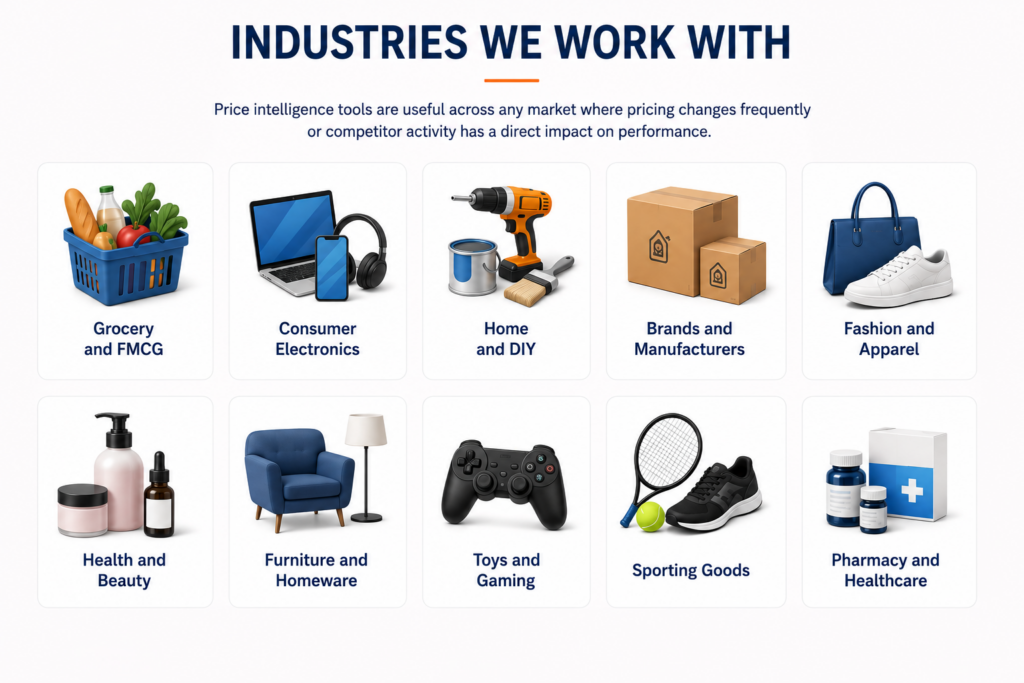
Price intelligence tools are useful across any market where pricing changes frequently or competitor activity has a direct impact on performance.
Â
Grocery and FMCG
Grocery and FMCG categories often involve frequent price changes, promotions, multibuy offers, and high margin pressure.
Price intelligence software helps teams monitor fast-moving products and understand how competitors adjust prices across key categories.
Â
Consumer Electronics
Consumer electronics is often highly price-sensitive, with rapid price matching and frequent promotional activity.
Pricing intelligence helps businesses track competitor movement, identify pricing gaps, and respond quickly to changing market conditions.
Â
Home and DIY
Home and DIY retailers often manage large product ranges, seasonal demand, and category-level pricing strategies.
Price intelligence tools help monitor competitor pricing across broad catalogues and identify market trends over time.
Â
Brands and Manufacturers
Brands can use price intelligence to monitor reseller pricing, channel consistency, and market positioning.
This is useful for understanding how products are priced across different retailers and sales channels.
Click here to find out more about our brand price monitoring approach.
Training, Support & Implementation
Price intelligence software is most effective when it is set up around the way a business actually works. At Insitetrack, implementation is a guided process, not a do-it-yourself setup.
Â
We work with retailers during the initial onboarding stage to understand their product ranges, competitors, reporting needs, and pricing workflows. This includes support with product matching, system configuration, reporting structure, alert setup, and user access, so the platform is aligned with the retailer’s commercial priorities from the start.
Â
Our team guides users through the setup and training process, helping them understand how to use dashboards, reports, alerts, and pricing data confidently. This hands-on approach ensures the system is practical, accurate, and suited to real retail requirements.
Â
Support can include:
Â
- product matching setup and guidance
- platform training
- follow-up sessions
- help desk guidance
- tailored report setup
- alert configuration
- workflow support
- support by phone, email, or in-app messaging
Â
This means retailers are not left to configure the system alone. Insitetrack works closely with each business to make sure the software supports their data needs, pricing processes, and long-term commercial goals.
Â
Click here if you still feel like you have unanswered questions around price intelligence.
Price Intelligence Built Around You
Book a demo with our team and discover how accurate, validated insights and expert support can transform your pricing strategy.
Price Intelligence Software
FAQ
What is price intelligence?
Price intelligence software helps businesses collect, organise, validate, and analyse competitor pricing information from websites, marketplaces, and other digital channels.
It gives pricing teams a clearer view of market activity, competitor movement, promotions, availability, and historic price trends. Instead of relying on manual checks or disconnected spreadsheets, teams can use a pricing platform to understand where products sit in the market and where action may be needed.
How does a pricing intelligence platform work?
A pricing intelligence platform usually works by collecting competitor information, matching comparable products, validating the results, and presenting the findings through dashboards, reports, alerts, or exports.
The strongest systems do not simply collect raw prices. They help turn market data into useful pricing insight by highlighting changes, trends, exceptions, and opportunities across products, categories, and competitors.
What is the difference between price tracking and price intelligence?
Price tracking shows when prices change over time, while price intelligence helps explain what those changes mean for your pricing strategy.
Tracking is useful for visibility, but it is only one part of the process. A more complete pricing intelligence approach combines monitoring, product matching, validation, historical reporting, and analysis so commercial teams can understand market position and make more informed pricing actions.
What features should price intelligence tools include?
Useful pricing tools should include automated data collection, accurate product matching, validation, dashboards, alerts, historical reporting, user permissions, and flexible exports.
For larger retail teams, it is also important that the system supports different workflows, report formats, and pricing objectives. The best tools help teams reduce manual work while still giving them control over how competitor insights are reviewed and used.
What are the common competitor pricing intelligence challenges facing retailers and brands?
Common challenges include poor data quality, inaccurate product matching, inconsistent reporting, and difficulty turning competitor information into useful pricing actions.
Retailers and brands often manage large catalogues, multiple competitors, frequent promotions, and changing product availability, which can make manual tracking unreliable and difficult to scale. Without the right processes in place, pricing teams may struggle to trust the data, identify meaningful trends, or respond quickly when the market changes.
A strong pricing intelligence approach should combine reliable data collection, product matching, validation, flexible reporting, and clear workflows so teams can turn competitor information into practical pricing insight.
What makes pricing data accurate?
Accurate pricing information depends on reliable extraction, strong product matching, and regular validation.
Â
If products are matched incorrectly or outdated information is used, pricing reports can become misleading. This is why validation is essential, especially for businesses monitoring large catalogues, frequent promotions, or product ranges where competitors describe similar items in different ways.
How often should market pricing be updated?
Update frequency depends on the category, competitor activity, and how quickly prices change in the market.
Â
Some businesses may only need daily updates, while fast-moving ecommerce categories may require refreshes multiple times throughout the day. The right frequency should reflect how the data will be used, whether that is for reporting, alerts, price reviews, or automated pricing workflows.
What should retailers look for when choosing pricing software?
Retailers should look for a solution that fits their products, competitors, workflows, and reporting needs rather than forcing them into a fixed setup.
Â
Important areas to review include data quality, product matching, alert configuration, reporting flexibility, onboarding support, and the ability to handle large or complex catalogues. A guided setup process is also valuable because it helps ensure the platform reflects real commercial requirements from the start.
How much does price intelligence software cost?
The cost of price intelligence software depends on the size of the product catalogue, the number of competitors being monitored, update frequency, reporting requirements, and whether automation or bespoke setup is needed.
Â
Insitetrack solutions start from £495 per month, with pricing tailored around each business’s requirements rather than a fixed one-size-fits-all model. For a clearer understanding, visit our pricing page.
Why does UK market experience matter when choosing pricing intelligence tools?
UK retailers often operate in highly competitive, promotion-led markets where pricing, availability, delivery costs, and product ranges can change quickly across ecommerce, marketplaces, and physical retail.
Â
Working with a UK-based pricing partner can make implementation more practical because the provider understands local retail pressures, trading rhythms, category complexity, and the need for responsive support. At Insitetrack, this means combining market data, product matching, tailored reporting, and guided setup with an understanding of how UK pricing teams actually work.
Â
For businesses managing large catalogues or multiple competitors, that local knowledge helps ensure the system is configured around real commercial needs rather than a generic one-size-fits-all workflow.