
Price Intelligence
Data Coverage & Technical Capabilities
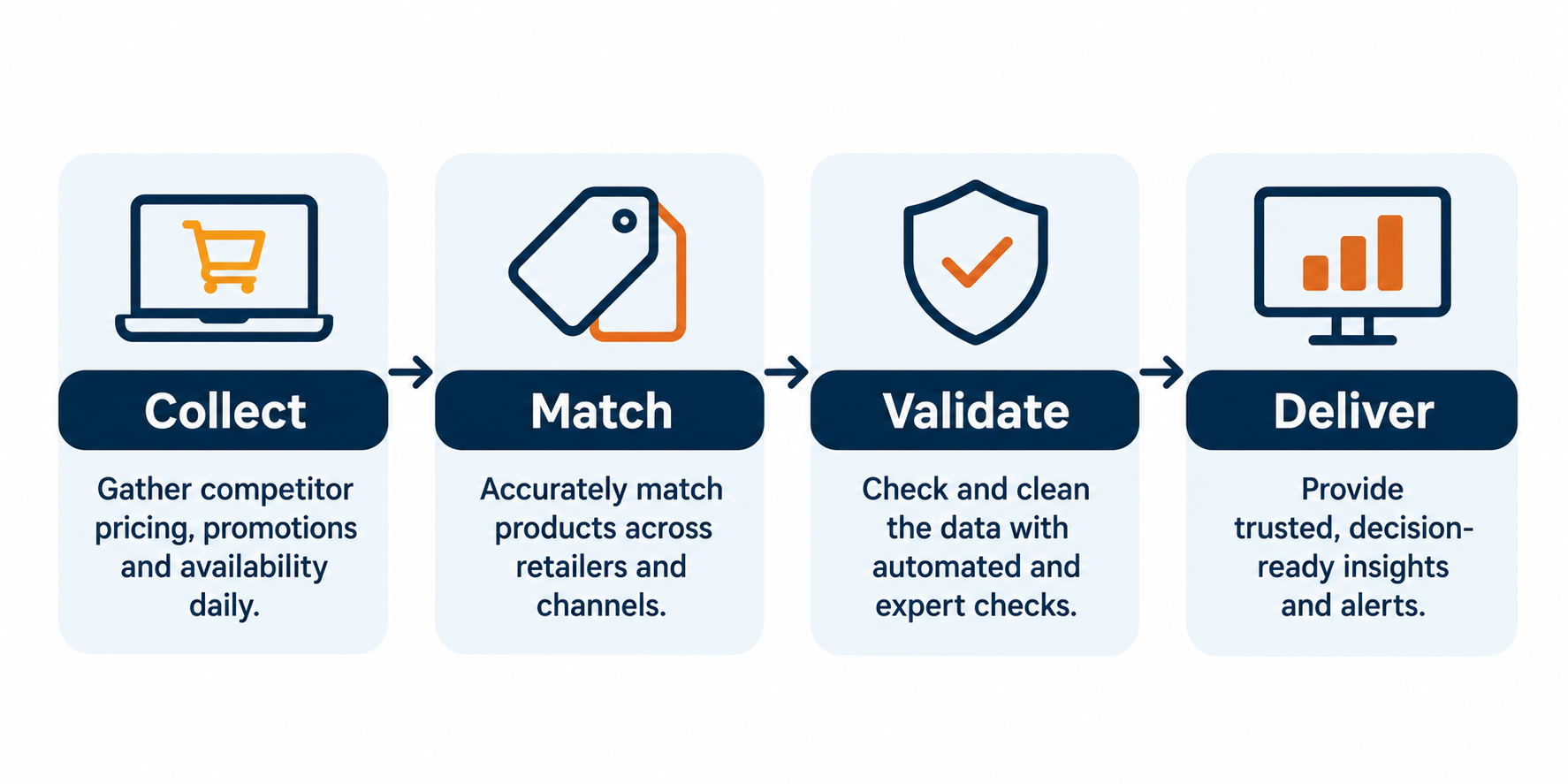
Insitetrack provides retailers and brands with reliable competitor pricing data collected from selected websites, online marketplaces and other relevant digital channels. Depending on the monitoring requirements, this can include competitor prices, promotions, stock availability, delivery charges, product information and historic pricing movements.
Our approach combines automated data collection, accurate product matching, validation and flexible reporting to help businesses work with consistent, usable market information.
From monitoring large product catalogues to delivering data through dashboards, reports and integrations, our solutions are configured around each business’s products, competitors and pricing workflows.
This page explains the data Insitetrack can collect, how our monitoring and validation processes work, and the reporting, integration and automation capabilities available.
What Data Can Insitetrack Monitor?
Our team collects competitor pricing and product data from selected retailer websites, resellers and supported online marketplaces. Depending on the source and monitoring setup, this includes selling prices, promotions, stock availability, delivery charges, product information and historical price changes.
Price Intelligence Data Coverage
| Data Type | Insitetrack Capabilities |
|---|---|
|
Competitor prices |
Collects advertised selling prices and compares them against matched products across selected competitors. |
|
Promotions and discounts |
Tracks advertised promotional prices, discounts and price reductions where available. |
|
Stock availability |
Monitors product availability and stock-status information to provide context for price comparisons. |
|
Delivery charges |
Captures available delivery pricing information to support comparisons of competitor offers. |
|
Marketplace listings |
Monitors product listings and pricing across supported marketplaces, including Google Shopping, Amazon and eBay, subject to the relevant service and source coverage. |
|
Product information |
Collects product names, identifiers, descriptions and relevant attributes to support product matching. |
|
Historic pricing |
Records competitor price movements for historical analysis, price-change reporting and trend identification. |
|
Customer pricing data |
Uses customer-supplied product SKUs, selling prices, costs and margins within configured reports and pricing workflows. |
Data Coverage and Limitations
Data availability depends on the retailer or marketplace being monitored. Not all sources provide the same information, and complex promotions, delivery options or location-specific prices may require additional configuration.
Insitetrack agrees the products, competitors, data fields and collection requirements with each customer during setup.
Which Websites, Marketplaces and Regions Can Insitetrack Monitor?
We can monitor competitor pricing across selected retailer websites, reseller websites and supported online marketplaces, including Google Shopping, Amazon and eBay. Monitoring is configured around each customer’s products, competitors and required sales channels.
Supported Online Sources
| Source | Monitoring Capabilities |
|---|---|
|
Retailer websites |
Competitor product listings and prices across selected ecommerce retailers. |
|
Reseller websites |
Pricing and product availability across online retail partners and third-party sellers. |
|
Google Shopping |
Product pricing comparisons and shopping-channel positioning through supported reporting. |
|
Amazon and eBay |
Marketplace product and pricing comparisons, subject to the relevant platform and monitoring configuration. |
UK And International Coverage
Insitetrack is a UK-based price intelligence provider with international monitoring capabilities across Europe, Oceania, North and South America, and other global markets.
We collect competitor pricing data from retailers, resellers and online marketplaces across different countries and regions. Geographic coverage is tailored to each customer’s requirements, including the specific websites, markets and sales channels they need to monitor.
Coverage Limitations and Complex Websites
We have over 15 years of experience in web data collection and developing bespoke scraping solutions, including extracting pricing information from technically challenging websites.
Some websites present additional complexities, such as dynamic content, login-protected pricing, geographic restrictions, or frequently changing website structures. These sources may require custom data collection methods, additional configuration or authorised access.
Our technical team can assess difficult-to-monitor websites and develop tailored collection solutions where feasible. Many complex data requirements can be accommodated, although access permissions, website restrictions and the availability of information can affect what is possible.
We assess each source during setup and confirm the available coverage, technical requirements and any limitations before implementation.
How Does Insitetrack Match and Validate Competitor Products?
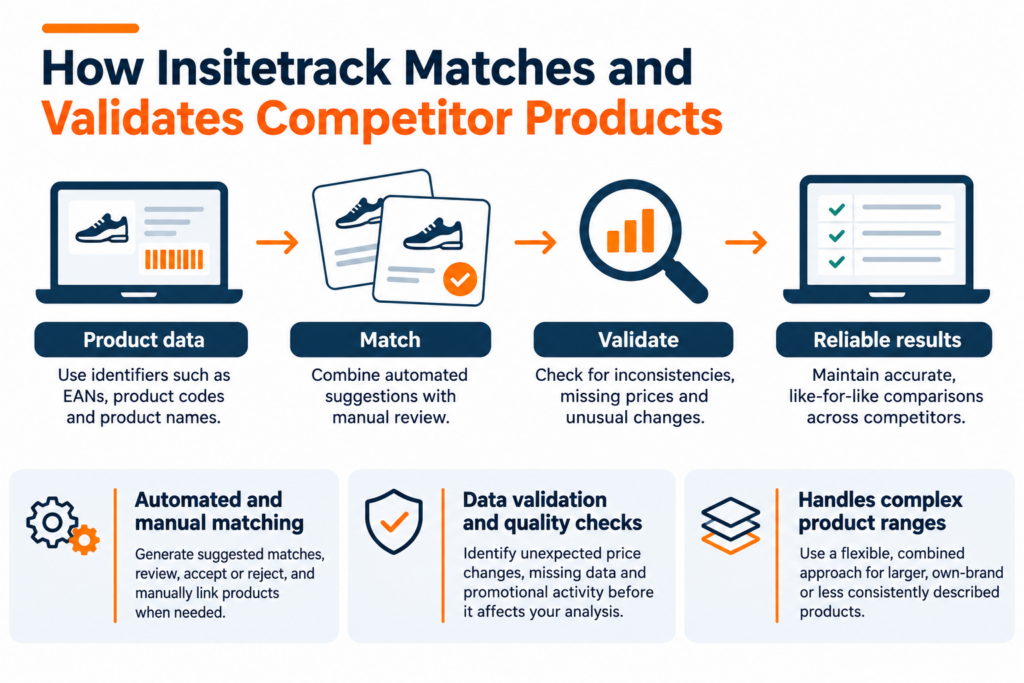
Reliable competitor pricing data starts with accurate product matching. A price comparison is only useful when the products being compared are genuinely equivalent. Differences in model numbers, specifications, sizes or pack quantities can easily create misleading results.
To reduce these risks, Insitetrack combines automated product matching, manual review and ongoing data validation.
Automated and Manual Product Matching
The platform generates suggested matches using product identifiers such as EANs, product codes and product names. This works particularly well for branded products with consistent identifiers, even when retailers use different titles or descriptions.
Not every product is straightforward to match. Own-brand ranges, generic products and variations in pack sizes or specifications often need closer attention.
Suggested matches can be reviewed, accepted or rejected, while manual search tools allow users to find and link products that the automated process has not identified. Existing matches can also be corrected or removed when required.
Data Validation and Quality Checks
Product matching is only one part of maintaining reliable pricing information. The collected data also needs to be checked for inconsistencies, missing prices and unusual changes.
Insitetrack uses automated monitoring and human validation to help identify potential data issues, including:
Unexpected changes in competitor prices or market activity.
Missing or outdated competitor price captures.
Unusual changes in product matching or collection performance.
Promotional prices or product comparisons that require further review.
Checks take place at both reporting and individual product levels, helping identify problems before they affect wider pricing analysis.
Handling More Complex Product Ranges
For larger or more complex catalogues, a combination of automated suggestions and manual matching provides greater flexibility than relying on product identifiers alone.
Where a suitable match cannot be established automatically, products can be investigated individually using additional search and matching tools. This is particularly useful for specialist, own-brand or less consistently described products.
The objective is to maintain dependable like-for-like comparisons, rather than simply maximise the number of products matched.
How Often Is Competitor Pricing Data Updated?
Insitetrack’s standard monitoring frequency is daily, with competitor prices collected and updated each day. More frequent collection is available where required, depending on the websites being monitored and the needs of the business.
Flexible Monitoring Frequencies
Not every product or competitor needs to be monitored at the same frequency. In fast-moving retail categories, such as consumer electronics or grocery, prices and promotions can change several times throughout the day.
Collection schedules can be tailored around these requirements, with more frequent monitoring arranged for specific products, competitors or markets where appropriate.
The agreed schedule also takes account of the complexity of the websites involved, the volume of products being monitored and how the information will be used.
Monitoring Data Freshness and Capture Rates
Reliable pricing intelligence depends on more than collecting data regularly. It is also important to understand whether expected competitor prices have been successfully captured.
Insitetrack’s Competitor Summary Report provides visibility into the number of matched products, daily prices collected and the percentage of expected prices successfully captured for each competitor.
Missing prices do not always indicate a technical problem. Products may have been discontinued, removed from a competitor’s website or become unavailable. Capture-rate reporting helps teams identify these gaps and review the affected products or matches.
Alongside automated monitoring, our technical team oversees the service and provides ongoing support when collection issues arise.
What Reporting and Price Analysis Capabilities Does Insitetrack Offer?
Insitetrack provides competitor pricing dashboards, historical analysis, price comparisons and category-level reporting. Alongside the standard platform reports, data can be organised into tailored views based on the products, competitors and commercial information each business needs.
Competitor Pricing Reports
Different reports help teams investigate specific areas of their competitive position, from individual product price differences to wider category trends.
| Report | What It Provides |
|---|---|
|
Price Changes Report |
Identifies which competitors have changed prices, which products are affected and the size of each movement, including available delivery-price changes. |
|
Lowest Prices Report |
Shows the lowest competitor price for each matched product, the retailer offering it and how many competitors are priced above or below your own price. |
|
Price Variance Report |
Compares selling prices against competitors, showing price differences in monetary and percentage terms alongside available margin information. |
|
Crosstab Report |
Allows users to filter and organise competitor pricing data by retailer, brand, product category and pricing position. |
|
Marketplace Report |
Compares product prices and marketplace positions across supported channels, including Google Shopping, Amazon and eBay. |
|
Index Drilldown Report |
Provides category and product-level price index analysis, helping users identify their most and least competitive areas. |
Price Index and Category Analysis
For retailers managing large product ranges, reviewing every individual price difference isn’t always practical.
The Index Drilldown Report provides a way to examine competitive price positioning across categories before investigating individual products. This helps category and pricing teams identify areas that may need closer attention, rather than working through product comparisons one at a time.
Historical Pricing and Market Trends
Historic pricing information provides context around competitor behaviour. The dashboard includes price-history and pricing-position views, while individual product reports allow users to investigate changes over time.
These views help distinguish isolated price movements from recurring discounting or longer-term changes in market position.
Tailored Dashboards and Reporting
Not every business needs to analyse the same information in the same way. Reports can be tailored to different products, competitor groups, categories and pricing requirements.
The standard reports provide a starting point, with bespoke reporting available for businesses requiring more specific calculations, analysis or presentation of their pricing data.
How Can Insitetrack Pricing Data Be Exported and Integrated?
Competitor pricing data can be accessed through Insitetrack’s online platform, downloaded in Excel or CSV format, or delivered through tailored data feeds and API integrations.
The delivery method depends on how the information will be used. Some teams prefer downloadable reports, while others need competitor pricing data integrated directly into their existing business systems.
Data Export And Integration Options
| Delivery method | Capabilities |
|---|---|
|
Excel and CSV exports |
Download competitor pricing information and report data for further analysis, sharing or use in existing spreadsheets. |
|
API integration |
Connect pricing data to internal systems, including ecommerce platforms, order processing and stock control systems, through configured API integrations. |
|
Power BI reporting |
Integrate competitor pricing data into tailored Power BI dashboards for analysis alongside existing commercial information. |
|
Custom data feeds |
Receive structured competitor pricing feeds configured around existing reporting processes and internal data requirements. |
|
Online dashboards |
Access pricing information, product comparisons and standard reports directly through Insitetrack’s browser-based platform. |
Working With Existing Business Systems
For retailers with established reporting and pricing processes, introducing another standalone platform isn’t always the most practical approach.
Data feeds and integrations allow competitor pricing information to sit alongside existing product, sales and margin data, giving teams greater flexibility in how they analyse and use market information.
A UK DIY retailer, for example, uses an Insitetrack-powered Power BI dashboard alongside a daily product feed delivered into its own infrastructure, providing access to competitor pricing and historical data within its existing reporting environment.
Integration Requirements
Excel and CSV exports are available within the platform, while API access, bespoke dashboards and more complex integrations are scoped around each customer’s requirements.
The technical setup depends on the systems involved, the data fields required and how frequently information needs to be delivered. These requirements are reviewed during implementation to establish the most suitable approach.
How Does Insitetrack Support Rules-Based Pricing and Automation?
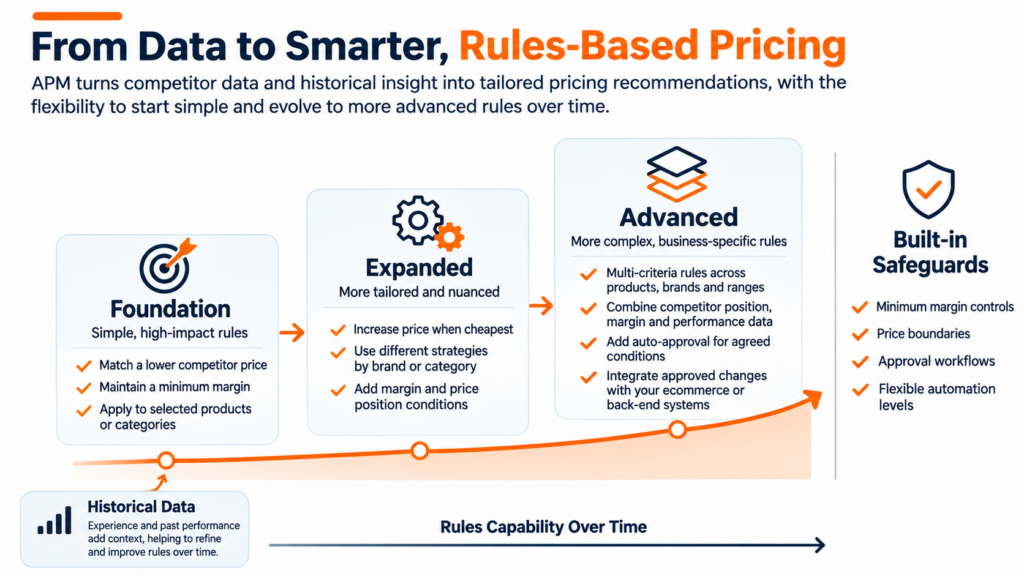
Insitetrack’s Auto Price Manage (APM) functionality uses competitor pricing data and predefined business rules to recommend price changes. Depending on the strategy, these recommendations can involve reducing prices to improve competitiveness or increasing them where there is an opportunity to improve margins.
Rather than automatically matching every competitor movement, pricing rules are configured around each business’s commercial objectives and agreed constraints.
Configurable Pricing Rules
APM evaluates competitor prices against the customer’s current selling prices and applies the business rules configured within the system.
These rules can be tailored to individual products, brands or categories and can include conditions such as competitor price positions and minimum profit margins.
For example, a retailer might configure rules to:
Match a lower competitor price, provided the new selling price maintains a minimum margin of 10%.
Increase a product’s price when it is already the cheapest in the market, bringing it closer to the next lowest competitor.
Apply different pricing strategies to selected brands, product categories or groups of products.
More complex rules can be developed around specific commercial requirements, allowing different parts of a product range to follow different pricing strategies.
Manual Approval and Automated Price Changes
Not every pricing recommendation needs to be implemented automatically.
APM provides an approval process where users can review suggested price changes before authorising them. Approved changes are moved into a separate report, which can be downloaded and used to update prices in the customer’s own systems.
For businesses looking to reduce manual intervention, optional auto-approval rules can be configured. For example, recommendations that maintain an agreed minimum profit margin can be approved automatically.
Where the appropriate integrations are in place, approved price changes can also be passed directly into an ecommerce or back-end system.
Maintaining Control Over Pricing Decisions
Each customer’s requirements determine the level of automation. Some businesses prefer to review every recommendation, while others use automated approval for pricing changes that meet clearly defined conditions.
This flexibility allows retailers to automate repeatable pricing decisions while retaining control over the commercial rules and safeguards that govern them.
How Does Insitetrack Handle Implementation and Ongoing Support?
Unlike a purely self-service approach, Insitetrack provides a fully guided implementation process, helping businesses get their competitor monitoring and reporting set up without having to manage the technical work themselves.
From initial configuration and product matching through to reporting, training and ongoing support, our UK-based team works closely with each customer to ensure the solution fits their requirements and existing pricing processes.
A Managed Setup, Not a DIY Process
Getting started shouldn’t mean spending weeks configuring software, matching thousands of products or figuring out how to make the reporting useful.
We take an active role throughout implementation, working with your team to:
Understand your requirements: Establish the products, competitors, markets and pricing information most relevant to your business.
Configure the monitoring: Set up the agreed competitor websites, data collection requirements and product matching.
Prepare the reporting: Tailor dashboards, reports and data delivery around how your pricing and commercial teams work.
Review the data: Check product matches, data quality and reporting outputs before launch.
Provide training: Guide your team through the platform, reports and relevant pricing workflows.
Implementation typically takes around 14 days, depending on the complexity of the requirements. The platform is hosted online, so there’s no software to install locally.
Ongoing Support Beyond Implementation
Our involvement doesn’t end once the system goes live.
As product ranges, competitors and pricing requirements change, the Insitetrack team continues to provide technical assistance, reporting adjustments and support with monitoring configuration.
Customers can also manage products, competitors and existing matches through the platform’s maintenance tools, but they aren’t expected to handle everything independently.

Do You Have Specific Price Intelligence Data Requirements?
Every business has different products, competitors and reporting needs. Whether you're looking to monitor complex websites, improve product matching or integrate reliable pricing data into existing systems, our team can help you explore the options.
Price Intelligence Data & Technical
FAQs
What happens if a competitor's website changes or pricing data cannot be collected?
Competitor websites change regularly, and products can be removed, discontinued or become temporarily unavailable.
Capture-rate reporting helps identify missing competitor prices and changes in data availability. Where collection issues arise, our technical team can investigate the source, review affected product matches and make adjustments where necessary.
Can Insitetrack collect data from websites that are difficult to scrape or require login access?
Some websites present additional challenges, including dynamic content, geographic restrictions and login-protected pricing.
With over 15 years of experience in web data collection, our team regularly assesses complex monitoring requirements and develops bespoke collection solutions where feasible. Login-protected sources may require authorised access, while other restrictions require individual evaluation.
Not every source can be guaranteed, but difficult-to-access websites are something we are experienced in investigating rather than automatically ruling out.
What happens when products cannot be matched automatically?
Not all products have consistent EANs, model numbers or descriptions, particularly own-brand and specialist ranges.
Where automated matching cannot identify a reliable comparison, suggested matches can be reviewed, corrected or rejected. Manual matching tools also allow products to be investigated individually.
If a suitable equivalent cannot be established, the product should not be treated as a confirmed like-for-like match.
How can I check whether competitor pricing data is complete?
The Competitor Summary Report shows the number of matched products, prices collected and the percentage of expected competitor prices successfully captured.
These figures help identify gaps in collection and changes in competitor coverage over time. However, a missing price does not always indicate a collection problem, as products may have been removed or discontinued by the retailer.
Can additional data fields or more complex monitoring requirements be accommodated?
Yes, bespoke data collection is available for requirements that fall outside a standard monitoring setup.
This could involve additional product information, specialist competitor websites or specific reporting requirements. The feasibility depends on the information available from each source and the complexity of collecting it.
Our team reviews these requirements before agreeing on the appropriate approach.
Are custom integrations and automated pricing updates included as standard?
Excel and CSV exports are available through the platform, while API integrations, bespoke data feeds and automated pricing connections are configured according to the customer’s requirements.
Auto Price Manage (APM) can generate pricing recommendations and support manual or automatic approval. Passing approved changes directly into an ecommerce or back-end system requires a suitable integration.
These requirements are discussed during setup so the delivery and automation arrangements are clear from the outset.